


Instead of protecting people from current threats, they were in the business of creating new epidemics to get more funding. Ebola, prediabetes, you name it and CDC officials were asking for money. But the biggest win during that period was manufacturing a vaping epidemic in teens.
Vaping had existed since shortly after Johnson & Johnson and others rolled out nicotine patches and gums. They spent a lot of money getting FDA approval and wanted to make that back - respect for the free market thinking - so when vaping came out as a grassroots alternative to Big Pharma they got vaguely creepy UC San Francisco Professor Stan Glantz (funded by J&J, naturally) and other credible anti-smoking advocates to turn the cultural guns on it.
With no scientific data to rely on (any harms would not be evident that quickly) they fell back on epidemiology and its ability to correlate anything to anything. They didn't need even that. All they had to do was look at surveys and change the definition of addiction to being tried once. If a young person claimed on surveys they had tried vaping in the last year, that was the same as being a chronic user. Using that breezy, unscientific definition of addict they began to roll out campaigns claiming Big Tobacco was creating nicotine zombie armies of kids throwing things through televisions.(2)
So they pivoted to making it all illegal. The government helped J&J and others immensely by declaring that all vaping tools had to go through the same regulatory process as nicotine patches and gums. With a sweep of the pen, they wiped out 10,000 businesses that didn't have enough revenue to justify spending a billion dollars.
In 2026, no vaping product has FDA approval.
The Reefer Madness government posturing did what anyone with kids knew would happen - the government made it cool.(3) And just like that, right when the Biden administration was gleefully using heavily-armed federal agents against vaping shops (and farmers), the fad ended. Young people moved on to Roblox and blue-light glasses.
Now academics are claiming it wasn't just a fad aggravated by government getting hysterical that then faded, vaping declined because government got hysterical.
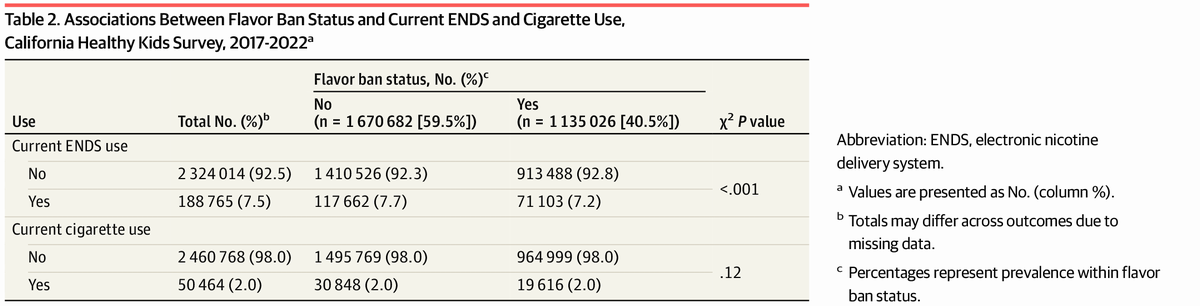
The new survey results are at least better than the CDC because they don't try to claim one use per year is an epidemic, though once per month is neither addiction nor concern either. The analysis was also just California so the families are overwhelmingly one political demographic but it is as least a reasonable proxy for the US. As good as any survey can be.
They wanted to see if bans on flavored vapor made a difference, and it did, though they really had to torture confidence intervals to declare the statistical significance I wish journals would stop assuming means real insight. Surveys in cities with bans on flavors reported 6.2% student use while those without reported 7.7%. Both are still half of cigarette smokers and, like in previous studies, no one migrated from vaping to cigarettes. Nicotine doesn't kill, cigarettes inhaled into lungs do, but time will tell if vaping has any effect.
We may never get to that data. People who vape look ridiculous now, like they are trapped in 2015, so they may be addicted yet, if so, banning flavors is the worst way to cure it. Without flavors to gradually step down from addictive nicotine, the taste that remains is tobacco or menthol. The taste of cigarettes. The government claims they ban flavors so the product stays for adults but that means government is perpetuating one of the psychological hooks of addiction in adults.
Vaping has plummeted and cigarettes also continue to decline but the former is because of the fad ending while the latter is due to better health awareness. Academics saying flavor bans are why fewer young people do it is like government claiming taxes ended cigarettes.
Citation: Appolon G, Leas E, Pines HA, Strong D, Trinidad D, Choi S, Oren E, Local Flavored Tobacco Bans and Youth Electronic Nicotine Delivery Systems Use. JAMA Health Forum. 2026;7(4):e260631. https://jamanetwork.com/journals/jama-health-forum/fullarticle/2847325
NOTES:
(1) After they refused to send testing kits to hospital until the hospital first bizarrely somehow proved patients had the virus. Then the test kits the White House made them send were made by CDC and had faulty reagents making them useless, which forced the administration to issue an emergency authorization for companies that know what they are doing.
(2) The problem with that narrative was obvious; Big Tobacco was not involved. Their product, Blu, was so incompetently managed they had Jenny McCarthy marketing it for them. If you were selling anti-vaccine hysteria to Democrats, sure, she was perfect, but vaping? No, it was a complete flop. The industry was instead grass-roots driven.
(3) Which did make one company successful - Juul. I've long written about the clear harms of cigarettes and alcohol, and then smoking cessation and harm reduction to get people off cigarettes, but Juul basically came out of nowhere thanks to the government-created fad among rebellious kids. They are the ones who actually got Big Tobacco funding. Then they made the misstep of having a numbskull give a talk at a school which was positioned as Juul targeting children. Government then crushed their business and Big Tobacco lost almost as much money as Ford lost selling electric cars.





Comments