A 1979 seismic event was a different kind of earthquake, and it is has intrigued scientists ever since.
A new look at old data has provided some additional answers.
On Feb. 24th, 1979, seismographs recorded a magnitude 3.8 earthquake under Randolph, Utah, located near the Idaho and Wyoming borders.
Yet no one felt a thing and the seismic data made no obvious sense. Because its focal depth was 50 miles below sea level, the hypocenter wasn't in Earth’s crust, it was well into the upper mantle.
It was an atypical earthquake in an area where it should not have happened. On Sept. 10th, 2025, another one struck outside Maeser in Utah’s Uinta Basi This one was magnitude 4.1 with a focal depth of 35 miles below sea level. That's 10 miles below the Mohorovičić discontinuity, the boundary separating Earth's crust from underlying mantle.
A new analysis of data that 1979 quake and eight other suspected deep earthquakes prove the existence of what are called "continental mantle earthquakes."
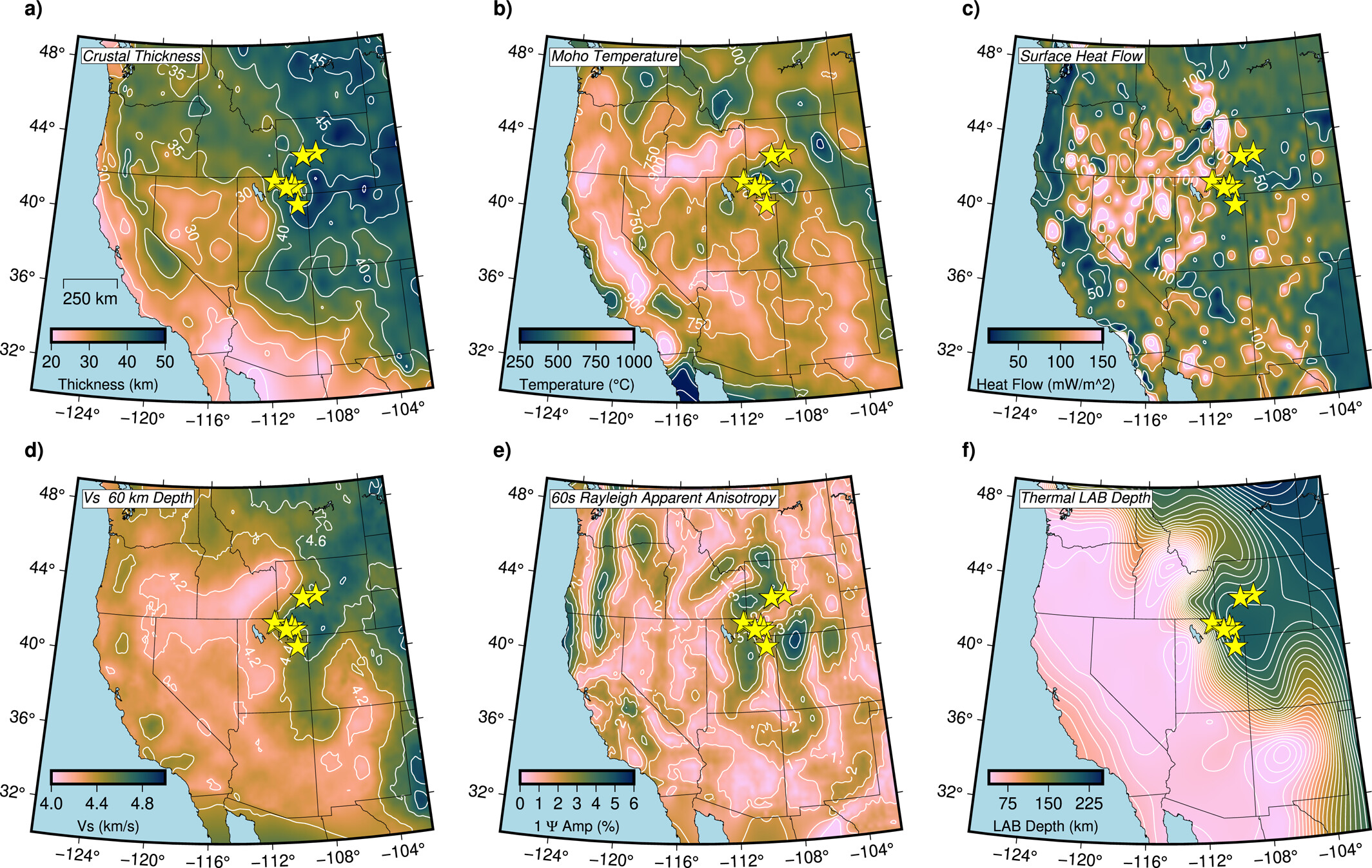
Earthquake epicenters (yellow stars) compared to (a) crustal thickness (Buehler&Shearer, 2017), (b) Moho temperature (Schutt et al., 2018), (c) surface heat flow (Lucazeau, 2019), (d) mantle shear velocity (Schmandt et al., 2015), (e) amplitude of the 1Ψ component of 60 s Rayleigh wave apparent anisotropy (Zeng et al., 2024), and (f) depth to the thermal lithosphere-asthenosphere boundary (Priestley et al., 2024). Lithospheric edges are emphasized in panels (d–f), though the long-wavelength model in panel (f) seems to underestimate the amount of erosion beneath the northwestern section of the Wyoming Craton that is observed in high resolution regional studies (e.g., Bezada et al., 2024; Dave & Li, 2016).
To pinpoint the origins of earthquakes, seismologists interpolate using how long it takes different types of seismic waves to reach seismographs on the surface. The analysis found that unlike typical earthquakes, deep events occur in isolation with no foreshocks or aftershocks. They all seem to happen near the western edge of the Wyoming Craton, Earth’s lithosphere at high temperatures, often greater 1500 degrees.
Cratons are like geological icebergs, the essentially float in the earth's mangle and models have shown because of the mantle hitting the Wyoming Craton and flowing around it, it has been heavily eroded by seismic activity, leading to thinning of the lithosphere westward across Idaho and Utah.
Citation: Hutchings, S. J., Koper, K. D., Burlacu, R., Zeng, Q., Lin, F.-C., & Zandt, G. (2025). Upper mantle earthquakes along the edge of the Wyoming Craton. Geophysical Research Letters, 52, e2024GL114073. https://agupubs.onlinelibrary.wiley.com/doi/full/10.1029/2024GL114073