



Natural gas is much cleaner than coal but it's also important that its energy return on investment (EROI) - the total input energy with the energy expected to be made available to end users - is similar to coal, according to a paper in the Journal of Industrial Ecology.

The paper looked at gas from horizontal, hydraulically fractured wells in the Marcellus Shale of Pennsylvania and their analysis indicates that the EROI ratio of a typical well is likely between 64:1 and 112:1, with a mean of approximately 85:1. This range assumes an estimated ultimate recovery of 3.0 billion cubic feet per well, similar to the estimated ultimate recovery of coal, which falls between 50:1 and 85:1.

If you want to design new materials that are durable, lightweight and environmentally sustainable, it makes sense to look at old kinds: Natural composites, such as bone. Bone is strong and tough because its two constituent materials, soft collagen protein and stiff hydroxyapatite mineral, are arranged in complex hierarchical patterns that change at every scale of the composite, from the micro up to the macro.

While researchers have come up with hierarchical structures in the design of new materials, going from a computer model to the production of physical artifacts has been a persistent challenge because the hierarchical structures that give natural composites their strength are self-assembled through electrochemical reactions, a process not easily replicated in the lab.

The end of the Atlantic Ocean is coming. 

A new subduction zone forming off the coast of Portugal shows that a passive margin in the Atlantic ocean is becoming active and Europe could to move closer to America, according to a paper in Geology.

The US Supreme Court recently sided with patient advocacy groups that a company cannot patent your genes.  Sounds like a pretty clear case, but the decision also creates some exceedingly odd loopholes, and even loopholes within loopholes, to say nothing of the fact that Justice Scalia dissented with the uncontroversial, basic science introduction to the case.

The gap between hypothesis and observation is never more evident than efforts to figure out howblack holes produce so many high-power X-rays.

The big question in many aspects of medicine is whether there is more of something or if it is simply better diagnosis than in the past.

In youth baseball programs, throwing injuries seem to have gone up despite pitching limits that weren't evident in the past. Professional baseball once used a four-man rotation and there was no consideration at all about pitching for kids.

But a multicenter, national research study says serious pitching injuries requiring surgery have skyrocketed, with one estimate reporting serious throwing injuries are occurring 16 times more often today than just 30 years ago.

Water in the Earth's upper mantle and crust likely plays a less important role as a lubricant of plate tectonics than previously assumed, according to a paper presented by geoscientists present in the current issue of Nature (13/06/2013) after the examination of water in the mineral olivine.

Laboratory experiments over the past three decades have suggested the presence of water greatly weakens the mechanical strength of the mineral olivine, a key component of the Earth's upper mantle.

In the recent study, led by the Bayerisches Geoinstitut in Bayreuth, the Secondary Ion Mass Spectrometer (SIMS) facility at the Potsdam based GFZ German Research Centre for Geosciences was used to reassess the importance of water in defining the rigidity of olivine. 

Do you like nuclear weapons?

If you respond yes to that, I think you have lost your mind. While I understand the value of an overwhelming force to end a bloody world war, it's also something that can't be unmade.  We had opened "Pandora's Box", the belief went.
The U.S. Supreme Court just released a groundbreaking decision about the ability to patent genes – the assembly instruction for life.  

Amid much discussion about potential implications for the biotech industry, a separate, extremely troubling aspect of this decision has largely slid under the radar: one of the SCOTUS Justices dissented with basic science saying he is "unable to affirm... knowledge or even my own belief" in high school biology
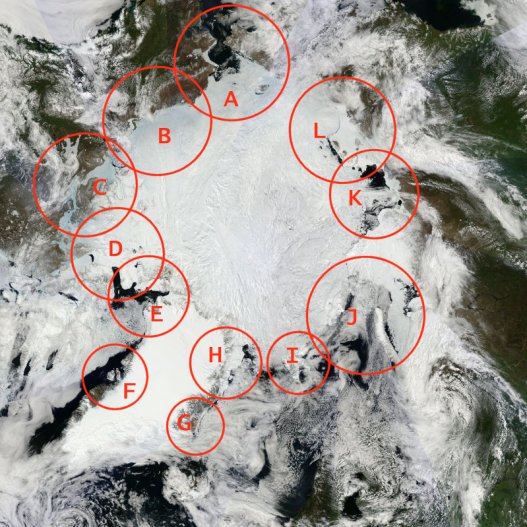
Around The Arctic June 2013


The Arctic is currently primed for rapid and extensive ice loss, unless we see some very unusual weather conditions this Summer.

The state of the ice can be seen in the following series of satellite images from NASA's Earth Observing System Data and Information System - EOSDIS.  EOSDIS produces near real-time data and makes images such as the Arctic mosaic and the Near Real Time (Orbit Swath) Images available on the web.


