



Retroviral proteases are a class of enzymes that play an important role in the maturation and proliferation of the AIDS virus. As such, this class of enzymes is a subject of intense research. The efforts, however, were hindered by a fundamental problem: nobody knew exactly what these enzymes looked like.

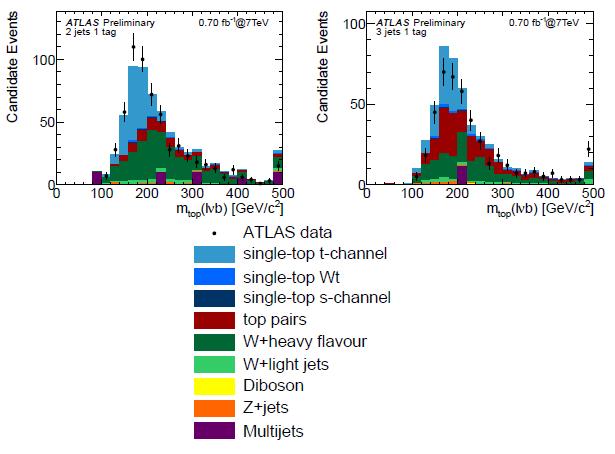
A well-known HEP rule says that yesterday's searched new processes will be tomorrow's annoying irreducible backgrounds; but since I am an optimist, I always see the glass half-full and feel compelled to add that today they are pleasing high-statistics signals. Take single top quark production: the Tevatron experimentalists (you can include me in the lot) banged their head for a decade trying to measure it; they finally succeeded, but the signal always remained a small excess of events in the tail of a highly-refined multi-variable discriminator.
Last time I blogged, I discussed entropic gravity and ended with the prediction that we will witness some more opposing and supportive views on entropic gravity before the dust will settle on the subject. The moment I wrote these words, a critical article on Verlinde's entropic gravity idea appeared, soon followed by a an article that brushes aside all earlier entropic gravity criticism based on neutron experiments. 

Think someone is bored if they yawn? Perhaps their brain is just overheating.

A study led by Andrew Gallup, a postdoc in Princeton University's Department of Ecology and Evolutionary Biology, says yawning frequency varies with the seasons and that people are less likely to yawn when the heat outdoors exceeds body temperature.  Conclusion: yawning could serve as a method for regulating brain temperature.

$65 billion is is the increase in net farm income, the farm level benefit after paying for the seed and its biotech traits, that the biotech industry has provided across the globe during the period 1996 to 2009, according to an analysis published in the International Journal of Biotechnology.

The study's authors estimate that almost half of that money was derived by farmers in the developing world.

Should the least-proven medical treatments have fewer guidelines than evidence-based medicine?

Gonorrhea is a sexually transmitted disease (STD) that causes urethritis and pelvic inflammatory disease.  Before AIDS, this was what you got for having promiscuous, unprotected sex with many anonymous partners in a consequence-free environment (a period known as "The 1970s" yet often assumed to be the '60s) and when you contracted it you took some antibiotics and then it was back to Studio 54.

The number of individuals who are obese and suffer with its associated health problems has continued to rise, even being called an epidemic.

Is it genetics?  The dream of cheap food finally being realized? Or are we slaves to marketing?

Researchers from Yale University School of Medicine and the University of Southern California say they have visualized differences in the way that the brains of obese and non-obese individuals respond to visual cues of high-calorie foods.  They see those foods differently.

Massachusetts implemented health care reform to increase employer-based insurance and to provide no-cost or low-cost insurance to those unable to afford it but it hasn't worked - the uninsured in Massachusetts remain predominantly the working poor, according to a new study by researchers at Harvard Medical School.

Some people have no fingerprints.  That might be handy in a burglary but it can be an issue when passing through immigration or in security situations where a fingerprint is required, like getting a notary public to take your five bucks for some benign document.

Like DNA, fingerprints are unique to each person or set of identical twins. That makes them a valuable identification tool for everything from crime detection to international travel. But what happens when the tips of our fingers are missing those distinctive patterns of ridges?

