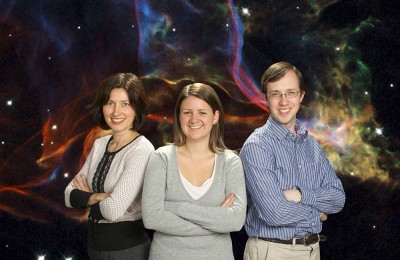
Amelia Fraser-McKelvie is not a career researcher or a post-doctoral fellow or even in graduate school, but working on a summer scholarship at the Monash School of Physics, she conducted a targeted X-ray search for the matter called the Universe's 'missing mass' and found it – or at least some of it.
The School of Physics put out a call for students interested in a six-week paid astrophysics research internship during a recent vacation period, and chose Fraser-McKelvie. Dr. Kevin Pimbblet, lecturer in the School of Physics put the magnitude of the discovery in context by explaining that scientists had been hunting for the Universe's missing mass for decades.
Simon Baron-Cohen is best known for his research into autism spectrum disorders (ASDs) and his theories on the origins of ASDs, from a failure of theory of mind, to fetal testosterone levels, to the latest formulation of a low empathizing/high systemizing theory. In his newest work, The Science of Evil: On Empathy and The Origins of Cruelty, Baron-Cohen moves beyond his decades long work in autism to look at empathy in general and what a deficit of empathy in people can lead to. The result is a slim volume aspiring to greater things.
I'll share with you my most recent finds, which I found at
Craigleith last weekend in a brief interlude from the fieldwork that I'm doing down the road from there:


I've got nothing at all against chefs. I'm just suggesting that when a restauranteur and TV personality says something like
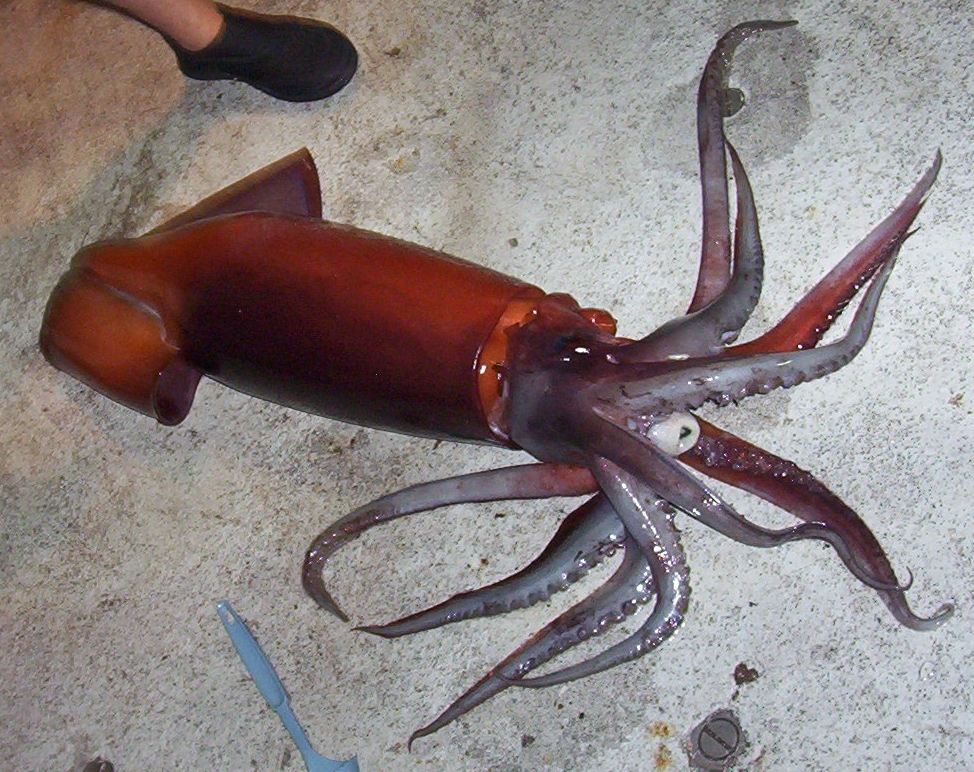
“Squid is now the dominant species in the Pacific,” Cosentino says. “The waters have changed.”
. . . then you might want to fact-check with an actual oceanographer. Or, say, a squid biologist.
The quote is from a piece in
Men's Journal called
Save the Ocean, Eat A Squid--a title guaranteed to raise my hackles. The article documents chef Chris Cosentino's fishing trip to collect Humboldt squid, which he then cooks up for patrons of his San Francisco restaurant.
The figure for you to guess which I
posted two days ago is built with simulated events featuring the production, at the Tevatron collider, of a Z boson (decaying to electron-positron or muon-antimuon pairs) together with an energetic photon. Apart from Tulpoeid, who of course knew this since Z-gamma production was her PhD thesis topic, only one other reader posted here a solution close to the correct one.
In a report sure to send left-wing science blogging into a tizzy, an analysis by Sen. Tom Coburn, M.D., Republican from Oklahoma (naturally, because Republicans hate science if they object to obscure studies that cost hundreds of thousands of dollars) says the NSF is spending money foolishly.
Does high-fructose corn syrup, a common ingredient in soft drinks and snacks and too many products to count, make you fatter than sugar? The Sugar Association, Inc., which represents sugar growers, certainly wants you to think so.
But, like cultural pundits who insist Ronald McDonald makes kids fat, there needs to be more than one study funded by an interested party to make the case. A review of studies analyzing research on High Fructose Corn Syrup (HFCS) and other sweeteners found there is no evidence of any significant variation in the way the human body metabolizes HFCS as opposed to standard table sugar, or any difference in impact on risk factors for chronic disease.
The
locavore movement, which was born on the US West Coast, may have convinced more people to shop at their local farmers' markets and participate in
community-supported agriculture--but it's been a challenge to make similar progress toward
eating local fish.
The main commercial catch off our local [Southern California] coast are sardines and squid, but many Americans prefer to stick with the greatest hits (a.k.a. shrimp, salmon, and tuna.) So the primary market for our catch is overseas.
The rapid development of Mars, as little as two to four million years after the birth of the solar system (far more quickly than Earth) explains why it is so small by comparison, according to a new paper.
Mars probably is not a terrestrial planet like Earth, which grew to its full size over 50 to 100 million years via collisions with other small bodies in the solar system, says Nicolas Dauphas, a geophysicist at the University of Chicago. "Earth was made of embryos like Mars, but Mars is a stranded planetary embryo that never collided with other embryos to form an Earthlike planet."
In a recent set of posts there was a discussion about evolutionary psychology and how it can be used to explain various behaviors. However, one of the fundamental challenges raised is whether the references to biological phenomenon are, in fact, settled issues and whether they should serve as a basis for drawing additional conclusions. As a result, I wanted to focus on one particular paragraph from one paper to illustrate the problem.