Arctic Ice May 2011 - Update #1Even if it leaves you too tired to come back and read my own humble offerings - but I hope you do come back - there are two very topical blog posts that I want to recommend to you:
Tell good stories that entertain and are relevant. It is so easy to say “use simple everyday life language”, but for a scientist who are trained to do the exact opposite it hurts. Almost physically.
A new paper in Nature says the most widely used methods for calculating species extinction rates are "fundamentally flawed" and overestimate extinction rates by as much as 160 percent.
A team of scientists say they have uncovered the basis for drug resistance in acute lymphoblastic leukemia, the most common form of childhood cancer. Acute lymphoblastic leukemia accounts for about 23 percent of all cases of cancer in children under the age of 15, according to the National Cancer Institute.
Cosmic Embryo #5: Aiming for the moon with all rockets blazing? A critique of Breast Cancer Deadline 2020®
The multibillion dollar breast cancer enterprise has just issued its damning self-assessment:
Whole body computerized tomography (CT) scanning has helped diagnose the earliest confirmed case of coronary artery disease in history.
The Egyptian princess Ahmose-Meryet-Amon, who lived in Thebes (Luxor) between 1580 and 1550 B.C., lived on a diet rich in vegetables, fruit and a limited amount of meat from domesticated (but not fattened) animals. Wheat and barley were grown along the banks of the Nile, making bread and beer the dietary staples of this period of ancient Egypt. Tobacco and trans-fats were unknown, and lifestyle was likely to have been active.
A gene in the nucleus of muscle and brain cells named
MLIP (Muscle enriched A-type Lamin Interacting Protein)
affects heart development and the aging process, according to a study in the Journal of Biological Chemistry .
Mutations in the Lamin gene family are associated with muscular dystrophy and other degenerative heart muscle diseases.
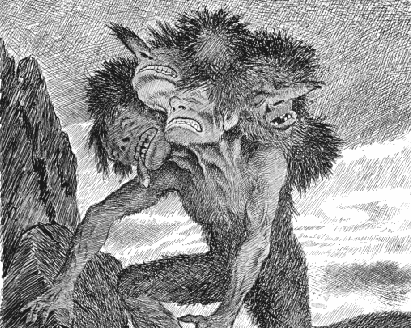
Anyone who have been working in a multidisciplinary science project knows how hard it is to establish coherent dialogs that make sense and are productive for all participants. Scientists from each discipline tend to form their own 'head' creating an unmanageable n-headed troll. Implementation of the Global Earth Observation System of Systems (GEOSS) is such a project. In this article I discuss how we can use new media to facilitate an effective dialog that connects all GEOSS science and technology stakeholders, the citizens that will both build and use GEOSS.
Aggression in mating males is a successful reproductive strategy for individuals but a numerical model says it can drive a species to extinction,
Evolutionary biologists have long debated whether the behavior of the individual is able to influence processes on a population or species level but the possibility of selection at the species level remains controversial. Using a mathematical model, an international team of researchers now say that aggressive male sexual behavior not only harms the female, but can also cause entire populations to die out.
Human embryonic stem cell research is limited in the US and Europe but creative researchers have made significant advances using the existing hESC lines allowed under US federal guidelines along with induced pluripotent stem cells and adult stem cells.
Scientists at Monash University's Immunology and Stem Cell Laboratories (MISCL) say they can now make precursor human stem cells from healthy adult kidneys without working on human embryos at all.