A new technology can make nanoscale protein measurements - which may mean understanding the effects of therapeutic agents in tumor cells and different cell populations within patients, a key step toward being able to tailor therapy for each patient.
Currently, research on cancer agent activity requires patients to undergo several invasive biopsies to generate enough cells for testing. A group of researchers have developed a highly sensitive test called the nano-immunoassay (NIA) that can make nanoscale protein measurements in cells from minimally invasive blood draws or fine-needle aspirates. The researchers used a microfluidic instrument called the Nanopro1000.
Quick, what's the world's favorite beverage?
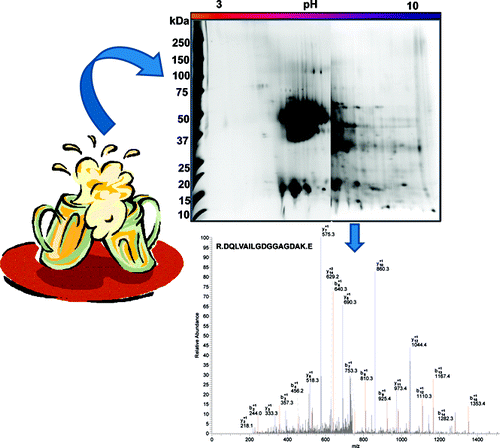
If you said 'beer', you're wrong, water and tea are way ahead, but it means the most comprehensive deciphering of the beer's proteome (the set of proteins that make beer "beer") ever reported will interest you just the same. Their report on the beer proteome could give brewers a new way to engineer and even customize the flavor and aroma of beer by experimenting with the proteinaceous components.
Beer is the world's favorite alcoholic beverage, so you needn't feel bad about your beverage answer.
Can crowdsourcing lead to better medicine?
Crowdsourcing is used in astronomy and protein folding in biology, along with engineering and computer software. But can the 'wisdom of crowds' also help cure disease?
It's certainly possible. An unheralded clockmaker in England named John Harrison showed that longitude could be determined by using a timepiece, making the study of astronomy by experts overkill and revolutionizing travel by sea
A group at Harvard created The Challenge in February to find out if citizen science could work for diabetes research too, and their results are in.
Duality is one of the most important insights in physics and philosophy of physics. What does duality mean? It means that there are dual descriptions of one and the same observed physics. Duality implies that you cannot possibly decide whether the one description T or the other, to T dual description T’ is right or wrong, because both descriptions lead to the exact same observations for the observers who live in a universe that can be described by the theories T and T’. Both are equally right or wrong, as they are dual descriptions.
My main computer died, and I'm on my backup system. While I can still work, it feels like I've shifted from my starship bridge to the tiny emergency control room, while still on full battle alert.
I have many working computers in the house. Between my main (a linux PC), the Windows box (for when you absolutely need 100% Windows compatibility), the 2 netbooks, and the music/vid box, I can 'do' stuff. I just can't do it as seamlessly, and that's caused frustration.
Social rejection isn't just emotionally unsettling, it can also impact your heart in a literal sense, according to a new study which finds that being romantically rejected makes your heart rate drop for a moment.
Bregtje Gunther Moor, Eveline A. Crone, and Maurits W. van der Molen of the University of Amsterdam and Leiden University in the Netherlands say research has shown that the brain processes physical and social pain in some of the same regions but they wanted to find out how social pain affects people physically.
In the wake of the
Pepsigate scandal at Scienceblogs.com and the departure of some two dozen bloggers, a variety of companies decided to capitalize on the disarray and start their own blogging networks - PLoS started a blog network for outside contributors, as did
Wired and soon Nature Publishing Group will tackle it one more time at
Scientific American.
I have a few notes on home networks, which notes come from recent experience with some network setup issues.
Encryption: How to secure one’s network — or whether not to — continues to be a point of debate. I favour some of the arguments for being a “good citizen” and leaving your network open, and then making sure your computers are secure. Still, that works best if you don’t want to communicate between computers within your network, and can just wall each one off.
There are some Happy Coffins from Singapore challenging death's taboos. Today, designer coffins deck a nursing home where three residents fulfill their pre-departure wishes about how their final resting places should look.
"Without any fear," Elsie Chua said, "I am not afraid to talk about my eventual departure. It is very meaningful to be able to shape the design of my coffin and see it before I die. I want to have a matching kebaya to go along."
A kebaya is a traditional Straits Chinese garment for women.
The art of dying
Elsie's wish was granted through an initiative between the Lien Foundation, a Singapore philanthropic house and St Joseph's Home and Hospice.
I always wondered why research findings funded by tax dollars are freely available to pharma companies to make big bucks.
It is a vicious cycle. It starts from taxpayer funding

research projects that culminate in publishing papers. And It ends in pharmaceutical companies selling products/drugs designed based on same research findings. Unfortunately, the general public pays for both, and my question is, why should they?
A company, when using research findings from a publicly funded project, should pay for it.