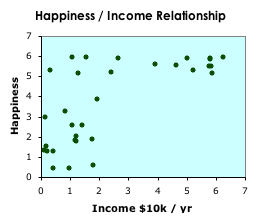
Does money make you happy? Economists think so - the concept of 'utility' assumes that economic activity represents people consuming in ways that best supports their happiness. And yet, high sales of Backstreet Boys CDs prove that this cannot be true. What's going on here?
Happiness is a difficult thing to study scientifically
A study in the latest JAMA using data from two nationally representative surveys indicates that hearing loss among U.S. adolescents increased by about 30 percent in a 12 year period ending 2006, with 1 in 5 adolescents having hearing loss in the 2005-2006 results.
Hearing loss is a common sensory disorder, affecting tens of millions of people in the United States. Adolescent hearing loss is not well understood but some risk factors, like loud sound exposure from listening to music, may be of particular importance to both adolescents and parents.
Arctic Ice August 2010 - Update #3
The NSIDC has just issued an update report for August -
August 17, 2010
North by Northwest
The end of summer is approaching in the Arctic; temperatures are dropping and melt is ending in the high latitudes. Yet summer is not quite over in the lower latitudes of the Arctic Ocean, where sea ice extent continues to decline. Sea ice has melted out extensively in the northern route of the Northwest Passage, but the passage is not completely open.
Ah, summer, the time to neglect thinking and just build crap. So, much as with the
DIY Clean Room, I started gathering bits to make the DIY Vacuum chamber.
I'm building a vacuum chamber to make sure that my satellite doesn't go kablooey when it hits space. Vacuum is a nasty environment. We have no pressure, we have outgassing, and (least we not forget) we have the simple removal of air.
Princeton scientists say they may have discovered the oldest fossils of animal bodies; sponge-like creatures that were living in ocean reefs 650 million years ago. The shelly fossils, found beneath a 635 million-year-old glacial deposit in South Australia, would represent the earliest evidence of animal body forms in the current fossil record by at least 70 million years.
Is attention deficit hyperactivity disorder (ADHD) too often confused with immaturity or just young age? It may be, according to new research by a Michigan State University economist published in the Journal of Health Economics.
ADHD is the most commonly diagnosed behavioral disorder for kids in the United States, with at least 4.5 million diagnoses among children under age 18, according to the Centers for Disease Control and Prevention.
Science has a long history of being multinational and has long been a way to bridge cultures and balance the public good with private gain. Science, being about excellence, has zero interest in race, creed or religion. Maybe it has too much concern with politics and policies in some corners but even that is a minor blemish. The fact is, cooperation works.
Cooperation comes naturally to science, as the big problems science is being called upon to address, like the future of energy, climate change and new pandemics, respect no boundaries. The days of science as a solitary thing are good. Modern science at its best is now a group effort, inclusive and open. Social even.
Charity, What Does It Mean? - Sadaqa, Matlab Kya He?An essay on the meaning of the term 'charity', with scientific, philosophical and historical discussion.
"There is no person who does not have the obligation of doing charity every day that the sun rises."
Prophet Mohammed
"Though I speak with the tongues of men and of angels, and have not charity, I am become as sounding brass, or a tinkling cymbal."
Saint Paul
All people in all lands share a common tool: language.
Donald Light, professor of comparative health policy at the University of Medicine and Dentistry of New Jersey, says the pharmaceutical industry is a market for 'lemons' - a market in which the seller knows much more than the buyer about the product and can profit from selling products less effective and even less safe than consumers are led to believe.
Talking at the meeting of the American Sociological Association, he said three reasons why the pharmaceutical market produces "lemons" are: Having companies in charge of testing new drugs, providing firewalls of legal protection behind which information about harms or effectiveness can be hidden, and the relatively low bar set for drug efficacy in order for a new drug to be approved.
Being married has been associated with improving health but a new study suggests that having that long-term bond alters hormones in a way that reduces stress - but you don't need to buy a ring just yet; unmarried people in a committed relationship show the same reduced responses to stress, said Dario Maestripieri, Professor in Comparative Human Development at the University of Chicago and lead author of a new study in Stress.