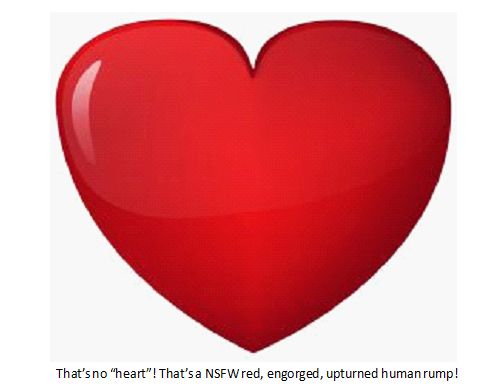

It’s Valentine Day, and children everywhere celebrated friendship and love by giving cards and candy to their friends. In what alien observers must consider one of the most bizarre human customs, these same children were asked to draw lewd pictures of human private parts. You don’t think you or your children participated in this custom? Take a look a the figure below…

valentines heart as human rump
One of the positive side-effects of preparing a seminar is being forced to get up-to-date with the latest experimental and theoretical developments on the topic. And this is of particular benefit to lazy bums like myself, who prefer to spend their time playing online chess than reading arxiv preprints.

It happened last week, in the course of putting together a meaningful discussion of the state of the art in global electroweak fits to standard model observables, and their implications for the unknown mass of the Higgs boson: by skimming the hep-ph folder I found a very recent paper by a colleague in Padova, which I had shamefully failed to notice in the last couple of careless visits.
Scientific Blogging fave Greg Critser has a new book out, Eternity Soup: Inside The Quest To End Aging(available at fine retailers everywhere, or at that link if you want us to make a nickel) and in celebration he has put together a short quiz to find out what you know.
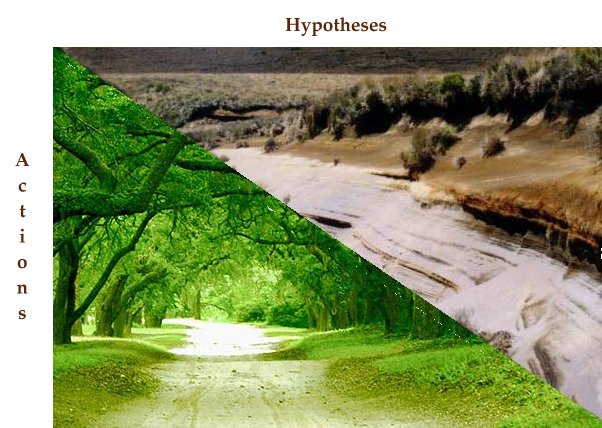
The Pragma Hypothesis

A speculation on the possibility of the accurate prediction of future, hind-sight based, historical worldviews, and the application of such prediction to the current climate change debate.

Pragma - mass noun: the practical outcome of a decision-based action as viewed from a historical perspective.  Pragma is to science and politics as karma is to spirituality.

"This is not just some intellectual argument between people who think they know the answer, we are talking about the future of the globe.

...
When asked to justify the research I do, I always struggle a little to explain my dissatisfaction with the traditional descriptive, non-quantitative explanations of molecular biological systems. As a glance at a classic molecular cell biology textbook will easily demonstrate, molecular biologists have been tremendously successful with verbal or semi-quantitative explanations of what goes on inside the cell. And in any case, the complexity of the cell is extremely daunting for the would-be theoretical biologist.
Last fall, ScientificBlogging introduced our first ever University Writing Competition. We were blown away by the quality of science articles we received, and are excited to announce that we’re doing it again this spring. This time the contest is open to ALL graduate students. The official rules are below, but the big idea is that we are inviting graduate students to write about science – on any scientific topic of their choosing. It is our hope to discover those exceptional students that not only know their science, but can also effectively communicate it to the scientific community as well as to the general public.
This morning, upon leaving Brussels to go back home after my seminar in Louvain-la-Neuve, my attention was caught by a big green banner hanging from a tall building at Place Schuman. It said "Safe Internet Day" and below, in smaller fonts, "think before you blog". I found it inspiring.

A blog, if used correctly, is a very nice tool which enhances one's possibility to express one's ideas, or to do scientific outreach, as in my case. It may also be used for self-promotion at times (and the opportunity does not escape me, although I try to self-contain these outbursts). But a blog, if it attracts traffic, may become also a dangerous instrument, which must be handled with care.
Scientific Evidence Of Your Own Awesomeness


Do you like to share awe-inspiring articles with your friends, like the many [New York] Times readers whose habits are analyzed in a new study? Or do you have other motives?


Jonah Berger and Katherine A. Milkman, researchers at the Wharton University of Pennsylvania, have been analysing the New York Times most e-mailed articles list.  They have been trying to determine what factors contribute to making an article 'most emailed'.


It appears that NYT readers like to share news about positive, long and intellectually challenging topics.  Most of all, the study indicates that people most like to share topics that inspire awe.
The protein ToxT controls the virulent nature of Vibrio cholerae, the bacteria that causes cholera. And buried within ToxT is a fatty acid that appears to inhibit the protein, preventing V. cholerae from causing cholera. The findings appeared recently in PNAS and the authors say the research may enable the development of a new treatment for the potentially fatal illness.
New research published in Stroke has linked the risk of suffering a stroke to the presence of a certain type of antibody in the immune system. According to the study, researchers may now be able to develop a vaccine that can mobilize the body's own defence against arteriosclerosis and stroke.

The study compared 227 individuals who had suffered stroke over a 13-year period with 445 sex and age-matched controls. After controlling for other risk factors (age, sex, smoking habits, cholesterol levels, diabetes, BMI and blood pressure), they were able to show that low levels (below 30 per cent of average) of PC antibodies correlated with a higher risk of stroke, which in women meant an almost three-fold increase.