

An article in the latest (August 2009) edition of Scientific American describes an astronaut floating motionless with respect to his distant spaceship. He is not tethered to the spaceship and has no objects available that can be hurled away or can in some other way create a thrust.

How is he ever going to make it back to his spaceship?
If you were a linguist, how would you accurately describe 'click' sounds distinct to certain African languages?   It's no easy task but in order to accurately preserve a language like N|uu, which has fewer than 10 remaining speakers (and all over age 60) linguists have to be able to document.

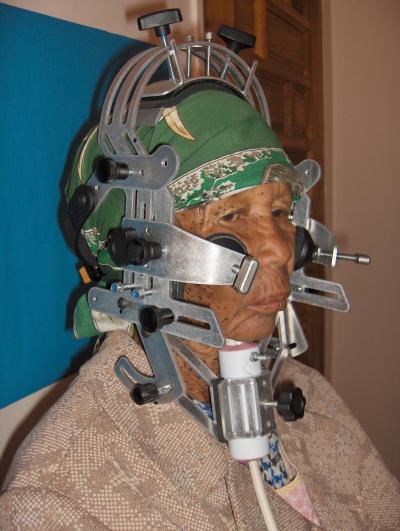
Cornell University professor Amanda Miller and colleagues recently used high-speed, ultrasound imaging of the human tongue to precisely categorize sounds produced by the N|uu language speakers of southern Africa's Kalahari Desert, a step toward understanding the physics of speech production.
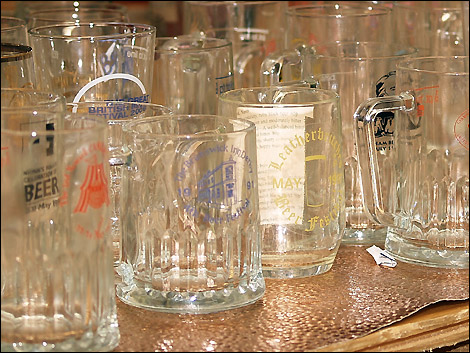
Think University of Nottingham students enjoy a pint on occasion?   It's a safe bet, since the school is putting in a fully-functioning brewery, and brewing must be a key contributor to the East Midlands economy since it boasts some 78 small or medium sized micro-breweries.  
You're all either old enough or young enough to remember "Where's Waldo?"   It involved a lovable scamp with glasses who would get himself trapped in awfully complex situations and only keen eyes could rescue him.

We have our own lovable scamp, sans glasses, and his name is Garth Sundem.   If you haven't seen Garth be lovable, watch this clip from his show on the Science Channel.  I'll wait.  


As a science nerd, and as a science nerd with friends who are science teachers, I am always on the lookout for new and interesting ways to expose others to the beauty and wonder that is science and broaden their horizons in a concise, meaningful way.

I was bested today by aforementioned science teacher extraordinaire (and best friend) Maggie Nufer, who sent me a site that fulfills all criteria, and as a bonus is aesthetically pleasing (the site, I mean, but Maggie is too).
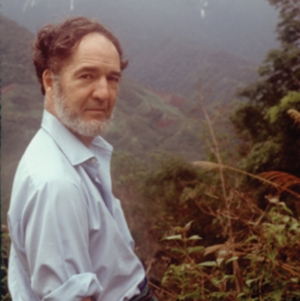
Two New Guinea men, Henep Isum Mandingo and Hup Daniel Wemp, have filed a $10 million defamation  suit against the New Yorker and Jared Diamond for a story the New Yorker printed called “Annals of Anthropology: Vengeance Is Ours: What can tribal societies tell us about our need to get even?“, that recounts a series of revenge killings committed by Wemp:
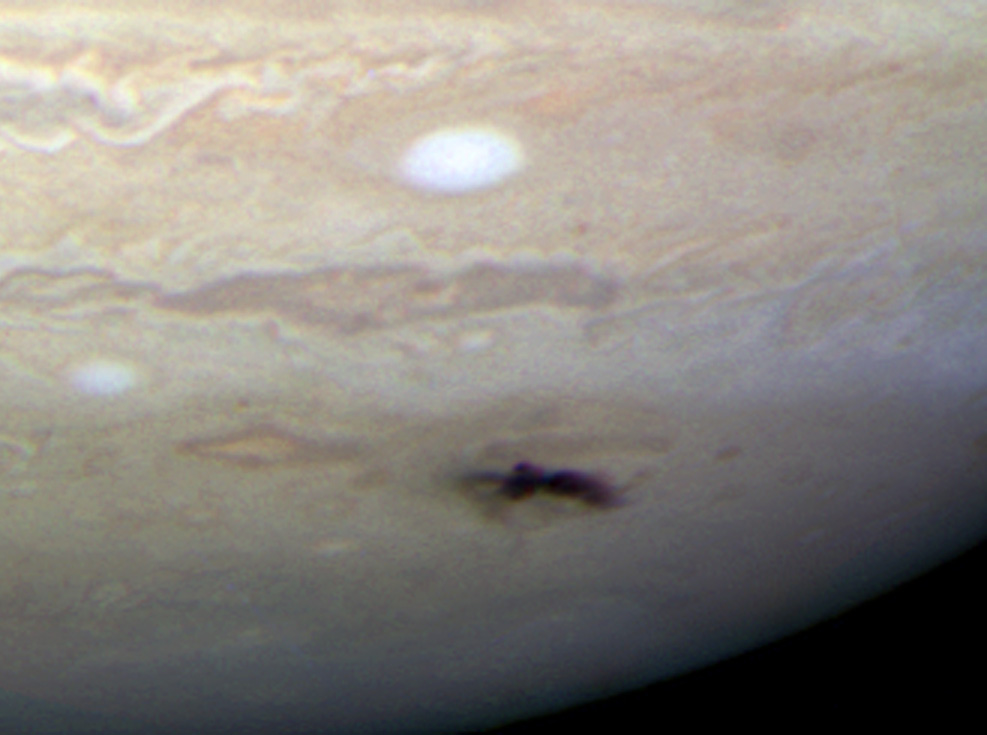
A surprising impact on Jupiter is big news this past week.   The eyes of the entire space world have been riveted on the discovery of amateur astronomer Anthony Wesley of Canberra, Australia.   Now Hubble is in on the act and has provided the clearest picture yet.
One component of the American Recovery and Reinvestment Act (AKA: Stimulus Package) still making its way through the pipeline is 250 million for the development of statewide longitudinal data systems managed by the Department of Education's Institute of Education Sciences.
Less stable materials may not sound like a great thing for your car but they may be the solution to producing a clean-running hydrogen fuel cell vehicle. More on that in just a minute. First, let's talk about where things are in clean energy.

If you've read this site for more than five minutes you know I believe it's better to spend money researching legitimate clean energy rather than porkbarrelling environmental activism darlings like ethanol, wind energy, solar panels and CFL bulbs. Hydrogen fuel-cell vehicles can not only be an important part of the solution to America's energy crisis, they can eliminate it ... but challenges remain.
In addition to shark attacks and boredom-related deaths due to mid-season baseball, the summer months are the time of food poisoning. If you live in Florida or California, you should be especially vigilant, as you are susceptible to all three (the most baseball teams, the most shark-infested beaches, and—according to the CDC—the most restaurant outbreaks of food poisoning, with a combined 143 in 2007).

In all, the CDC estimates that food-borne diseases every year cause approximately 76 million illnesses, 325,000 hospitalizations and 5,000 deaths (salmonella alone costs the United States upwards of $5 billion annually in medical care and lost productivity).

One can only imagine the sheer volume of liquid effluvium generated by these 76 million people.