



Antidepressants, commonly used to treat anxiety, pain and other disorders, may play a role in dental implant failure, according to a new pilot study which found that the use of antidepressants increased the odds of implant failure by four times. 

While these drugs are often used to manage mood and emotions, a side effect decreases the regulation of bone metabolism, which is crucial to the healing process.

Each year of antidepressant use doubled the odds of failure.

Green tea is touted for its many health benefits as a powerful antioxidant, but experiments in a laboratory mouse model of inflammatory bowel disease suggest that consuming green tea along with dietary iron may actually lessen green tea's benefits.

"If you drink green tea after an iron-rich meal, the main compound in the tea will bind to the iron," said Matam Vijay-Kumar, assistant professor of nutritional sciences, Penn State. "When that occurs, the green tea loses its potential as an antioxidant. In order to get the benefits of green tea, it may be best to not consume it with iron-rich foods." Iron-rich foods include red meat and dark leafy greens, such as kale and spinach. According to Vijay-Kumar, the same results also apply to iron supplements.

Hydra is a genus of tiny freshwater animals that catch and sting prey using a ring of tentacles. But before a hydra can eat, it has to rip its own skin apart just to open its mouth. Scientists reporting March 8 in Biophysical Journal now illustrate the biomechanics of this process for the first time and find that a hydra's cells stretch to split apart in a dramatic deformation.

Researchers have revealed the global spread of an ancient group of retroviruses that affected about 28 of 50 modern mammals' ancestors between 15 and 30 million years ago.

Retroviruses are abundant in nature and include human immunodeficiency viruses (HIV-1 and -2) and human T-cell leukemia viruses. The scientists' findings on a specific group of these viruses called ERV-Fc, to be published in the journal eLife, show that they affected a wide range of hosts, including species as diverse as carnivores, rodents, and primates.

The distribution of ERV-Fc among these ancient mammals suggests the viruses spread to every continent except Antarctica and Australia, and that they jumped from one species to another more than 20 times.

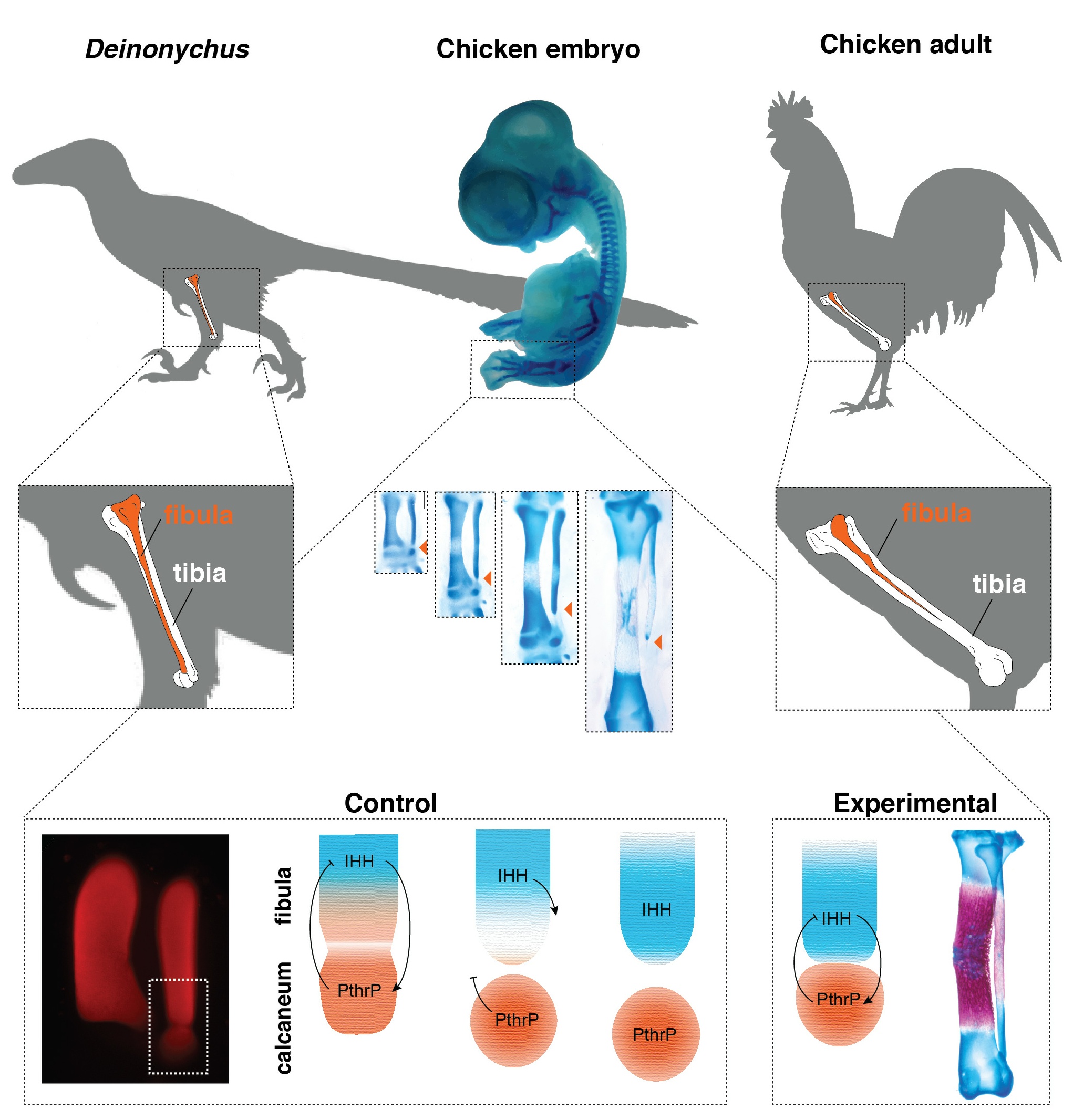
Anyone that has eaten chicken knows what a drumstick is - it's the lower leg of a long, spine-like bone, more specifically the fibula, one of the two long bones of the lower leg (the outer one).

In dinosaurs, the ancestors of birds, this bone is tube-shaped and reaches all the way down to the ankle, but in evolution birds lost the lower end, and no longer connects to the ankle, being shorter than the other bone in the lower leg, the tibia. In the 19th century, scientists had noted that bird embryos first develop a tubular, dinosaur-like fibula. Only afterwards, it becomes shorter than the tibia and acquires its adult, splinter-like shape.  
The issue is not new. Scientific journals require articles to produce quantitative answers - of course, that's how you do science. And scientists usually rely on a formalism based on classical statistics to report those results: they report the probability of their data given some hypothesis.

P-values, that is.

New University of Warwick research indicates cause of recurrent miscarriage
Stem cell research to start to help end heartache for thousands of women

Scientists at the University of Warwick have discovered that a lack of stem cells in the womb lining is causing thousands of women to suffer from recurrent miscarriages.

The academics behind the breakthrough are now to start research into a treatment which they believe could bring hope to those who have suffered failed pregnancies.

pic

This is Prof. Jan Brosens. Credit: Prof. Jan Brosens

Avoidable harm to patients is still too high in healthcare in the UK and across the globe -- making safety a top healthcare priority for providers and policy makers alike.

These are the findings of two reports launched today by researchers from Imperial College London. Both reports, produced by NIHR Imperial Patient Safety Translational Research Centre (PSTRC), provide evidence on the current state of patient safety and how it could be improved the future. They urge healthcare providers to embrace a more open and transparent culture to encourage continuous learning and harm reduction.

Last April, Kraft Heinz announced it would remove artificial flavors, preservatives and dyes from its iconic Blue Box, and did exactly that in December.
Kraft Mac&Cheese replaced artificial dyes (yellow 5 and 6) with paprika, annatto and turmeric to maintain its signature color. This change has been listed in the ingredient line for the past few months. There are also no artificial flavors or preservatives in the new recipe.

Scientists at Case Western Reserve University School of Medicine have identified a novel mechanism that could be used to protect the brain from damage due to stroke and a variety of neurodegenerative conditions, including sporadic Creutzfeldt-Jakob disease, Alzheimer's disease, and Parkinson's disease.

Neena Singh, MD, PhD, a professor of pathology at the school, has spent much of her career studying the role of metals such as iron, copper, and zinc in the pathology of neurodegenerative diseases. She has previously reported that some of these metals are regulated by the brain's normal prion protein, called PrPC. Her goal is to identify common pathogenic processes in neurodegenerative diseases that could lead to the development of a new generation of treatments.


