Doom and gloom types always want to lament that the presence of people is killing the Earth. Not so, say California Institute of Technology (Caltech) scientists. At least on a cosmic scale, the presence of life may increase longevity for planets.
In traditional thinking, a billion years from now the ever-increasing radiation from the sun will have heated Earth into inhabitability, causing the carbon dioxide in the atmosphere that serves as food for plant to disappear. The oceans will evaporate and all living things will disappear.
Maybe not quite so soon, say researchers from Caltech, who have come up with a mechanism that doubles the future lifespan of the biosphere while also increasing the chance that advanced life will be found elsewhere in the universe.
Almost 90 percent of the world’s population will not have timely access to affordable supplies of vaccines and antiviral agents in the current influenza A (
H1N1) pandemic but inexpensive generic drugs that are readily available even in developing countries could save millions of lives, according to the conclusion reached by an extensive review and analysis by immunization expert Dr David Fedson within hours of the World Health Organization declaring a pandemic.
Newborn babies have immature immune systems, making them highly vulnerable to severe infections and unable to mount an effective immune response to most vaccines, thereby frustrating efforts to protect them. The World Health Organization estimates that more than 2 million newborns and infants less than 6 months of age die each year due to infection. Now, researchers at Children's Hospital Boston believe they have found a way to enhance the immune system at birth and boost newborns' vaccine responses, making infections like respiratory syncytial virus, pneumococcus and rotavirus much less of a threat.
Today I visited the 53rd international art exposition at the Biennale di Venezia, which this year is titled "Fare Mondi" (making worlds). I am posting below a few pictures I took of the installations I saw there, for those of you who are not insensitive to contemporary arts. But before I do, let me add a personal note.
D'you dig the Geek Off? Did you email your answers to
geekoff@gmail.com? If not, too late sucka! That is, too late until Monday morning, when we play another round of the feud. Yep, every week there's a Geek Off and every week you can win a free
Geeks' Guide to World Domination: Be Afraid, Beautiful People. Check the quiz Monday, email your answers 'til Friday at midnight EST, then check the answers and fight about corrections starting Saturday
morning.
Here are the answers to last week's geek off:
1. Geek Culture/Ephemera
Faces: Hulk Hogan, Junkyard Dog, Captain Lou Albano, Wendi Richter, Superfly Jimmy Snuka, Hillbilly Jim
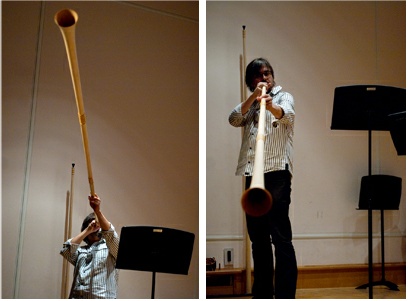
21st century computer modelling software has enabled a long-lost, trumpet-like instrument called the Lituus to be recreated – even though no one alive today has heard, played or even seen a picture of this forgotten instrument - allowing a work by Bach to be performed as the composer may have intended for the first time in nearly 300 years.
Generally acknowledged to be one of the greatest composers of all time, Johann Sebastian Bach was born in the German town of Eisenach in 1685 and produced over 1000 sacred and secular musical compositions. He died in Leipzig in 1750, at the age of 65.
Kin selection is one of those special considerations derived from “selfish gene theory” that postulates that it is the degree of relatedness between organisms that will determine the likelihood that altruistic actions will occur. This also clearly implies the existence of a social group, of some type, so it isn’t expected that it would play a role between members of different species, or among asocial animals (although it could).
In general the idea of “kin selection” is that individuals are more apt to behave altruistically to “blood relatives” than to others in the interest of propagating their genes into future generations. A classic example occurs in eusocial insects where sterile females help maintain the colony for the reproductive queen.
I wrote about
the opening of the World Science Festival 2009 and Edward O. Wilson's 80th birthday at the Lincoln Center in New York City but he was not the only august personage in attendance. Present to give tribute to him was also molecular biologist, Nobel laureate and co-discoverer of the structure of DNA, James Watson.
Fingerprints are essential for crime dramas and look nicely distinct for each of us but what are fingerprints really for?
According to Roland Ennos, from the University of Manchester, other primates and tree-climbing koalas have fingerprints and some South American monkeys have ridged pads on their tree-gripping tails, so everyone presumed that fingerprints are there to help us hang onto objects that we grasp. This theory that fingerprints increase friction between the skin and whatever we grab onto has been around for over 100 years, but no one had directly tested the idea.
From 1958 to 1970 Wladimiro Dorigo, my father, directed a political and cultural magazine called "Questitalia" ("This italy"), where emerging political issues were discussed, and the ongoing transformations of Italian society were dissected by a distinguished group of intellectuals. I own a copy of all the 150 issues of that publication, and every once in a while I pick one of them out of the lot at random, and learn what Italy was 40 or 50 years ago.