Bats, unlike most animals, don't primarily use their voices for communication. Instead, they use echolocation to navigate their surroundings but they can also use it, and the characteristics of other bats' voices, to recognize each other, according to a study by researchers from the University of Tuebingen, Germany and the University of Applied Sciences in Konstanz, Germany.
The study published June 5 in PLoS Computational Biology, explains how bats use echolocation for more than just spatial knowledge and it might also help explain how some bats travel at high speed, at night, in formation without interfering with each other.
In
previous posts I have made the argument that the brain constructs a data organization framework which represents our worldview (or belief systems). It is against this structure that new information will be evaluated, accepted, or rejected. I also want to be clear that the idea of a worldview or belief system is not optional. All humans have one, since it is a requirement to provide a minimal framework against which data is acquired and classified. It should also be understood that the concept of a belief system carries no special connotation be it religious, superstitious, supernatural, or anything else. It is simply a term that refers to the data organization framework in the brain.
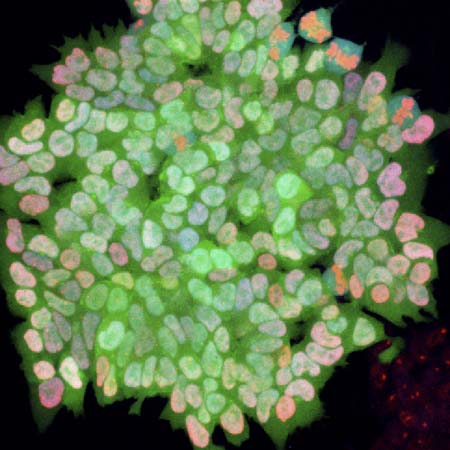
One of the biggest recent breakthroughs in stem cell research is the ability to reprogram non-stem cells into stem cells using genetic engineering. The hitch with this technique is that genetic engineering like this can have side effects: stem cells produced in this way can turn into tumors in mice (and presumably humans, but we haven't tried that yet).
And thus researchers have been looking for ways to reprogram stem cells without genetic engineering. One promising way to do this is to use chemicals that can mimic the effects of the genes typically used for reprogramming. (The jargon for these genes is 'reprogramming factors' - who says technical jargon has to be opaque?)
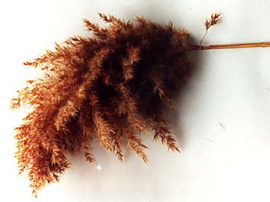
Comic books have warned us time and time again to keep villains away from radiation. It only makes them stronger. Researchers at University of Delaware have discovered that ultraviolet radiation from the sun increases the plant-destroying powers of the common reed, making it an invasive archnemesis to its wetland plant victims.
Speculation continues about the crash of Air France jetliner flight 447 on its transatlantic journey. A University of Indianapolis international relations expert says recent events point to the possibility of terrorism.
Although there have been no claims of responsibility or specific indications of sabotage, the disappearance of a large airliner without warning is extremely rare and investigators say no potential causes have been ruled out. Today, aviation authorities revealed another Air France flight from Buenos Aires to Paris was grounded temporarily May 27 because of a telephoned bomb threat.
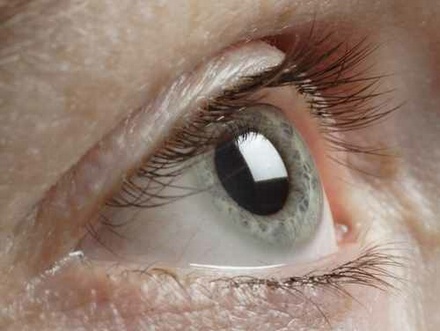
Seeing the world through 'rose-colored glasses' may be more biological reality than metaphor, according to a University of Toronto study that provides the first direct evidence that our mood literally changes the way our visual system filters our perceptual experience.
The U of T team used functional magnetic resonance imaging to examine how our visual cortex processes sensory information when in good, bad, and neutral moods. They found that donning the rose-coloured glasses of a good mood is less about the colour and more about the expansiveness of the view.
An ultra-broadband, low-power radio chip, modeled on the human inner ear could enable wireless devices capable of receiving cell phone, Internet, radio and television signals. Rahul Sarpeshkar, associate professor of electrical engineering and computer science, and graduate student Soumyajit Mandal designed the chip to mimic the inner ear, or cochlea. The chip is faster than any human-designed radio-frequency spectrum analyzer and also operates at much lower power.
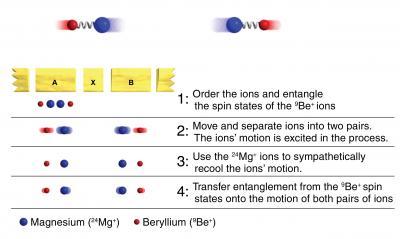
Physicists at the National Institute of Standards and Technology (NIST) have demonstrated entanglement—a phenomenon peculiar to the atomic-scale quantum world—in a mechanical system similar to those in the macroscopic everyday world. The work extends the boundaries of the arena where quantum behavior can be observed and shows how laboratory technology might be scaled up to build a functional quantum computer.
The research involves a bizarre intertwining between two pairs of vibrating ions (charged atoms) such that the pairs vibrate in unison, even when separated in space. Each pair of ions behaves like two balls connected by a spring , vibrating back and forth in opposite directions. Familiar objects that vibrate this way include pendulums and violin strings.
Nothing makes modern progressives happy like hoping mankind regresses and nothing makes modern conservatives happy like hoping progress in the future will clean up the environment.
Both sides may win, according to research led by Durham University. The secret of a successful sandcastle could aid the revival of an ancient eco-friendly building technique in the future. Parts of the Great Wall of China and the Alhambra at Granada in Spain were built using 'rammed earth', which means it lasts a long time and is sustainable, pleasing one side, and both of those have military applications, pleasing the other.
Sleeping pills have been associated with a four-fold increase in suicide risk in the elderly but is it just bad correlation, in that sleeping pills are just a convenient way to commit suicide? Researchers writing in the BMC Geriatrics say that after adjusting for the presence of psychiatric conditions sedatives and hypnotics were both associated with an increased risk of suicide.
Anders Carlsten and Margda Waern from Gothenburg University carried out a case control study to determine whether specific types of psychoactive drugs were associated with suicide risk in later life.