Astronomers have found more than 300 alien (extrasolar) worlds so far. Most of these are gas giants like Jupiter, and are either too hot (too close to their star) or too cold (too far away) to support life as we know it.
Sometime in the near future, however, astronomers will probably find one that's just right – a planet with a solid surface that's the right distance for a temperature that allows liquid water -- an essential ingredient in the recipe for life.
But the first picture of this world will be just a speck of light. How can we find out if it might have liquid water on its surface? If it has lots of water – oceans – we are in luck.
Employees who have some influence at work perform better service but praise and encouragement from managers has no particular significance in terms of loyalty toward the employer.
Social recognition, recognition as an individual whose expertise and input are appreciated, is crucial for how well employees in service companies perform their job assignments. Tómas Bjarnason, a doctoral student in sociology from the University of Gothenburg, Sweden, studied over 900 employees in service organizations for his thesis. He states that social recognition contributes to increased self respect, which means that employees make a greater effort to act in the company’s best interests.
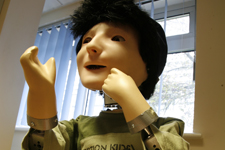
A new robot house will be launched at the University of Hertfordshire tomorrow, Wednesday 27 Mayth.
Professor Kerstin Dautenhahn and her team at the University’s School of Computer Science have taken their robots out of their laboratory and have them “living” in a house in Hatfield, so that the academics can develop them as personal companions. The academics will open the robot house to the media tomorrow, before launching it to the public in early June.
At the event, the academics will showcase the work they are doing to advance the relationship between robots and humans as part of the European project LIREC – Living with Robots and Interactive Companions. Different robots with mechanical and/or humanoid features will be shown.
U.S. Army Chemical Materials Agency (CMA) officials have announced the destruction of 60 percent of the U.S. declared stockpile under the Chemical Weapons Convention (CWC). This milestone was achieved Saturday, April 25. CMA reached the 50 percent milestone in December 2007 and is poised to destroy its two-millionth munition in the coming months.
I happened to get my hands on some interesting literature on pre-natal genetic screening, literature that amply reinforces my impression that clinical genetic testing is still in the dark ages.
Let's say you (or your wife/fiance/girlfriend) are pregnant, and you're interested in taking a blood test to see if your baby is going to develop a neural tube defect, like spina bifida. Should you take the test?
In this case, it's a no-risk test (unlike amniocentesis) that involves measuring a blood protein called AFP. Here's what the pamphlet I've got says:
- There is a 1:1000 chance that your baby will have spina bifida.
- The blood test can identify 80% of spina bifida cases.
Do you have what it takes to be Scientific Blogging's alpha geek? Well it’s time put your geek where your mouth is…IF YOU CAN!
But first a warning: yes, you could Google for these answers, but then, deep down, you’ll know you’re a bad person. Then again, you might win a free
Geeks’ Guide to World Domination. So you’ll have to balance total loss of self worth with free geek schwag. It’s up to you.
When Albert Einstein constructed his general theory of relativity he decided to resort to some reverse engineering and introduced a 'pressure' term in his equations. The value of this pressure was chosen such that it kept the general relativistic description of the universe stable against the gravitational attraction of the matter filling the universe.
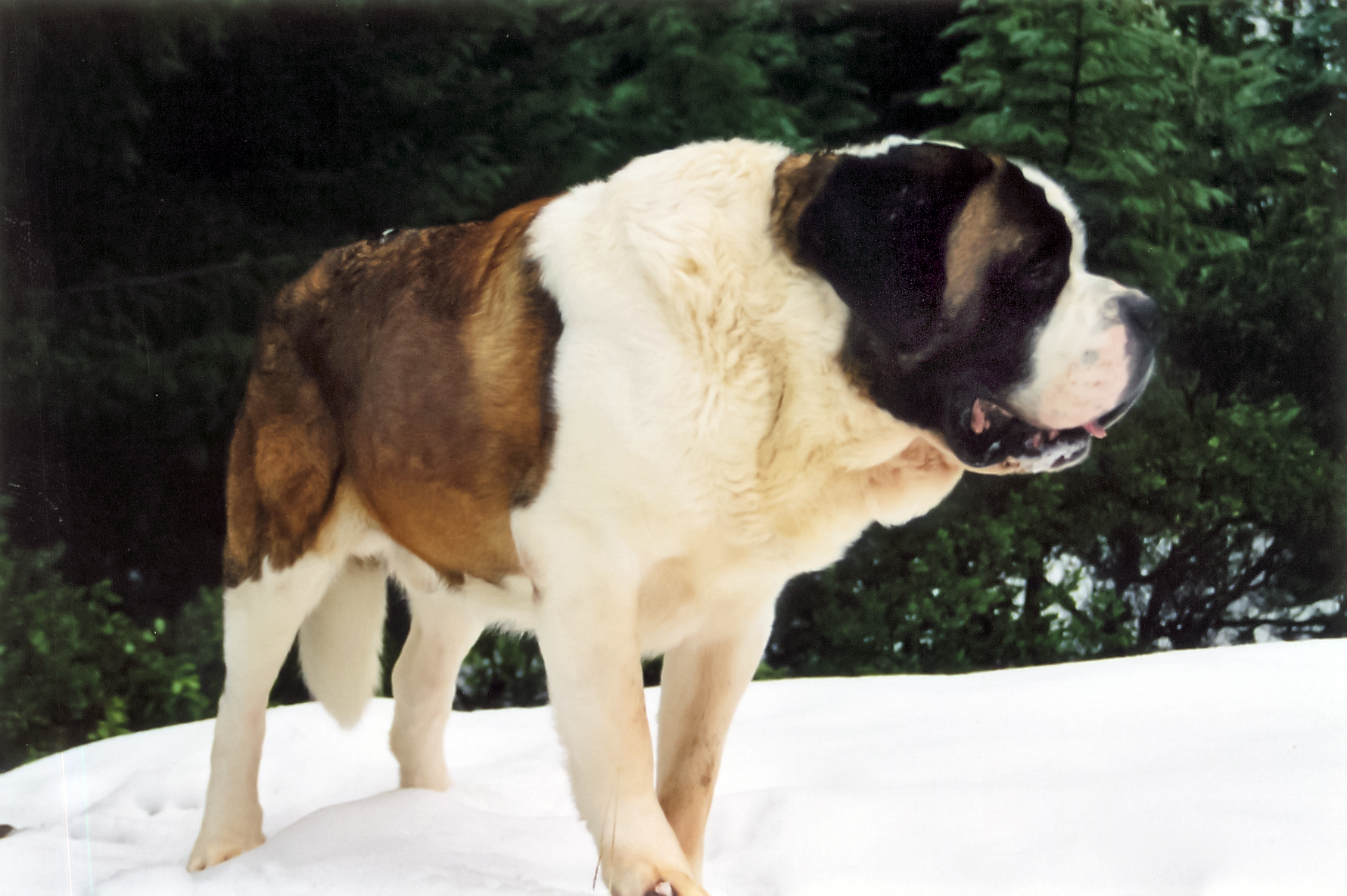
Take a look at your dog. If you don't have a dog, then check this out:
Figure 1. What dogs may look like.
This Memorial Day weekend, it is tradition to visit the graves of our fallen military soldiers – to remember, appreciate, and honor the lives given in service to our nation’s security and freedom. It is humbling to visit a national cemetery and see the thousands of headstones – each representing a life, a story, and a service to our country.

Professor Maria da Graça Bicalho, head of the Immunogenetics and Histocompatibility Laboratory at the University of Parana, Brazil, told the annual conference of the European Society of Human Genetics that people with diverse major histocompatibility complexes (MHCs) were more likely to choose each other as mates than those whose MHCs were similar, and that this was likely to be an evolutionary strategy to ensure healthy reproduction.
Yes, opposites attract. Even genetically.
The MHC is a large genetic region situated on chromosome 6, and found in most vertebrates. It plays an important role in the immune system and also in reproductive success. Apart from being a large region, it is also an extraordinarily diverse one.