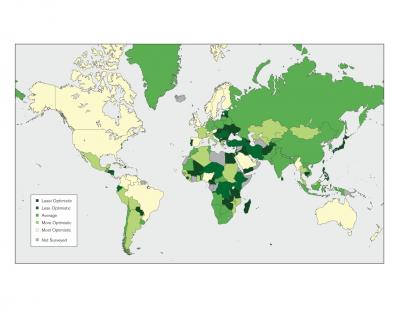
Money does not buy happiness, it is said, and apparently it does not factor much into optimism either. 20 percent of humanity hoards 83 percent of the world's wealth but the vast majority of people, including the 60 percent of the world possessing just 6 percent of world wealth, think the next 5 years will be better for them.
Yes, despite an economic recession, famine, thousands of years without a single day bereft of war somewhere in the world and media reports about a flu epidemic afflicting the Earth, a new study from the University of Kansas and Gallup indicates that humans are optimistic. Apparently it is just our nature.
70% of you, man or woman, will have an HPV infection at some point in your life. There is no cure for HPV, just as there is no cure for the common cold and in most people, an HPV infection will clear up on its own, like the common cold. It can also be passed on to other people during the infection period, like the common cold.
A
new paper in the Arxiv attracted my attention this morning. It is titled "Perturbative QCD effects and the search for a

signal at the Tevatron", and is authored by a set of quite distinguished theorists: C.Anastasiou, G.Dissertori, M.Grazzini, F.Stockli, and B.Webber.
How do you reproduce when you lack the genes for reproduction? Duke University Medical Center researchers want to know also because that can tell a lot about how yeast infections occur.
In a paper published in Nature, Joseph Heitman, M.D., Ph.D., director of the Center for Microbial Pathogenesis in the Duke Department of Molecular Genetics and Microbiology and colleagues report that eight Candida species which have a sexual cycle were missing many of the genes related to reproduction found in other species.
It appears that some superbugs have evolved to develop the ability to manipulate the immune system - and that can be a good thing, say a team of researchers at The University of Western Ontario.
Some processes that reduce the lethal effects of toxins from superbugs allow humans and microbes to co-evolve, a discovery that may lead to novel alternatives to antibiotics that specifically target the toxic effects of these superbugs.
Today’s children are coming of age immersed in a world video games, instant messaging and 3-D avatars of themselves. Many have cell phones, laptops, and hand-held video games. Heck, even robot pets are being raised in virtual worlds.
What impact does this technology have on children?
The journal Children, Youth and Environments (CYE) this month published a special issue titled “Children in Technological Environments.” The issue examines the increasing prevalence of technology from various perspectives, including knowledge and education, social and moral development, culture and community, access and equity, relationship to nature, therapy and health, art and expression, and future scenarios.
Here in Missouri, the annual intelligent design bill has
died with the end of the legislative session. Every year, several representatives from Missouri's rural areas introduce some sort of creationism bill. This year, the bill contained the latest anti-evolution line - students must analyze the "strengths and weaknesses" of the science evolution, with the weaknesses being defined as whatever creationists say they are.
San Diego, CA, March 17, 2009 – The benefits of moderate physical activity to general health and well-being are well known. It is recommended that people engage in 150 minutes per week of moderate intensity physical activity, equivalent to 30 minutes each day 5 times a week. Although pedometers are widely used as a physical activity monitoring tool, they are unable to measure activity intensity. Researchers have determined that a rate of at least 100 steps per minute achieves moderate intensity activity. Therefore a simple pedometer-based recommendation of 3000 steps in 30 minutes can get people started on a meaningful exercise program. The study is published in the May 2009 issue of the American Journal of Preventive Medicine.

That first early morning cup is wearing off; it's time for more coffee zen and a dose of science browsing to bring the day back into equilibrium:
Who knew bugs could be beautiful?
Bug Safari is one of the most enjoyable blogs in my reader. Cindy has a fine eye for a world that is invisible to most of us - head on over and see for yourself.
Recently, I was discussing the relative virtues of four-door and two-door cars with a friend. I prefer four-door cars, because they make it much easier for back-seat passengers to get in and out (they make it easier to access the back seat, in general). My friend prefers two-door cars, because he seldom has back-seat passengers, and the larger doors of two-door cars make it easier for the front-seat occupants to get in and out.
“But,” I say, “on a two-door car, the doors are larger and heavier.