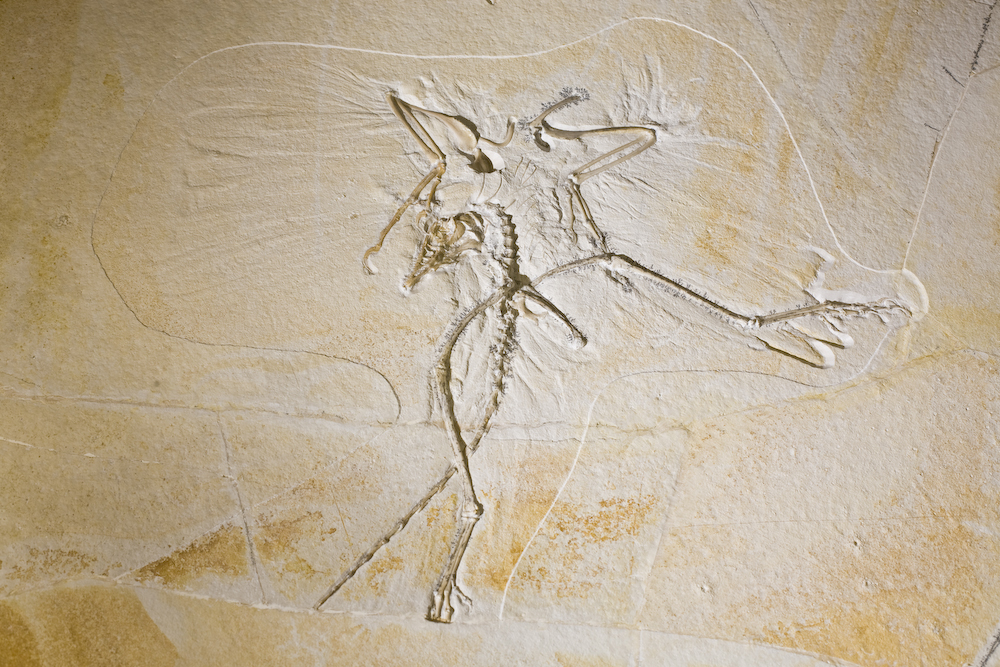
The Archaeopteryx is experiencing a phoenix-like reascent to fossil celebrity status.  The disovery of this clearly birdlike dinosaur in 1861 lent ethos to Darwin’s brand new Theory of Evolution.  In December, the Thermopolis, WY archaeopteryx fossil was escorted to the Stanford Synchrotron Radiation Lightsource laboratory for synchrotron X-ray analysis.  According to researcher Uwe Bergmann, "What you normally can't see are the chemical elements from the original organism that might still be present in the fossil. Using X-ray fluorescence imaging, we can bring these elements to light, getting a better look at the fossil and learning more about the original animal.”
"When people live where the weather is colder and they are more covered with clothing, they depend on their diet for their vitamin D," reports Raymond Hobbs, MD.  Dr. Hobbs’ study in the January/February issue of Endocrine Practice reveals that Detroit-area Arab-American women who wear the hijab, modest dress with headscarf, receive approximately half of the vitamin D of their western-dressed Arab-American neighbors.  
Last night at two in the morning I woke to find someone had grafted a zombie arm to my left shoulder. I commanded it to move—no response. I jabbed it with my right hand—no response. I threw it against the wall—no response. Would this limb remain forever zombific? Medical literature is conflicted.

The current guidelines for tourniquet use suggest a one-hour maximum for restricted blood flow to upper extremities and a two-hour maximum for lower extremities, but also admit that the onset and degree of tissue death (necrosis) varies according to patient age and physical condition. Past these thresholds, restricted blood flow can result in nerve damage. (The tingling you feel is your nerves’ way of expressing angst—a call to roll over before they get really pissed.)


“The Extended Phenotype – The Long Reach of the Gene” is the book Richard Dawkins wants you to read “if you read nothing else of mine” because “It is probably the finest thing I shall ever write.”
It purports to be about science, for scientists, yet at the very beginning there is a quite remarkable disclaimer. Dawkins warns the reader that the book contains nothing new, that it is “unabashed advocacy”, (in other words a mere personal opinion) and that it contains no hypotheses that are testable. In short, the book is declared from the outset to be non-scientific.
Cancer cells need a lot of nutrients to multiply and survive. While much is understood about how cancer cells use blood sugar to make energy, not much is known about how they get other nutrients. Now, researchers at the Johns Hopkins University School of Medicine have discovered how the Myc cancer-promoting gene uses microRNAs to control the use of glutamine, a major energy source. The results, which shed light on a new angle of cancer that might help scientists figure out a way to stop the disease, appear Feb. 15 online at Nature.

Without formalized sign language instruction, deaf children in families develop their own language using simple gestures that become more complex over time.     Unless they are gather in large groups, those specific deaf languages can result in thousands of dialects, called 'homesigns' by researchers.

There may be thousands of homesigners in a given society.    Marie Coppola, postdoctoral fellow at the Department of Psychology, University of Chicago, Illinois, says her work with four Nicaraguan homesigners shows how such individual gesture systems likely provided the raw materials for the language that emerged in a school for the deaf there.

 A research review published recently in Nutrition Today(1) says that the high-quality protein in eggs makes a valuable contribution to muscle strength, provides a source of sustained energy and promotes satiety. High-quality protein is an important nutrient for active individuals at all life stages, they say, and while most Americans consume the recommended dietary allowance (RDA) for protein, additional research suggests that some Americans are not consuming enough high-quality protein to achieve and maintain optimal health.(2,3,4)

Study Findings

Sunday Science Book Club, February 15 2009

Monkey Girl: Evolution, Education, Religion, and the Battle for America’s Soul
by Edward Humes
HarperCollins, 2007


It is rare for the world to see born on one day two towering individuals whose imprint on history is strong enough to be noted around the world 200 years later. Abraham Lincoln successfully saw the United States through a near-fatal convulsion, whose early symptoms had been palliated but not cured at the nation’s founding; the after-effects have reached all around the world. Charles Darwin, more than anyone else in the 19th century, put biology on its modern scientific footing, and his ideas play a critical role in the genome sciences at the very forefront of 21st century biology.

We celebrate their achievements this week, but both Lincoln and Darwin have left legacies of divisiveness, and in fact these legacies intertwine. The contours of the rift that initiated the Civil War still shape American politics, from Nixon’s influential Southern Strategy to the Red State-Blue State divide in the 111th Congress. Evolution is a poster child for culture war. It may not be a top issue on the national political agenda, but it is a culture war conflict that penetrates just as deeply and personally than any other, as Edward Humes vividly describes in Monkey Girl, the best book about the nation’s first court trial over Intelligent Design in public schools.
A team of MIT undergraduate students has invented a shock absorber that harnesses energy from small bumps in the road, generating electricity while it smoothes the ride more effectively than conventional shocks. The students hope to initially find customers among companies that operate large fleets of heavy vehicles. They have already drawn interest from the U.S. military and several truck manufacturers.
According to a recent study, diets rich in omega-3 fatty acids protect the liver from damage caused by obesity and the insulin resistance it provokes. This research should give doctors and nutritionists valuable information when recommending and formulating weight-loss diets and help explain why some obese patients are more likely to suffer some complications associated with obesity. Omega-3 fatty acids can be found in canola oil and fish.