In the latest Vanity Fair is a brilliant piece of journalism, Goodbye to All That: An Oral History of the Bush White House by Cullen Murphy and Todd Purdum. In a fun, easy-to-read format, it tells some basic truths I had never read before. Here are two examples:
Matthew Dowd, Bush’s pollster and chief strategist for the 2004 presidential campaign:
When Abu Ghraib happened, I was like, We’ve got to fire Rumsfeld. Like if we’re the “accountability president,” we haven’t really done this.
When thinking of a child with ADD, most people will picture an easily-distracted hyperactive child... long on energy, and short on attention span. And although that is sometimes the case, that description accurately describes only a portion of children diagnosed with ADD - and very rarely describes the behavior of girls with the condition.
When comparing players in baseball, it's difficult to cross even modern 'eras' because conditioning and strategies have changed. 6'2" shortstops are relatively common now but unheard of even 30 years ago. Likewise, American football has undergone strategic shifts that are easily recognizable, with the West Coast Offense less in vogue but a 3-4 defense coming back into popularity as compared to 20 years ago.
New research by an Arabian prince could see the millions of date stones disposed of in Saudi Arabia each year instead used to decrease air and water pollution. Abdulrahman Bandar Al-Saud, 34, is studying for a PhD at Queen’s University Belfast’s School of Chemistry and Chemical Engineering.
His research is based on the premise that date stones can be used to develop activated carbon with a high adsorption capacity. Activated carbon is a form of the element that has been processed to make it extremely porous with a very large surface area available for adsorption.
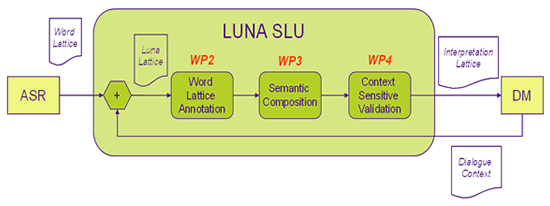
European researchers say they have developed the most advanced spontaneous language understanding (SLU) system ever devised for both Polish and Italian languages. That's because it is also the first one, according to the Luna project behind the work.
Spontaneous language understanding is far more advanced than the traditional interactive voice response (IVR) systems that people may already be familiar with. In traditional IVRs, the user is required to answer questions with specific words or short sentences proposed by the systems.
But with SLU, language systems are designed to respond to spontaneous speech: real conversations between people that include the sentence fillers and pause words like ‘um’ and ‘er’.
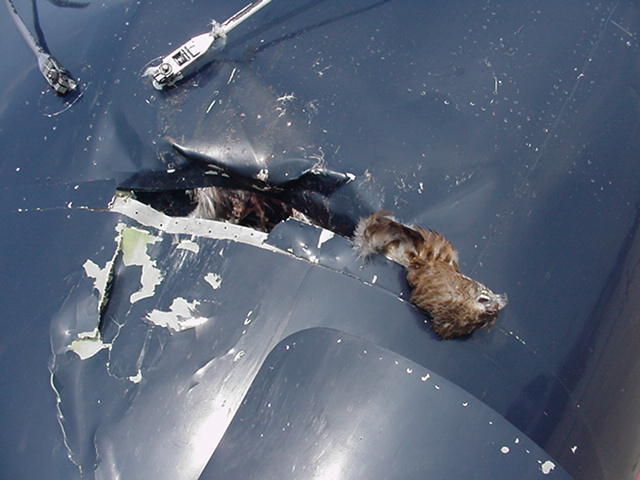
Captain Chesley "Sully" Sullenberger's
heroic Hudson River landing was a good reminder that a twenty pound bird at 200 miles per hour is not so different from a bowling ball shot from a cannon. The results range from minor dents to Flight 1549's disabled engines to the damage below: double-lapped, 1/16” reinforced aluminum totally blown through, and feathers clear to the cockpit.
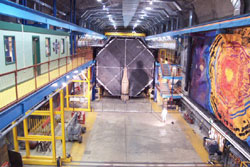
Half a mile underground is probably the last place you might expect to be able to observe atmospheric phenomena. If you knew about the MINOS experiment, however, you might think otherwise. MINOS, which stands for Main Injector Neutrino Oscillation Search, was built to detect particles originating far away but of terrestrial origin.
Recently, researchers have noticed that the detectors at MINOS occasionally detect particles from the atmosphere, and that these detections correlate with weather patterns in the high atmosphere.
Did a catastrophic flood of biblical proportions occur, as stated in the story of Noah's Ark? If so, it may have been the shores of the Black Sea that were drowned 9,500 years ago, wiping out early Neolithic settlements around its perimeter.
Imaging systems, artificial intelligence and computer programs for facial recognition could get a boost by work from Dr. Adrian Dyer of Monash University, one of Australia's leading bee experts - he says his latest research shows that honeybees can learn to recognize human faces even when seen from different viewpoints.
The findings show that despite the highly constrained neural resources of the insects (their brains are 0.01 per cent the size of the human brain) their ability has evolved so that they're able to process complex visual recognition tasks.
A recent theory of aging says that
caloric restriction may do the trick but the research is inconsistent; the mice in the most promising studies were weaned that way, something unlikely to happen in human children. New research says even those studies may not be entirely accurate and that for lean mice – and therefore lean humans, if prior mouse studies were to be taken at face value – caloric restrictions as an anti-aging strategy may be a pointless, frustrating and even dangerous exercise.
But for fat mice, dieting makes sense and will extend life, the researchers say. That goes for people as well.