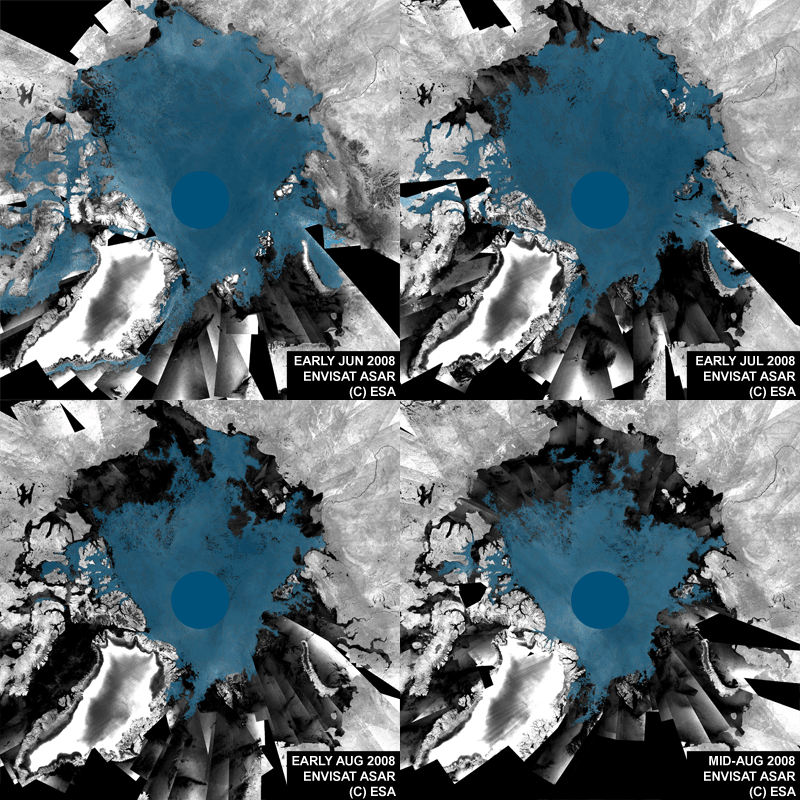





Observations of ice coverage in the Arctic from space began 30 years ago so it's inflammatory to talk about record lows in such a short period of time but two consecutive years near this 'record' still merit some concern.

Because the extent of ice cover is usually at its lowest about mid-September, this year's minimum could still fall and set another record low.

Envisat observations from mid-August depict that a new record of low sea-ice coverage could be reached in a matter of weeks. The animation above is a series of mosaics of the Arctic Ocean created from images acquired between early June and mid-August 2008 from the Advanced Synthetic Aperture Radar (ASAR) instrument aboard Envisat. The dark grey colour represents ice-free areas while blue represents areas covered with sea ice.

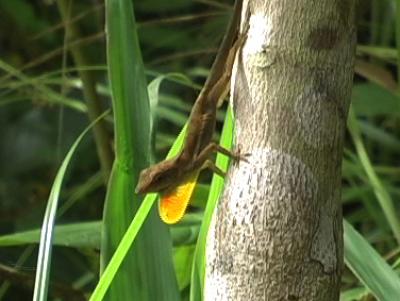
Are male Jamaican anole lizards masking some deep insecurity? Overcompensating for small body parts?

Nothing quite that dramatic, though the reason they begin and end the day with displays of reptilian strength, like push-ups, head bobs and extensions of a colorful neck flap, or dewlap, was unknown until recently.

The answer? Nothing more than wanting to defend their territory, according to a new study.

"Anoles are highly visual species, so in that sense it is not surprising that they would use visual displays to mark territory," said Terry J. Ord, a postdoctoral researcher at UC Davis and at Harvard University's Museum of Comparative Zoology. The lizards are the first animals known to mark dawn and dusk through visual displays, rather than the much better known chirping, tweeting, and other sounding off by birds, frogs, geckos and primates.

If the "Book of Science" were written by a kid it would start by answering some basic questions:

1) How was the universe started?

2) Why do girls put on make-up?

3) Where and when was science first used in the world?

Just as the world keeps spinning, so does the list of questions about science from kids, in this case, one seventh-grade science class taught by Kim Swayze who teaches middle-school science at E.V. Cain in Auburn, CA.

Her students questions reflect concepts and emotions that many other teachers have seen their students grappling with as well.

Muscles are capable of providing an amazing amount of stability to the spine; a normal human spine can experience compressive loads of up to about 1,350 pounds during more demanding everyday tasks (9), and almost 4,000 pounds during something like Olympic weightlifting (2). So why can you hurt your back just by bending down to pick up a pencil or pen? The simple answer is that spinal stability is not a simple function of muscular force.
One way to think about spinal stability is that it is made up of three different components: the spine itself, the muscles surrounding the spine, and the circuitry that is in charge of firing these muscles (11). The neural control unit is the circuitry that coordinates the muscle activity to respond to both expected and unexpected forces. For appropriate spinal stability, this system must fire the right muscles, at the right time, by the right amount, to protect the spine from injury while still allowing the desired movement (1). The muscles surrounding the spine are like the "rigging on a ship's mast," and as such an inappropriate magnitude from just one of them could perturb the fine balance of the mast (10). STOP! Don't pick up that pen!

Most people probably think of change when they hear the word evolution, but some of evolution's most amazing molecular inventions have stuck around hundreds of millions, even billions of years. The complex protein machinery needed to express genes, metabolize energy sources, reproduce sexually, and lay out body plans has remained in place largely unchanged in spite of the tremendous variety we see in the living world. These constant core cellular processes are why biologists could crack the universal genetic code by experimenting with bacteria, and why we gain insight into cell division and cancer by studying yeast.

The big question, argue the authors of The Plausibility of Life, is not how evolution keeps inventing new genes - it's how evolution can produce so much variety when the basic processes change so little. Later in the book Kirschner and Gerhart are going to argue that these basic systems have persisted so long because they are versatile, that they posses features which make them well-suited to facilitating the biological diversity we see today. We'll come to that argument later; today we'll take a closer look at the core conserved molecular systems that carry out the most basic cellular functions.

The geysers of Yellowstone National Park owe their existence to the "Yellowstone hotspot", a region of molten rock buried deep beneath Yellowstone, geologists have found, but how hot is this "hotspot," and what's causing it?

In an effort to find out, Derek Schutt of Colorado State University and Ken Dueker of the University of Wyoming took the hotspot's temperature. They published results in the August, 2008, issue of the journal Geology.

"Yellowstone is located atop of one of the few large volcanic hotspots on Earth," said Schutt. "But though the hot material is a volcanic plume, it's cooler than others of its kind, such as one in Hawaii."

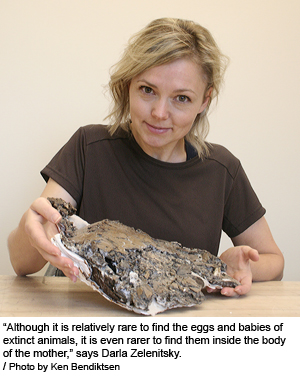
A 75-million-year-old fossil of a pregnant turtle and a nest of fossilized eggs that were discovered in the badlands of southeastern Alberta by scientists and staff from the University of Calgary and the Royal Tyrrell Museum of Palaeontology are yielding new ideas on the evolution of egg-laying and reproduction in turtles and tortoises.

It is the first time the fossil of a pregnant turtle has been found and the description of this discovery was published today in the British journal Biology Letters.

The mother carrying the eggs was found in 1999 by Tyrrell staff while the nest of eggs was discovered in 2005 by U of C scientist Darla Zelenitsky, the lead author of the article and an expert on fossil nest sites, and her field assistant. Both were found about 85 km south of Medicine Hat in the Manyberries area.

New research suggests that preventative agents, such as those found in concentrated black raspberries, may more effectively inhibit cancer development than single agents aimed at shutting down a particular gene.

Researchers at the Ohio State University Comprehensive Cancer Center examined the effect of freeze-dried black raspberries on genes altered by a chemical carcinogen in an animal model of esophageal cancer.

The carcinogen affected the activity of some 2,200 genes in the animals' esophagus in only one week, but 460 of those genes were restored to normal activity in animals that consumed freeze-dried black raspberry powder as part of their diet during the exposure.

The popular phrase, "I have nipples, Greg, could you milk me?" from the 2000 movie "Meet the Parents", is similar to the widely held belief that tomatoes, because of their seeds, are really fruits instead of vegetables.

Botanically, tomatoes are fruits but cucumbers, zucchini, pumpkins, nuts, corn, peppers, peas, and other vegetation that may not seem like it also fit into this fruity category.

Botanists define fruit as any part of a plant that contains both its seed and the ovary that produce that seed. However, of all the botanically fruity plant pieces we commonly call 'vegetables', tomatoes are one food with an especially controversial history of classification.

A powerful collision of galaxy clusters has been captured with NASA's Chandra X-ray Observatory and Hubble Space Telescope. Like its famous cousin, the so-called Bullet Cluster, this clash of clusters provides striking evidence for dark matter and insight into its properties.

Like the Bullet Cluster, this newly studied cluster, officially known as MACSJ0025.4-1222, shows a clear separation between dark and ordinary matter. This helps answer a crucial question about whether dark matter interacts with itself in ways other than via gravitational forces.