




A fascinating story in the New York Times today on kin recognition in plants (see Plants Found to Show Preferences for Their Relatives ). They report
Now - I confess I was really impressed with how ASM handled this enormous meeting I was just at. If you are going to have a big meeting, ASM does a smashing job. And I can see how such big meetings can have their appeal - the diversity of work and activities relating to Microbiology are amazing. However, big meetings are still not my cup of tea. So here is my top 10 list of "You know the conference you are at is too big when ..." and all are based on experiences from this meeting.
Well, I just gave my talk on phylogenomic and functional predictions and am going to try and catch up with blogging.
In my talk I discussed how an understanding of function and prediction of function requires an understanding of how functions have evolved. I am trying to get my talk slides posted here but, alas, I need to deal with some Copyright issues first (OK - here is a little slideshow of my talk ... no audio sorry)

Patricia Babbitt gave a talk after mine on another aspect of phylogenomics and functional predictions. She has done some really interesting studies (see her lab site here) of functional diversifications and the molecular level by integrating genomic, structural, biochemical and phylogenetic analyses. She showed some really nice tools for clustering and visualization protein families that, although not phylogenetic, seemed to be very useful for the onslaught of genome data. Unfortunately, most of her publications are not in OA journals so I cannot use any of the figures here and am not going to bother linking to the papers.

In biology, everything has a history. Creationists love to try to calculate the probability of a new gene spontaneously coming into existence, but that's not how genes are born. New genes most often come from other genes: one gene gets duplicated by a freak accident (like the accidental duplication of a chunk of chromosome, a whole chromosome, or even an entire genome), so that you suddenly have a cell with two working copies of the same gene. As time goes on (that is, time on an evolutionary scale), those two duplicate genes start to divide up the work that was originally done by just one gene. One copy might end up specializing in one particular task, picking up mutations along the way that gradually transform this copy into an independent gene in its own right, with its own specialized function. From one gene, you get two, each with a distinct role in the cell.

It sounds like a nice evolutionary story, but do scientists have any real examples of duplicate genes evolving new functions?

Star players make better basketball coaches, according to research by scholars at the University of Warwick and Cornell University. The research is further evidence that experts in their field rather than generalists typically make the best leaders in organizations.

Using data from 15,000 basketball games between 1996 and 2004, the authors learned that the US’s premier basketball teams in the NBA tend to win more games if led by coaches who were good players or if they had long playing careers, controlling for other factors that affect team performance. That upholds the authors’ hypothesis that, across many kinds of industry, it is experts in their field who typically make the best leaders.

In the current US NBA finals, the Lakers’ coach, Phil Jackson, is tied with the Celtics’ legendary Red Auerbach for the most championships as a head coach (nine) and has the second best career regular-season winning percentage (0.700) of all time.

Researchers in Spain have proven that metamaterials, materials defined by their unusual man-made cellular structure, can be designed to produce an acoustic cloak - a cloak that can make objects impervious to sound waves, literally diverting sound waves around an object.

The research, 'Acoustic cloaking in two dimensions: a feasible approach', published today, Friday, 13 June, 2008, in the New Journal of Physics (NJP), builds on recent theoretical research which has sought ways to produce materials that can hide objects from sound, sight and x-rays.

Daniel Torrent and José Sánchez-Dehesa from the Wave Phenomena Group, Department of Electronics Engineering at the Polytechnic University of Valencia, cite theoretical work published early last year in NJP by researchers from Duke University in North Carolina, US, as the starting point for their more practical approach.

With the proper spin, forests can be the cause of global warming. They produce methane. American environmentalists have an irrational dislike of nuclear power so they forced America to use more coal so they can be blamed for the spike in CO2.

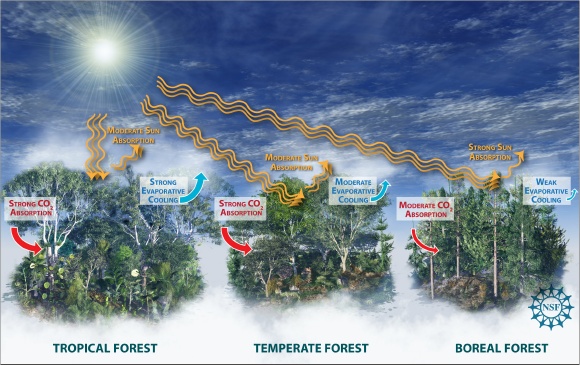
It takes understanding to go beyond perspective and detailed analysis of the forests impact on climate change is still sketchy. There are roughly 42 million square kilometers of forest on Earth, a swath that covers almost a third of the land surface, and those wooded environments play a key role in both mitigating and enhancing global warming.

The teeming life of forests, and the physical structures containing them, are in continuous flux with incoming solar energy, the atmosphere, the water cycle and the carbon cycle--in addition to the influences of human activities. The complex relationships both add and subtract from the equations that dictate the warming of the planet.

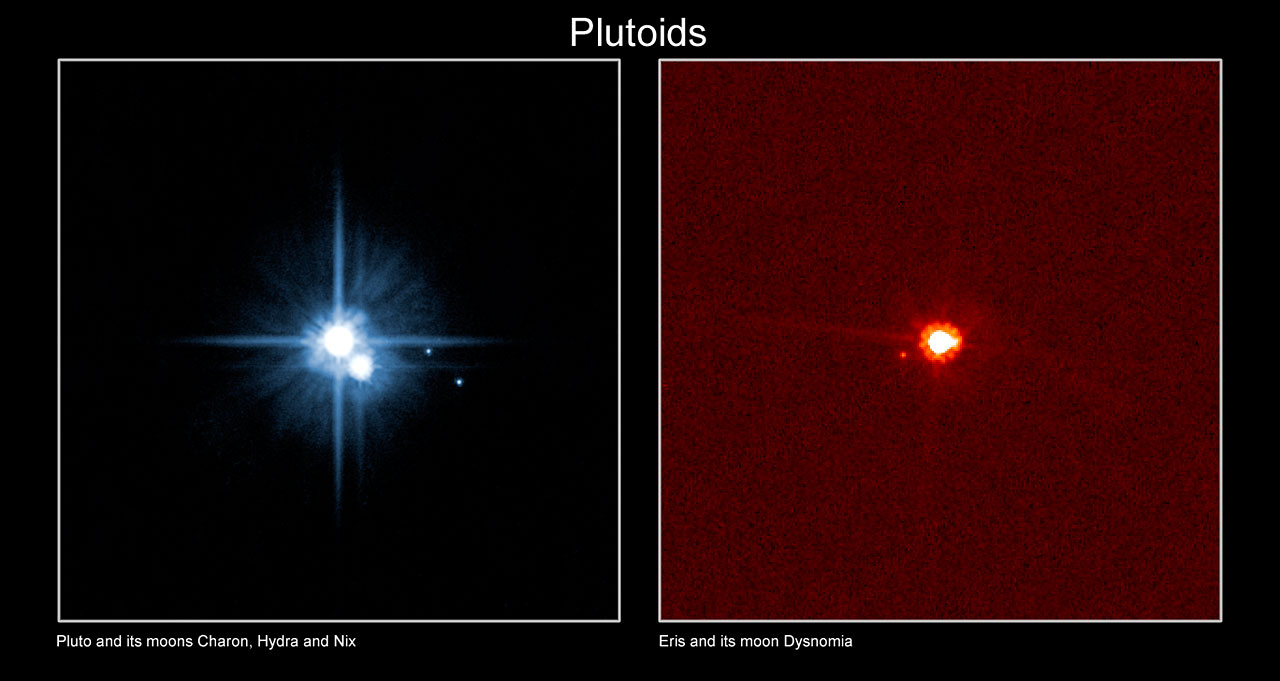
Almost two years after the International Astronomical Union (IAU) General Assembly introduced the category of dwarf planets, the IAU, as promised, has decided on a name for transneptunian dwarf planets similar to Pluto.

The name plutoid was proposed by the members of the IAU Committee on Small Body Nomenclature (CSBN), accepted by the Board of Division III, by the IAU Working Group for Planetary System Nomenclature (WGPSN) and approved by the IAU Executive Committee at its recent meeting in Oslo, Norway.

Plutoids are celestial bodies in orbit around the Sun at a distance greater than that of Neptune that have sufficient mass for their self-gravity to overcome rigid body forces so that they assume a hydrostatic equilibrium (near-spherical) shape, and that have not cleared the neighbourhood around their orbit. The two known and named plutoids are Pluto and Eris. It is expected that more plutoids will be named as science progresses and new discoveries are made.

Genetically modified foods are the enemy, say some activists, but organic foods have caused all the salmonella say others. The food safety message is a mess and Americans lack confidence in the system because of it.

A new national study conducted by the Harvard School of Public Health Project on the Public and Biological Security finds that, though there have been food safety incidents in recent years, Americans are confident that the food produced in the United States is safe but have concerns about the safety of imported food produced in some other countries.

The poll found that a majority of Americans believe that the food produced in the U.S. is either very (37%) or somewhat (58%) safe. Only 4% thought US-produced foods were unsafe. When asked about foods available in the U.S. but produced in other countries, fewer than one in ten (6%) considered foods from Canada to be unsafe. In contrast, almost half of Americans (47%) thought food from Mexico was unsafe, and 56% thought this about food from China. Possibly responding to these concerns, about half (53%) of Americans reported at least sometimes looking for information about what countries foods come from when shopping for groceries.

Silicone breasts for a football star's girlfriend, aging Hollywood actresses with doll-like, over-tightened faces - all this could soon be a matter of the past.

Cosmetic surgery is developing into an interdisciplinary medicine of beauty and rejuvenation which has only little use for silicone and scalpel.New cosmetic surgery relies to an important part on minimal-invasive, gentle surgery, done under local anaesthesia. Liposuction by use of microcannulas offers a good example, being easy on the tissue and allowing for precise shaping of body and face, followed by only minimal aftercare.

The second pillar on which new cosmetic surgery rests is the use of body-own stem cells. These allow for lasting breast augmentation without silicone and have made operations such as standard facelift, lid correction and wrinkle treatment with "fillers" obsolete. Stem cells have shown immediate rejuvenating and regenerating local effects and can be used for many aesthetic treatments.


