







Bacteria are ubiquitous on Earth. They've been found from the upper reaches of the atmosphere to miles below the ocean floor. Because of their ubiquity, scientists have long believed bacteria to be cosmopolitan, having similar genetic histories across the globe.

Curing cancer with 'natural' products used to be dismissed as shaman quackery but many chemotherapies that fight cancer in modern medicine are natural products or were developed on the basis of natural substances. Thus, taxanes used in prostate and breast cancer treatment are made from yew trees. The popular periwinkle plant, which grows along the ground of many front yards, is the source of vinca alkaloids that are effective, for example, against malignant lymphomas. The modern anti-cancer drugs topotecan and irinotecan are derived from a constituent of the Chinese Happy Tree.

Looking for new compounds, doctors and scientists are increasingly focusing on substances from plants used in traditional medicine. About three quarters of the natural pharmaceutical compounds commonly used today are derived from plants of the traditional medicine of the people in various parts of the world. The chances of finding new substances with interesting working profiles in traditional medicinal plants are better than in common-or-garden botany.

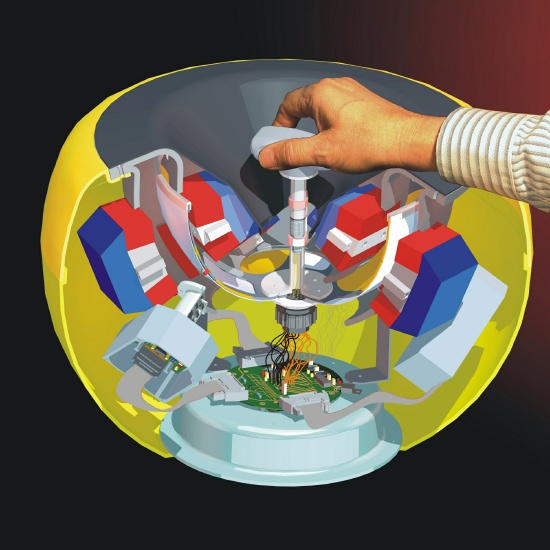
Computers are commonly used as tools to design and manipulate three-dimensional objects but soon they may provide people with a way to sense the texture of those objects or feel how they fit together, says the creator of a haptic, or touch-based, interface at Carnegie Mellon University.

Most haptic interfaces rely on motors and mechanical linkages to provide some sense of touch or force feedback but the device developed by Ralph Hollis, research professor in Carnegie Mellon’s Robotics Institute, uses magnetic levitation and a single moving part to give users a highly realistic experience. Users can perceive textures, feel hard contacts and notice even slight changes in position while using an interface that responds rapidly to movements.

Happiness in life is as much down to having the right genetic mix as it is to personal circumstances according to a recent study.

Psychologists at the University of Edinburgh working with researchers at Queensland Institute for Medical Research in Australia found that happiness is partly determined by personality traits and that both personality and happiness are largely hereditary.

My observations:

1. The first task I used to measure my mental function at frequent intervals (e.g., every 30 minutes) resembled an typical cognitive psych task. It wasn’t fun and I had to push myself to do it.

2. I made another test to do the same thing based on the lessons I drew from bilboquet. It consisted of tracking circles around the screen. It was mildly fun.

The exchange of genetic material between two closely related strains of the influenza A virus may have caused the 1947 and 1951 human flu epidemics, according to biologists.

The findings could help explain why some strains cause major pandemics and others lead to seasonal epidemics. Until now, it was believed that while reassortment – when human influenza viruses swap genes with influenza viruses that infect birds – causes severe pandemics, such as the ‘Spanish’ flu of 1918, the ‘Asian’ flu of 1957, and the ‘Hong Kong’ flu of 1968, while viral mutation leads to regular influenza epidemics.

But it has been a mystery why there are sometimes very severe epidemics – like the ones in 1947 and 1951 – that look and act like pandemics, even though no human-bird viral reassortment event occurred.

Biologists at the University of Pennsylvania and Harvard University have examined the complete genomes of viruses that infect the bacteria E. coli, P. aeruginosa and L. lactis and have found that many of these viral genomes exhibit codon bias, the tendency to preferentially encode a protein with a particular spelling.

Researchers analyzed patterns of codon usage across 74 bacteriophages using the concept of a "genome landscape," a method of visualizing long-range patterns in a genome sequence.

Their findings extend the translational theory of codon bias to the viral kingdom, demonstrating that the viral genome is selected to obey the preferences of its host.

A dietary supplement called NutraStem, also known as NT-020, is a proprietary formulation of blueberry, green tea, vitamin D3 and carnosine extracts - a combination of nutritional ingredients thought to be potent in protecting against brain damage.

“Stroke is the third leading cause of death and the leading cause for disability in the U.S. with two of every 1,000 adults experiencing their firsts stroke in any given year,” said Cesar V. Borlongan, PhD, of the Medical College of Georgia, lead author of a study that tested NT-020 post stroke effects in animal models. “We explored how increasing the nutritive diet through NT-020 supplementation might render a therapeutically potent neurogenesis following stroke.”

Penn engineers have developed a model that shows while metals tend to be stronger at nanoscale volumes, their strengths saturate at around 10-50 nanometers diameter, at which point they also become more sensitive to temperature and strain rate.

Using this model, they have found that, while metals tend to be stronger at nanoscale volumes, their strengths saturate at around 10-50 nanometers diameter, at which point they also become more sensitive to temperature and strain rate.

Researchers at MIT Lincoln Laboratory have developed a powerful sensor that can detect airborne pathogens such as anthrax and smallpox in less than three minutes.

The new device, called PANTHER (for PAthogen Notification for THreatening Environmental Releases), represents a "significant advance" over any other sensor, said James Harper of Lincoln Lab's Biosensor and Molecular Technologies Group. Current sensors take at least 20 minutes to detect harmful bacteria or viruses in the air, but the PANTHER sensors can do detection and identification in less than 3 minutes.


