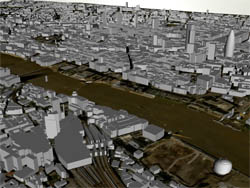









A new way of looking at cities has emerged during the last 20 years that could revolutionise planning and ultimately benefit city dwellers.

‘The Size, Scale and Shape of Cities’ in Science advocates an integrated approach to the theory of how cities evolve by linking urban economics and transportation behaviour with developments in network science, allometric growth and fractal geometry.

Professor Batty argues that planning’s reliance on the imposition of idealised geometric plans upon cities is rooted in the nineteenth century attitude which viewed cities as chaotic, sprawling and dirty.

Researchers at Dana-Farber Cancer Institute have found a previously unknown molecular pathway in mice that spurs the growth of new blood vessels when body parts are jeopardized by poor circulation.

At present, their observation adds to the understanding of blood vessel formation. In the future, though, the researchers suggest it is possible that the pathway could be manipulated as a means of treating heart and blood vessel diseases and cancer.

Bruce Spiegelman, PhD, and his colleagues at Dana-Farber discovered that PGC-1alpha – a key metabolic regulatory molecule – senses a dangerously low level of oxygen and nutrients when circulation is cut off and then triggers the formation of new blood vessels to re-supply the oxygen-starved area – a process known as angiogenesis.

Deadly emerging diseases have risen steeply across the world and an international research team has provided the first scientific evidence mapping the outbreaks’ main sources.

They say:

New diseases originating from wild animals in poor nations are the greatest threat to humans and;

Expansion of humans into shrinking pockets of biodiversity and resulting contacts with wildlife are the reason.

Meanwhile, richer nations are nursing other outbreaks, including multidrug-resistant pathogen strains, through overuse of antibiotics, centralized food processing and other technologies.


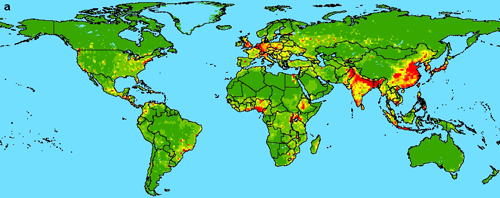
Zoonotic pathogens passed from wildlife to people, from lowest occurrence (green) to highest (red).

University of Michigan scientists and their colleagues at the National Institute on Aging have produced the largest and most detailed worldwide study of human genetic variation, a treasure trove offering new insights into early migrations out of Africa and across the globe.

Like astronomers who build ever-larger telescopes to peer deeper into space, population geneticists like Noah Rosenberg are using the latest genetic tools to probe DNA molecules in unprecedented detail, uncovering new clues to humanity's origins.

The latest study characterizes more than 500,000 DNA markers in the human genome and examines variations across 29 populations on five continents.


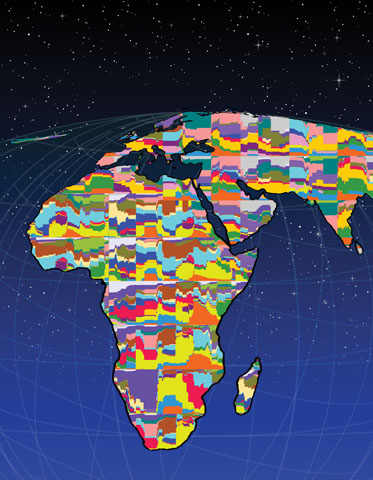
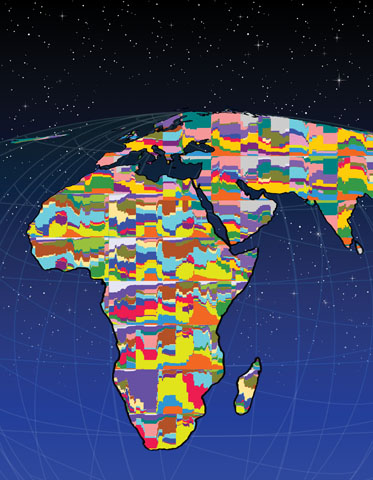
A schematic of worldwide human genetic vari

A team of researchers has discovered the remains in Madagascar of what may be the largest frog ever to exist.

The 16-inch, 10-pound ancient frog, scientifically named Beelzebufo, or devil frog, links a group of frogs that lived 65 to 70 million years ago with frogs living today in South America.

Discovery of the voracious predatory fossil frog is significant in that it may provide direct evidence of a one-time land connection between Madagascar, the largest island off Africa's southeast coast, and South America.


Beelzebufo. This ain't your daddy's giant devil frog. Credit: SUNY-Stony Brook

A straight line may be the shortest distance between two points, but it isn’t necessarily the fastest or easiest path to follow.

That’s particularly true when terrain is not level, and now researchers have developed a mathematical model showing that a zigzag course provides the most efficient way for humans to go up or down steep slopes.

Human migration from Africa to Europe more than 30,000 years ago is still visible in the genes of Europeans today - and because the numbers were small, the harmful variations were magnified as time passed.

A study in the Feb. 21 issue of Nature compared more than 10,000 sequenced genes from 15 African-Americans and 20 European-Americans. The results suggest that European populations have proportionately more harmful variations, though it is unclear what effects these variations actually may have on the overall health of Europeans.

Computer simulations suggest that the first Europeans comprised small and less diverse populations. That would have allowed mildly harmful genetic variations within those populations to become more frequent over time, the researchers report.

You may not be aware of it - they might not be aware of it, but the people in your work environment might be slowing you down.

New research by University of Calgary, Faculty of Kinesiology researcher Dr. Tim Welsh says that regardless of their intentions, having an individual working on a different task - within your field of vision - could be enough to slow down your performance.

“Imagine a situation like a complex assembly line,” said Welsh If you are doing a particular task and the person across from you is doing a different task, you’ll be slowed down regardless of their performance.”

There are several human characteristics considered to be genetically predetermined and evolutionarily innate, such as immune system strength, physical adaptations and even sex differences. These qualities drive the nature versus nurture debate and ask of our species, who is more successful and why?

Psychologists Agneta Herlitz and Jenny Rehnman in Stockholm, Sweden asked an even more complicated question of human predisposition: Does one’s sex influence his or her ability to remember every day events? Their surprising findings did in fact determine significant sex differences in episodic memory, a type of long-term memory based on personal experiences, favoring women.

The possibility of generating hydrogen from sea water using sunlight energy is now one step closer, say scientists at Atmos Technologies. They claim to have successfully developed a completely new, environmentally friendly technique for the production of photo voltaic diodes at a lower cost and with a substantially lower carbon footprint than that created by conventional methods.

They say the hydrogen produced using their technology can be generated economically and efficiently and utilized either in fuel cells or in conventional engines as a replacement for petrol. Current techniques cost more in energy to generate the hydrogen than what is given out when the hydrogen is used.


