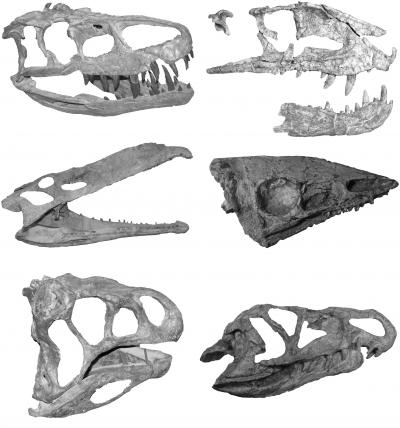










Depending on if you are pro- or con- on the dinosaur issue, you have good or bad things to say. While dinosaurs dominated land for well over 100 million years and evolved into numerous species, they still got snuffed out rather suddenly 65 million years ago. epitomize both success and failure. Failure because they went extinct suddenly 65 million years ago; success because they dominated terrestrial ecosystems for well over 100 million years evolving into a wide array of species that reached tremendous sizes.

University of Bristol researchers Steve Brusatte and Professor Mike Benton say it was just bad luck, and that's okay, because it was only good luck that made them dominant in the first place. This defies conventional thinking that some feature or characteristic helped them out-compete other vertebrate groups.

Like crocodiles, say Brusatte and Benton. They examined the evolution of dinosaurs and their closest competitors during the Triassic period (251 to 199 million years ago)and identified the the crurotarsan archosaurs, a large group of animals that are closely related to crocodiles, as the most likely 'competitors' to early dinosaurs. The other part of the group Archosauria are dinosaurs and their descendants, the birds.

We hear lots of concern about global warming and the world's rainforests, though they have even begun to thrive under warming conditions - but what about ancient rainforests, long before the Dawn of Man and the destruction we apparently set into motion just by evolving?

The answer lies in underground coalmines in Illinois.

There lay the remains of the first tropical rainforests to evolve on our planet around 300 million years - when the USA lay on the equator. An amazing feature of the forests is that they are preserved over a vast area. One example covers 10,000 hectares - the size of a city.

Our brains contain their own navigation system much like satellite navigation ("sat-nav"), with in-built maps, grids and compasses, neuroscientist Dr Hugo Spiers told the BA Festival of Science at the University of Liverpool today. The brain's navigation mechanism resides in an area know as the hippocampus, which is responsible for learning and memory and famously shown to be different in London taxi drivers in a Wellcome Trust-funded study carried out by Professor Eleanor Maguire at UCL (University College London).

That's right, cabbies have better brains for GPS. The study showed that a region of the hippocampus was enlarged in London taxi drivers compared to the general population. Even bus drivers do not have the same enlarged area, and general skill at navigating is not related to hippocampus size, suggesting that the difference is linked to 'The Knowledge' of the city's 250,000 streets built up by taxi drivers over many years.

Prof. Leonid Yaroslavsky from Tel Aviv University believes that humans may have an ability to "see" colors and shapes - with their skin.

He outlines his 'optic-less imaging model' in a chapter of a new book, "Advances in Information Optics and Photonics", and even says it could lead to a new form of optical imaging technology that beats the limitations of today's lens-based imaging devices. This model, he says, may also explain how a controversial primordial instinct might have evolved over millions of years.

Mayo Clinic investigators have demonstrated that stem cells can be used to regenerate heart tissue to treat dilated cardiomyopathy, a congenital defect, according to research published in Stem Cells.

The study expands on the use of embryonic stem cells to regenerate tissue and repair damage after heart attacks and demonstrates that stem cells also can repair the inherited causes of heart failure.

The team reproduced prominent features of human malignant heart failure in a series of genetically altered mice. Specifically, the "knockout" of a critical heart-protective protein known as the KATP channel compromised heart contractions and caused ventricular dilation or heart enlargement.


Natarajan found that ultra-massive black holes, which lurk in the centers of huge galaxy clusters like the one above, seem to have an upper mass limit of 10 billion times that of the Sun. (Credit: NASA)

There appears to be an upper limit to how big the universe’s most massive black holes can get, according to new research led by Yale University astrophysicist Priyamvada Natarajan and Ezequiel Treister, a postdoctoral fellow at the University of Hawaii.

The University of Southampton is launching the world's largest-ever study of near-death experiences this week.

The AWARE (AWAreness during REsuscitation) study is to be launched by the Human Consciousness Project of the University of Southampton - an international collaboration of scientists and physicians who have joined forces to study the human brain, consciousness and clinical death.

The study is led by Dr Sam Parnia, an expert in the field of consciousness during clinical death, together with Dr Peter Fenwick and Professors Stephen Holgate and Robert Peveler of the University of Southampton. Following a successful 18-month pilot phase at selected hospitals in the UK, the study is now being expanded to include other centres within the UK, mainland Europe and North America.

Yeast, the essential microorganism for fermentation in the brewing of beer, converts carbohydrates into alcohol and other products that influence appearance, aroma, and taste. In a study published online today in Genome Research, researchers have identified the genomic origins of the lager yeast Saccharomyces pastorianus, which could help brewers to better control the brewing process.

For thousands of years, ale-type beers have been brewed with Saccharomyces cerevisiae (brewer's or baker's yeast). In contrast, lager beer, which utilizes fermentations carried out at much lower temperature than for ale, is a more recently developed alcoholic beverage, appearing in Bavaria near the end of the Middle Ages.

Arthroscopic surgery is widely accepted as an effective treatment for osteoarthritis of the knee. It's a minimally invasive surgical procedure involving insertion of an arthroscope and other instruments into the joint through small incisions in order to remove cartilage fragments and smooth the joint surfaces. Osteoarthritis is the most common form of arthritis affecting one in ten Canadians and 27 million Americans.

A landmark study conducted in London, Canada at The University of Western Ontario and Lawson Health Research Institute shows that a routinely practiced knee surgery is ineffective at reducing joint pain or improving joint function for sufferers of osteoarthritis. The study appears in the September 11th New England Journal of Medicine.

SAO PAULO, Brazil, September 11 /PRNewswire/ --

- Agreement signed with OnAir will make the company the first in the Americas to offer this technology

TAM Linhas Aereas (Bovespa: TAMM4 and NYSE: TAM) will be the first airline in the Americas to offer onboard mobile phone service on its Airbus A320s, to be provided by OnAir -- a joint venture of Airbus and Sita, an organization that develops cutting edge technology for aviation. A trail-blazing partnership signed with the company will enable TAM passengers to use their cell phones and smartphones in flight -- for voice, SMS messaging or emails -- on South American routes.

(Logo: http://www.newscom.com/cgi-bin/prnh/20080221/SPTH002LOGO )

