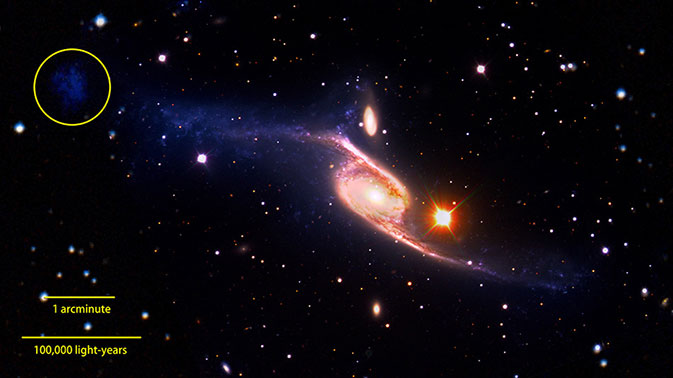




The barred spiral galaxy NGC 6872 has been considered a candidate for the biggest stellar system for decades and now a team of astronomers has officially crowned it the largest - so far.

A new study indicates that  thousands of individuals have had kidneys removed unnecessarily because doctors misdiagnosed their disease.

20% of individuals with kidney tumors common in patients with tuberous sclerosis complex (TSC), a genetic disorder, has had a kidney removed. 40% had some kind of surgical procedure performed. Better diagnosis could have led to treatment that would have made surgery or kidney removal unnecessary, according to John Bissler, MD, a nephrologist at Cincinnati Children's Hospital Medical Center and lead author of the study. 

While corn ethanol was always a bad idea, biofuels themselves have a potential.

Perennial biofuel crops miscanthus, switchgrass, and mixed prairie species have shown high yields in producing ethanol, and a 4-year University of Illinois study has found another beneficial characteristic – the ability to reduce the escape of nitrogen in the environment.

The study compared miscanthus, switchgrass, and mixed prairie species to typical corn-corn-soybean rotations and each of the perennial crops were highly efficient at reducing nitrogen losses, with miscanthus having the greatest yield. 

Harvested biomass and nitrogen, nitrous oxide emissions, and nitrate leaching in the mid-soil profile and through tile drainage lines were all measured.

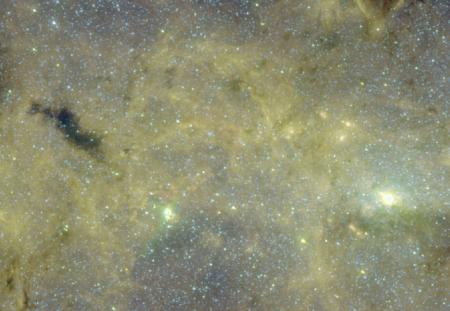
There's a mystery in them there clouds - but astronomers at Caltech are on the case.

Near the crowded galactic center, billowing clouds of gas and dust hide a supermassive black hole 3,000,000X as massive as our sun, Its gravity is strong enough to grip stars that are whipping around it at thousands of kilometers per second. One particular cloud named G0.253+0.016
has delighted astronomers. Because scientists love a mystery. 

G0.253+0.016 defies the rules of star formation. But apparently those are more guidelines than rules.

Students everywhere, put down those highlighters and pick up some flashcards! Some of the most popular study strategies, like highlighting and even re-reading, don't show much promise for improving student learning, according to a new paper.

In the article, psychologist John Dunlosky of Kent State University and colleagues review ten learning techniques commonly used by students.

Based on the available evidence, they provide recommendations about the applicability and usefulness of each technique.

People view brown-eyed faces as more trustworthy than those with blue eyes- unless the blue eyes belong to a man with a broad face, according to a new paper in PLOS ONE

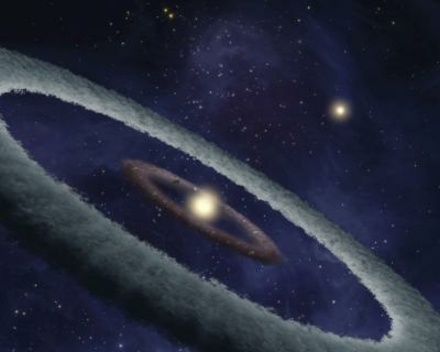
Vega is the second brightest star in northern night skies and astronomers using the Infrared Space Telescopes have discovered an asteroid belt much like that of our sun. 

Results showing an asteroid belt around Vega makes it more similar to its twin, the star called Fomalhaut. Both stars now are known to have inner, warm asteroid belts and outer, comet-filled belts, similar in architecture to the asteroid and Kuiper belts in our own solar system.

Writing in JAMA, a group of researchers say the way to curb gun violence is to treat guns as a public health awareness issue, the way we do awareness campaigns against cigarettes and drunk driving.

So media, celebrities and the public should "de-glorify" guns the same way, though the efficacy of the campaigns they list is suspect.  In movies, directors now make sure the edgy, rebellious person smokes, in order to show how edgy and rebellious they are. And marijuana use is actually being encouraged in lots of the same states that ban cigarettes in bars despite billions of dollars in awareness campaigns about the dangers of drugs.

A popular hypothetical alternative to Albert Einstein's theory for the acceleration of the expansion of the universe does not fit newly obtained data on a fundamental constant, the proton to electron mass ratio, which may mean the need for a new direction in learning about accelerating expansion.

To explain the acceleration of the expansion of the universe, astrophysicists have invoked dark energy – a hypothetical form of energy that permeates all of space. A popular concept of dark energy does not fit new results on the value of the proton mass divided by the electron mass in the early universe. The predicted change in the ratio by the dark energy theory, generally referred to as rolling scalar fields, don't fit the new data.

The Tree of Life is what Charles Darwin first sketched in 1837 to show how species evolved by natural selection. The diagram started at a central point with a common ancestor, then the lines spread apart as organisms evolved and separated into distinct species. The letters represented species.

