



American women extol the technical educations of women in India - it may be that so many women in India are intent on getting a technical degree so they can get out of India. While sexual violence is getting all the current media attention, sexism and other bias are persistent.  The male bias is even evident in in women's health care - a woman in India is more likely to get prenatal care when pregnant with boys, according to a new paper by Leah Lakdawala of Michigan State University and Prashant Bharadwaj of the University of California, San Diego, which suggests sex discrimination in male-dominated societies starts early - even in the womb.

I think I wrote a post about the "definitive results" of the CDF and DZERO experiments on the search for the Higgs boson at least a couple of times already in the past, but you know, these busy experimentalists continue to improve their analyses, adding previously incomplete information, combining results, tweaking and improving things here and there. It is only natural that on such an important topic as the observation of the Standard Model Higgs boson the Tevatron folks were not ready to give up just yet.

Solar cells act something like leaves, capturing sunlight and turning it into energy - unfortunately the manufacturing of solar cells, unlike trees, is something of an environmental disaster. From rare earth metals to all kinds of other materials due to substrates and cells, solar panels have to function for decades before they break even, as far as any ecological savings are considered.
 
If only solar cells could instead be made from trees.

Georgia Tech and Purdue researchers say they have done it; they have developed efficient solar cells using natural substrates derived from trees. Just as importantly, by fabricating them on cellulose nanocrystal (CNC) substrates, the solar cells can be quickly recycled in water at the end of their life cycle.

Carbon dioxide created by the widespread burning of fossil fuels is the key factor in climate change, so researchers are looking for new ways to generate cleaner power. 

Researchers from the University of Georgia have shown they can take the carbon dioxide trapped in the atmosphere and turn it into industrial products - a roadmap to biofuels made directly from the carbon dioxide in the air. 

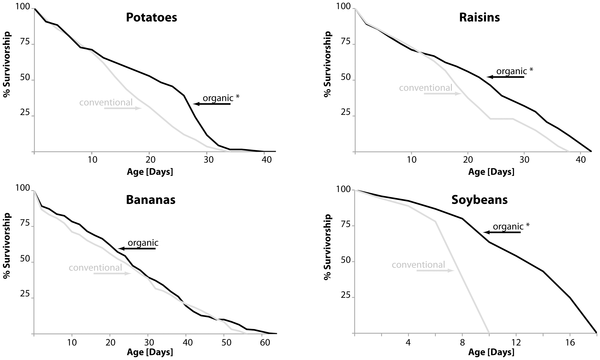
A new study led by Ria Chhabra, a student at Clark High School in Plano, Texas, set out to see if organic food is healthier than conventional food - and it was. In fruit flies. With some conditions.

Chhabra sought to conduct the experiments after hearing her parents discuss whether it's worth it to buy organic foods. Southern Methodist University biologist Johannes H. Bauer, principal investigator for the study, mentored Chhabra by helping guide and design her research experiments. The research focus of Bauer's fruit fly lab is nutrition and its relationship to longevity, health and diabetes. 

Though every election has high-profile female candidates and elected officials, a new paper conducted by American University Women and Politics Institute director Jennifer L. Lawless and Richard L. Fox of Loyola Marymount University says that young women are less likely than young men ever to have considered running for office, to express interest in a candidacy at some point in the future, or to consider elective office a desirable profession.  

It is well established that the hippocampus is central for learning and memory, encoding mnemonic data about past experiences and connections. However, the role of the hippocampus in emotional processes is less clear, although there have been inklings of evidence in the past suggesting that the hippocampus does indeed play a role in fear and anxiety.

Two manuscripts related to the ancestral wheat genomes of Triticum urartu and Aegilops tauschii  provide an unprecedented glimpse into the adaptation and domestication of wheat throughout the ages and shedding light on the biology of the world's primary staple crop. 

If 41 percent of the human genome is covered by longer DNA patents that often cover whole genes, and so many genes share similar sequences within their genetic structure that if all of the "short sequence" patents were allowed in aggregate they could account for 100 percent of the genome, then you don't own your genes.

Women may be terrible drivers but their abilities to make fair decisions when competing interests are at stake make them better corporate leaders, humanities scholars have found.

