



While perusing the news last night, I was horrified to come across a set of articles telling me that less sleep is better for academic performance.  If that’s the case, I should be in tip-top mental shape right now, because the reporting on that study was bad enough to keep me tossing and turning in scientific consternation.
The Heartland Institute and Murdoch Media

The Heartland Institute story broke on February 14th.  The revelation that anti-science bunkum has been funded by corporate dollars was no surprise to those of us who have been investigating these propaganda mills.  Peter H Gleik has confirmed that he was the one who obtained the secret documents.  In confirming that he got them straight from the Heartland Institute he also confirms their authenticity.
In the midst of CNN's non-stop coverage of a deceased singer whose biggest career hit was a cover of a Dolly Parton song, there may be a ray of rational sunlight shining down on a person worthy of our time; an accomplished military veteran, test pilot, Mercury astronaut and Senator named John Glenn.  50 years ago the 40-year-old Marine lieutenant sat atop a building-sized rocket stuffed with solid propellant and left the confines of Earth - backwards.
Nobel Prize winner Jack Szostak recently wrote an opinion piece titled "Attempts to Define Life Do Not Help to Understand the Origin of Life" which was published in the Journal of Biomolecular Structure and Dynamics. (open access, so you can read it free of charge)
 
The view he expressed was given respectful coverage by Carl Zimmer in his widely publicised article "Can Science Define Life in Three Words", the only blemish from the usually perceptive Zimmer in an otherwise interesting and balanced article.
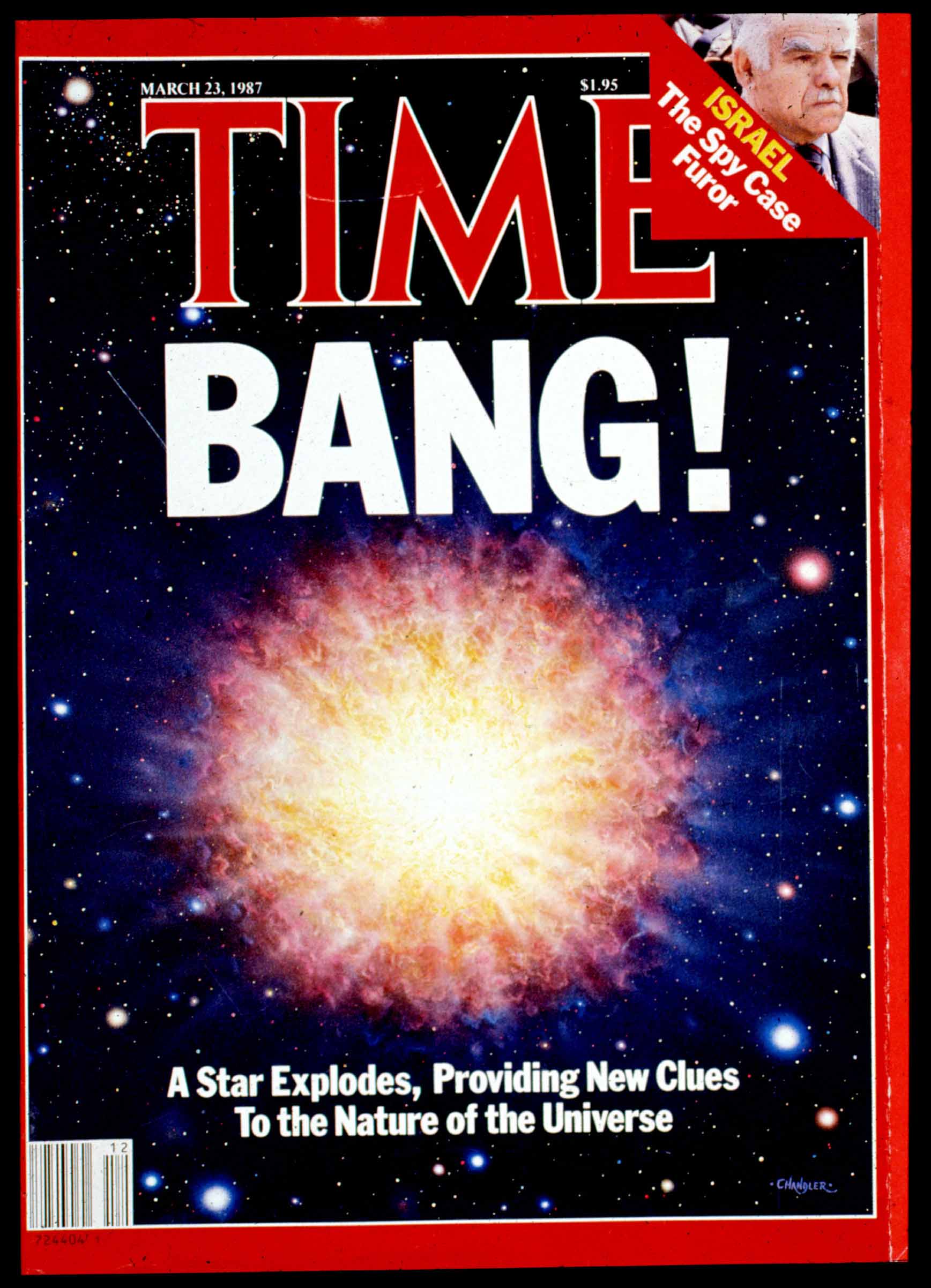
February 23rd 1987 is a day indelibly imprinted on the minds of everyone interested in astrophysics. At 7:36 GMT that day, now 25 years ago, the big one hit us. There was no escape. For 13 seconds a tsunami of neutrinos, emanating from a giant star eleven billion times more distant than the sun, flooded earth. This wave of neutrinos paled the steady stream of neutrinos reaching us from the sun by a factor of more than ten thousand.

Yet no one noticed.
A nice new search for heavy quarks has been completed by the ATLAS collaboration in 7 TeV proton-proton collisions data collected in 2011. The ideas behind the search are instructive to describe, so I will spend some time trying to do that before I discuss the results and their meaning.

Quarks: properties and decays
Last month, we were treated to the biggest solar storm since 2005, generating some of the most dazzling northern lights in recent memory. The source of that storm, and others like it, was the sun's magnetic field, described by invisible field lines that protrude from and loop back into the burning ball of gas. Sometimes these field lines break—snapping like a rubber band pulled too tight—and join with other nearby lines, releasing energy that can then launch bursts of plasma known as solar flares. Huge chunks of plasma from the sun's surface can hurtle toward Earth and damage orbiting satellites or bump them off their paths.

Signals can tell cells to act cancerous, surviving, growing and reproducing out of control. And signals can also tell cells with cancerous characteristics to stop growing or to die. In breast cancer, one tricky signal called TGF-beta does both – sometimes promoting tumors and sometimes suppressing them.

A study recently published in the journal Oncogene details how tumors may flip the TGF-beta signalling switch, allowing doctors to delete the pathway entirely when it promotes tumors, and leave it intact when it’s still working to suppress them.

