
The three conditions mentioned in the title, malaria, HIV and tuberculosis, are responsible for about 5 million deaths per year and thus constitute some of the most compelling challenges in biomedical research. Slowly but surely, new knowledge is being gathered about these conditions, improving the odds of developing a functional vaccine.

The recent rise of systems biology might also provide an important tool, according to Rappuoli and Aderem (2011). Through using systems biology to analyze data sets obtained during proof-of-concept trials, correlates of protection or signatures of immunogenicity could be identified, thereby aiding the acceleration of large scale clinical trials.

Extraordinary claims require extraordinary evidence. This is true of all science, but especially in palaeontology, where only a handful of exceptional fossils can give a disproportionate amount of weight to a hypothesis. As a consequence, palaeontologists are rightly highly suspicious of exceptional fossils, and thus new finds are, at first, treated with derision and pathological suspicion, until, after much scrutiny, they are found to make the grade.

Never was this more the case than with Archeoraptor. Here was a fossil that had a lot to prove and a long way to fall. But, despite the whinings of Kent Hovind and the like, from the very start, very few people were fooled by Archeoraptor, and the whole debacle barely registered within the scientific community.

Undecidability is weird, much weirder than quantum theory, which is benign by comparison. Let me give a simple example for something that may well be undecidable:

Take any natural number N. If it is even, divide it by two. If it is odd, then first multiply by three and add one before you also divide by two. This gives you a new number N1 which is either N/2 or (3N + 1)/2. Now repeat the same procedure over and over again, i.e. look at whether N1 is even or odd and get either N2 = N1/2 or - well you know what.

A pleasure it is, when Chemistry World drops through my letterbox each month, to read the Historical Profile therein.

This month (June 2011) featured the discovery of nitrous oxide, aka laughing gas, in No Laughing Matter, by John Mann, emeritus professor of chemistry, Queen’s University Belfast.  The caption declares:
Had it not been for nitrous oxide’s subversion as a recreational folly, its utility as an anaesthetic could have been uncovered much earlier.
It is generally accepted that pathological violence is a combination of factors, both biological and psychological, but brain studies of violent criminals haven't revealed much.

However, a new brain imaging study suggests that men with a history of violent behavior may have greater gray matter volume in certain brain areas, whereas men with a history of substance use disorders may have reduced gray matter volume in other brain areas.
What do Ivan Pavlov, Guglielmo Marconi and Thomas Edison all have in common?  Not much, you might think - but after the creation of General Electric’s first Global Research Laboratory in the barn behind Chief Engineer Charles Steinmetz’s house in Schenectady, NY, numerous top scientists began to visit to see what GE was working on next.

MIT Chemistry professor Wilis Whitney was hired as the Global Research Laboratory's first director and each famous mind that visited would stop to sign the VIP guest book, which he kept at that desk from 1914 to 1935.  The signatures are a veritable Who’s Who of inventors, physicists, chemists, physiologists, and businessmen of the period.
I see people around very, very interested in what the CDF experiment has recently unearthed. I am talking, of course, of the jet-jet resonance candidate that they observe in their W+jets sample. A recent update of the previous result shows that the significance of the bump is just short of the coveted five-sigma: that is to say, for non-insiders, there is now a chance in two or three millions that the effect is due to a statistical fluke.

Last seen in 1898, the red-crested tree rat (or Santamartamys rufodorsalis) has turned up in an ecolodge at a nature reserve in Colombia. Showing up at the front door and calmly posing for pictures, the red-crested tree rat can get 18 inches long and possesses a mane-like band of reddish fur around its neck and a black and white tail.


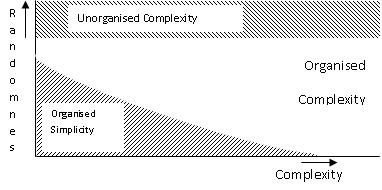
Complexity and Randomness

This pattern is from System's thinker Gerald Weinberg, and has been extremely helpful to illustrate the difference between complexity and randomness. It is also a nice example of the self-referential methodology of PAC, as the pattern is used to discuss scientific approaches: science discovers patterns, which are then used to elucidate scientific processes!

Methodological Stuff: