



LONDON, April 27 /PRNewswire/ -- The Grangemouth oil workers have taken out a series of adverts in the Scottish media today (Monday 28th April), to explain to the people of Scotland the reasons for their strike and to ask for their understanding and support.

Seven adverts have been placed in newspapers covering the whole of Scotland on behalf of the1,200 Grangemouth workers. They express regret for any potential inconvenience caused to the general public but explain that the workers have been left with no choice but to strike to defend their pensions.

LONDON, April 27 /PRNewswire/ --

- Calling Notice

- Sunday 27th April 2008

Grangemouth community demonstrates solidarity with striking workers The people of Grangemouth are turning out at the plant this morning to show their support for the striking oil workers.

Hundreds of people from the local community are due to attend the rally alongside Michael Connarty MP for Linlithgow and East Falkirk and Cathy Peattie, MSP for Falkirk East.

Rally details

Venue: Technical Building, Grangemouth Plant, Bo'ness Road, Grangemouth (between gates 4 and 5) Time: 11 am.

MP Michael Connarty and MSP Cathy Peattie will be at the event and available for interview.

At Abercrombie & Fitch, little girls were sold thong underwear tagged with the phrases "eye candy" and "wink wink." In Britain, preschoolers could learn to strip with their very own Peekaboo Pole-Dancing Kits, complete with kiddie garter belts and play money. And 'tween readers of the magazine Seventeen discovered "405 ways to look hot" like Paris Hilton.

This kind of sexualization of 'tween girls - defined as those between the ages of 8 and 12 - in pop culture and advertising is a growing problem fueled by marketers' efforts to create cradle-to-grave consumers, a University of Iowa journalism professor argues in her new book.

"A lot of very sexual products are being marketed to very young kids," said Gigi Durham, author of The Lolita Effect. "I'm criticizing the unhealthy and damaging representations of girls' sexuality, and how the media present girls' sexuality in a way that's tied to their profit motives. The body ideals presented in the media are virtually impossible to attain, but girls don't always realize that, and they'll buy an awful lot of products to try to achieve those bodies. There's endless consumerism built around that."

Are you exhausted? Do you have pain all over but can’t figure out what’s wrong? If so, you may be suffering from fibromyalgia, a chronic condition that causes exhaustion, sleep disturbances and diffuse pain in your muscles, tendons, and ligaments.

Fibromyalgia patients experience a range of symptoms of varying intensities that increase and decrease over time and often resemble other conditions. For years, because of their complex nature and a lack of research on the condition, many doctors misdiagnosed fibromyalgia symptoms or dismissed them as being in the patient’s head. Even today, it is estimated to take an average of five years for a fibromyalgia patient to get an accurate diagnosis.

There is no laboratory test available to diagnose fibromyalgia. Doctors must rely on patient histories, self-reported symptoms, a physical examination and an accurate manual tender point examination.

MILAN, Italy, April 27 /PRNewswire/ --

- Genomics improves our ability to target experimental cancer treatments

- A promising new drug is in hand, and more are on the way

- Improved ability to select patients to test particular drugs

At today's sessions of this, the final day of the 43rd Annual Meeting of the European Association for the Study of the Liver (EASL), leading hepatologists described several important advances in understanding and provide novel treatments for hepatocellular carcinoma (HCC). Most notably, progress has been made by acquiring data that improve our understanding of the disease process at the molecular level... what is taking place in the body that leads to the development of HCC.

WELWYN GARDEN CITY, England, April 27 /PRNewswire/ --

- Phase II Study Demonstrates Impressive End-of Treatment Response - Providing Future Hope for Patients

Roche's investigational treatment for hepatitis C, R1626, has shown an impressive end-of-treatment response rate when given in combination with the current standard of care, pegylated interferon and ribivarin. R1626 belongs to a new class of oral antivirals called polymerase inhibitors that directly targets the hepatitis C virus and inhibits its replication. It is hoped that this innovative combination will increase the number of patients who manage to clear the hepatitis C virus, thereby curing them of a disease that can lead to liver cirrhosis, cancer and death.

BASEL, Switzerland, April 26 /PRNewswire/ --

- Roche Also Provides Comment on Results of "IDEAL" Trial

Roche today announced that compelling new data from three studies indicate that chronic hepatitis C patients who received PEGASYS(R) (peginterferon alfa-2a) plus COPEGUS(R) (ribavirin) had a greater chance of being cured of their disease than those who received combination therapy with another pegylated interferon and ribavirin. Results from the studies were presented this week at the 43rd Annual Meeting of the European Association for the Study of the Liver (EASL) in Milan, Italy.

Ascione, et al: A Prospective, Randomised, Investigator-Initiated Head-to-Head Trial

BASEL, Switzerland, April 26 /PRNewswire/ --

- R1626 Also Shows a High Barrier to the Development of Resistance

Roche's investigational treatment for hepatitis C, R1626, has shown an impressive end-of-treatment response rate when given in combination with PEGASYS(R) (peginterferon alfa-2a) and COPEGUS(R) (ribavirin).

Maybe I’ve had elevators on my mind because the one in our building has gone through endless repairs of late, none of which apparently improved its speed or reliability. Or perhaps you simply cannot live in New York City without taking into account elevators as a major component of your life. But then my wife pointed out to me this snippet from an article published recently in The New Yorker (every self-respecting newyorker reads The New Yorker while in the subway):

Evolutionary trees, or "phylogenies", are a major part of modern evolutionary science. They depict hypotheses regarding the relationships among taxa, and are therefore important in reconstructions of the historical path of evolution (Gregory 2008a,b).

Various approaches can be taken to formulating phylogenetic hypotheses, including analyses based on morphological, fossil, and/or molecular data. These methods often agree well, but sometimes one or another can throw up some surprises and challenge previous hypotheses about the relationships among groups of organisms.

Reconstructing the tree of life is a difficult and complicated process, and one should expect there to be significant refinements and revisions along the way. This is especially true of the deepest branches of the tree, which are often the most difficult to resolve.

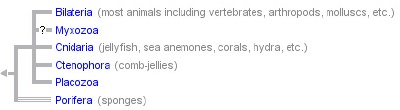
Case in point, the Tree of Life Web Project gives the following summary of deep branches among major animal lineages:

