"China’s Openness no One-Way Alley" appeared in the The Nanjinger. After all, it is called “science outreach” for a reason.

From the article:

One big knock on solar energy is that it is inconsistent; it doesn't work at night or on cloudy days and storing it in batteries takes away the cost effectiveness. But a new technology is in development that can transform that light energy into a storable clean fuel that still has a neutral carbon footprint - hydrogen.

What does it take? Water and iron oxide, better known as rust. Kevin Sivula and colleagues at Ecole Polytechnique Fédérale de Lausanne intentionally stuck to inexpensive materials and easily scalable production processes in order work toward an economically viable method for solar hydrogen production. 
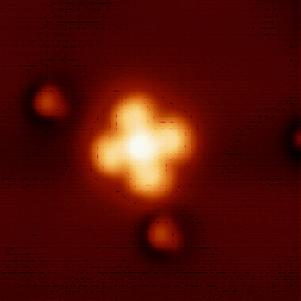
Want to help unlock the secrets of magnetism at the molecular scale without getting a PhD in physics? A citizen science project entitled Feynman’s Flowers lets volunteers from across the world analyze microscope images of individual molecules, which have characteristic flower shapes. Anyone can take part, and only a few clicks of the computer mouse are required to collect valuable information.

There's been plenty of research showing that when people inhale oxytocin, they tend to have more positive social behavior: trust, generosity,empathy and communication. But if taking one whiff of oxytocin can make younicer, will taking oxytocin regularly keep you nicer? If you take a biggerdose, will it make you even nicer?

U.C. Davis researchers wanted to find out the long-term effects of taking oxytocin, so they studied prairie voles, the monogamous rodents that first demonstrated the positive social effects of this brain chemical.

The U.C. Davis research team, led by Karen L. Bales, treateda group of 89 male prairie voles with low, medium or high doses of inhaled oxytocin. The medium dose was roughly equivalent to the amount given to human subjects in lab studies.

Sometimes when things catch the attention of the kookier segments of the public, they really take off. Fracking is a good example.  Though it's been around since the 1940s, once it got really popular people started inventing fake illnesses to get into the mainstream media Scare Journalism of the Week pieces.

I read the text below in the Facebook page of a colleague and friend, Christopher Hill. The text was meant as a facebook rant - sort of - but it raises important points. I liked what he wrote and I asked him if I could repost it here to the benefit of a larger audience. He graciously agreed. NB: the title of the post is mine.

Now that the election and Sandy is (sort of) over, I want to post a rant that I didn't think was appropriate before now.

First, Nate Silver. I have heard him called everything from a genius to a wizard to a witch in recent days. He is none of the above. He is a guy who understands mathematics (in particular statistics) enough to be able to use it to predict elections.
The CDF and DZERO collaborations at the Fermilab Tevatron collider just saw published on Physical Review D (PRD 86, 092003) their final combination of their most recent and precise measurements of the mass of the top quark.

This result, which is probably going to be the definitive one by the Tevatron experiments, reaches a precision in the top mass which is comparable to the precision of the scale you have in your bathroom, despite the fact that measuring your body weight is a quite simpler matter than determining the mass of an elementary particle, let alone one which exists for less than a trillionth of a trillionth of a second.

A digression
A new prostate cancer awareness survey found widespread misconceptions about the disease and says the emotional impact on men is underestimated.

The physical effects of prostate cancer are widely known but men know more myths than facts about how prevalent it is and what could happen. Janssen Biotech, Inc. has released the results of its "Mind Over Manhood: Misconceptions About Prostate Cancer" survey and it reveals a significant gap between the facts about prostate cancer and what men believe about the disease.

In the past, the stereotypes of autism often included a savant capability in some specific thing. A new look at eight child 'prodigies' suggests there may actually be a link between the children's special skills and autism. 

Or, people who are really good at some things tend to develop less socially. 

Of the eight prodigies they looked at, three had a diagnosis of autism spectrum disorders and as a group, the prodigies tended to have slightly elevated scores on a test of autistic traits  compared to the control group. Half of the prodigies had a family member or a first- or second-degree relative with an autism diagnosis.

The most startling thing to me about the election of 2012 was how spookily accurate polls were.  Social scientists in one camp want to dismiss determinism while the other camp has biology-envy but either the deterministic side got a big boost on Tuesday or the opposing sides in this election were so entrenched there was virtually no reason to vote, other than to see who had the best Get Out The Vote campaign. As I discussed in How Accurate Are Those Political Polls?, that is where the magic happens.  Could polls predict how successful a Get Out The Vote campaign is?

Maybe. I know one party is scrambling to see what went wrong.