Science based creationism has arrived and is fashionable: Established academics and NASA scientists claim that evolution is merely a deception, the fossil record planted; darlings of “new-atheists” get away with basically saying that the universe is made for humans; arXiv is not above promoting considerations of we-are-in-a-simulation scenarios that are hidden variable realities blatantly inconsistent with quantum mechanics.
Can researchers improve the quality of matter akin to that found in plasma screens? A new study improves the understanding of plasma sources, where a certain portion of the particles are ionized.
Under certain circumstances, plasma tends to form structures - filaments of electric discharge that are like mini-lightning. Researchers recently investigated barrier discharge, which features at least one electrical insulating material within the discharge gap that acts as an electrically insulating barrier and can be used as a plasma source. They investigated the transition from a highly ordered filament pattern, which is arranged hexagonally, to a disordered system due to the reduction of the externally applied voltage.
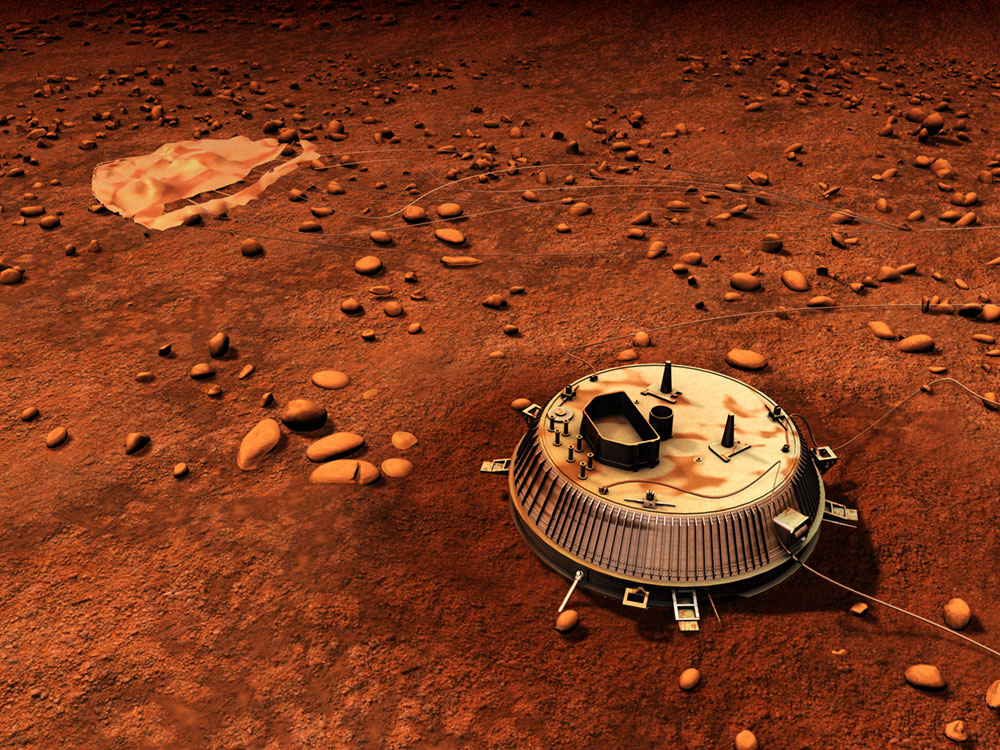
In January, 2005, ESA’s Huygens probe bounced, slid and wobbled its way to rest for 10 seconds after touching down on Saturn’s moon, Titan. As you can imagine, that tells scientists quite a bit about the nature of that moon’s surface.
They reconstructed the chain of events by analyzing data from a variety of instruments that were active during the impact, in particular changes in the acceleration experienced by the probe. The instrument data were compared with results from computer simulations and a drop test using a model of Huygens designed to replicate the landing and the analysis revealed that, on first contact with Titan’s surface, Huygens dug a hole 12 cm deep before bouncing out onto a flat surface.
Unless you are a microbiologist, you probably don't want to think about all of the things that are happening in your mouth right now.
One thing you share with microbiologists is incomplete knowledge regarding what determines the specific types of microorganisms that live there. Is it genes that decide who lives in your microbial village, or your environment? In a new paper, researchers contend that environment plays a much larger role in determining oral microbiota than biology, a finding that sheds new light on a major factor in oral health.
Is it feasible to use dead stars to navigate spacecraft in deep space? Long-term space travel may be a pipe dream outside science fiction math but people inside science are at least thinking about how to make navigation possible.
When temperatures get low, close to absolute zero, some chemical reactions still occur at a much higher rate than classical chemistry says they should – in that extreme chill, quantum effects enter the picture. Researchers have now confirmed this experimentally, providing insight into processes in the intriguing quantum world in which particles act as waves and perhaps also explaining how chemical reactions occur in the vast frigid regions of interstellar space.
It is clear from many discussions that there is a split between things people consider to be "natural" versus those that are the products of technology, or man-made. Obviously no one would consider a computer to be natural, nor would anyone suggest that a tree is man-made. These differences are intuitive.
Researchers from the University of Southampton have published a study in which they argue that crowdsourcing information can be improved through use of incentives. In
"Making crowdsourcing more reliable" Dr Victor Naroditskiy and Professor Nick Jennings and others propose to incentivize crowdsourcing tasks to improve the verification of credible contributors.
Is karaoke a passing fad?
Kevin Brown PhD. Associate Professor of Theatre History, Theory, Criticism, Performance Studies, New Media, Non-Western Theatre, and Popular Culture at the University of Missouri, US. believes not. For his doctoral dissertation, he conducted a two-year ethnographic study of karaoke in America, a portion of which is: ‘
Liveness Anxiety: Karaoke and the Performance of Class‘, and is published in Vol. 1, Issue 2, of the academic journal
Popular Entertainment Studies.“It is very tempting to dismiss karaoke as a passing fad.”
explains the professor.
The biggest feel-good fallacy perpetuated by some in science media today is that "the right", whoever they are, is anti-science, while "the left", whoever they are, is pro-science.
It's exactly the opposite. The right historically has been more pro-science than anyone since World War II, they just recently adopted more positions labeled anti-science as science academia skewed left. 40 years ago conservatives were the most pro-science of any group and 40 years ago there was also political parity in science academia; science was a politically agnostic endeavor for the common good, only the humanities had been hijacked by partisans.