Which science kills the most people each year? Prompted by a quote-- "guns don't kill people-- physics kills people." ('3rd Rock from the Sun') -- it's time we look at which science really is the deadliest.
So let's set up the big three: Physics, Chemistry and Biology. In a Hollywood movieland world, Physics would be the clear winner on early deaths. Car crashes, gunshot wounds, bicycle accidents, falling down, people hitting each other, and that biggie called 'war' are all physics-driven deaths.
The big news in the diabetes world this week is a new article in the New England Journal of Medicine (link
here) about how Actos (scientific name:
pioglitazone) can help prevent the development of diabetes in folks with prediabetes. The American Diabetes Association has a handy page for helping determine if you have "prediabetes" (link
here). If you're looking at HbA1c, it means that you are between 5.7% and 6.4%.
If we have done away -like postmodernism- with the notion of absolute truth, and we are living in a life-world where observers with limited knowledge try to 'make sense' of their envirnoment, then we we have certain freedom to define other forms of truth.
1.
Introduction 2:
Patterns3: Patterns, Objectivity and Truth
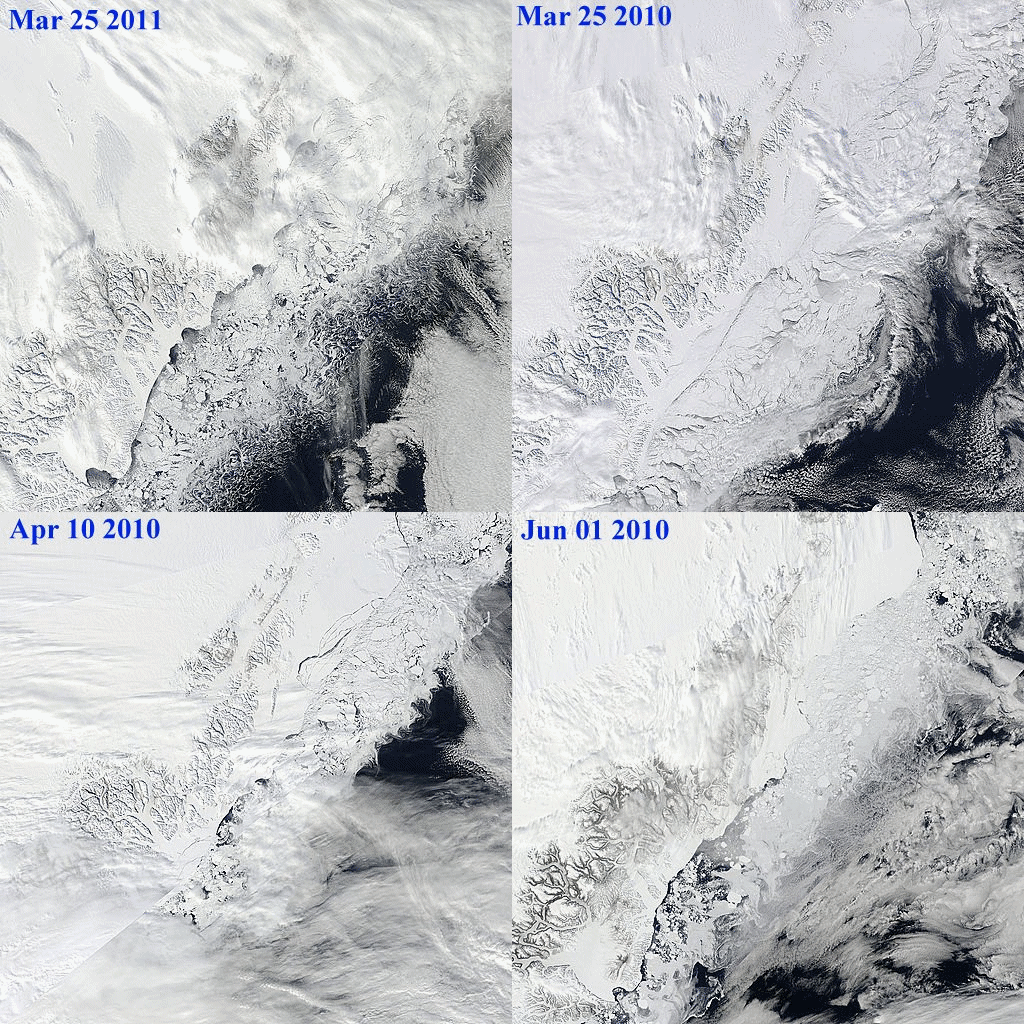
Arctic Ice March 2011 Update #2The melt season of 2010 ended with a low extent and with little ice older than two years. There are strong indications that the winter of 2010 - 2011 did not compact and thicken the sea ice as much as would normally be expected.
Arctic sea ice extent averaged over December 2010 was 12.00 million square kilometers (4.63 million square miles). This is the lowest December ice extent recorded in satellite observations from 1979 to 2010, 270,000 square kilometers (104,000 square miles) below the previous record low of 12.27 million square kilometers (4.74 million square miles) set in 2006 and 1.35 million square kilometers (521,000 square miles) below the 1979 to 2000 average.
...
Researchers have discovered a 525-million-year-old fossil which belongs to a group of tentacle-bearing creatures which lived inside hard tubes.
The creature belongs to a group called pterobranch hemichordates which are related to starfish and sea urchins but also show some characteristics that offer clues to the evolution of the earliest vertebrates. About 30 species of pterobranch are known to exist today although 380-490 million years ago a group of these animals called graptolites were common across the prehistoric oceans.
Scientists are launching a three-pronged attack on one of the most obstinate puzzles in materials sciences: what is the pseudogap?
They used three complementary experimental approaches to investigate a single material, the high-temperature superconductor Pb-Bi2201 (lead bismuth strontium lanthanum copper-oxide). Their results are the strongest evidence yet that the pseudogap phase, a mysterious electronic state peculiar to high-temperature superconductors, is not a gradual transition to superconductivity in these materials, as some have long believed.
Instead, it is a distinct phase of matter.
The pseudogap mystery
The Clovis people, Paleo-Indians whose tools were known for their distinctive 'fluted' points, were once thought to be the original settlers of North America about 13,000 years ago. The name originates not from the 5th century Frankish king but rather the town in New Mexico where the stone projectile points created by their distinctive percussion and pressure flaking techniques were first discovered.
The past few years have seen a decline in the percentage of Americans who believe what scientists say about climate science.
The science community shares some of the blame, obviously; the IPCC made rookie errors in its recent assessment and even intentionally included non-science results as data, and the so-called "Climategate" emails showed scientists weren't always out to promote science as much as they were out to stick it to opponents, behavior just like every other field where humans work.
We are developing past the merely human stage. We couldn’t stop it if we all really wanted to. Techno-future will be.
The transhumanism crowd has understood what evolution is all about while many other intellectuals still grapple with getting their head around mere old biological evolution. Evolution is true by tautology: Whatever there will be (successful, more numerous, …) in the future, will be there (successful, more numerous, …) in the future. This is the basis of what some call ‘algorithmic evolution’.
I think one of the first things that got me interested in evolutionary biology was finding out that whales used to have legs. It's pretty incredible that the sleek, powerful whales of modern day oceans had their origins in blundering land animals like cows and hippos. Nothing spoke more to me about the aeons of time that has passed than imagining generation after generation of whales tentatively playing with the water, feeding there, learning to become good swimmers, and eventually swimming in the open ocean amongst the fishes, their terrestrial history a long forgotten memory.