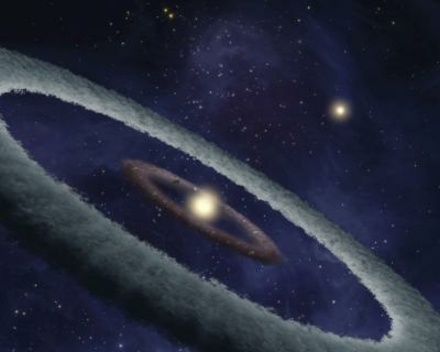
Sunspots are dark spots on the sun, at least as we see them, caused by magnetic activity in the plasma on the surface of Sol.
For 200 years scientists have known that they occasional disappear but no one was sure exactly why. A trio writing in Nature say they have solved the mystery and now can even predict the next time. Piet Martens, Dibyendu Nandi and Andres Munoz-Jaramillo say they have discovered why sunspots were missing from 2008 to 2010, which coincided with an extra-long "solar minimum" and unusually weak magnetic fields at the sun's poles. The fields are ordinarily much stronger when solar activity is minimal.
My husband has an enormous head. Sometimes this concerns me, when I consider the degree to which skull size may have a genetic basis and the fact that we'll probably reproduce at some point. That has to fit through there? OW.
But maybe I should be grateful. I'll certainly have an easier time of it than female Atlantic bobtail squid (Sepiola atlantica). These mamas, according to a recent study on their spawning behavior, can lay up to one and a half times their own body weight in eggs. That would be like me, at 125 pounds, producing 187.5 pounds of baby. WOW.
The results of a new Supersymmetry search have been released a few days ago by the ATLAS collaboration. They come from an analysis of events with large missing transverse energy and jets -the most classical signature of SUSY at hadron colliders, as well as the most sensitive one in a wide range of the complicated space of SUSY parameters.
On the face of it, Al Gore conducting a global warming conference during a blizzard a few years ago looked bad. But maybe it was a teaching moment.
The weather has always had swings and separating weather from climate is a key aspect in understanding why (a) pollution is bad and (b) we should have less of it, even if the weather is nice.
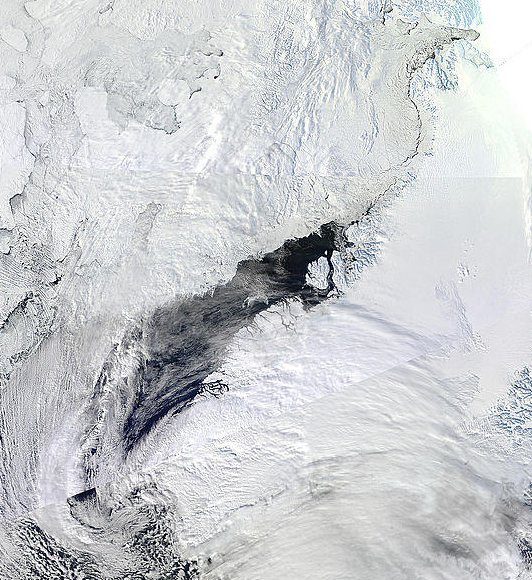
Arctic Ice March 2011
In April 2010 a late upward blip in Arctic sea ice extent led some bloggers to write about 'recovery'. The blip was anomalous, hence there is no reason to expect a repetition this year. On the contrary, it is likely that ice extent will not increase by any significant amount before the 2011 melt season gets fully under way - if it is not under way already.
Archimedes steps in again. The MacTutor tells us that
“Archimedes considered his most significant accomplishments were those concerning a cylinder circumscribing a sphere, and he asked for a representation of this together with his result on the ratio of the two, to be inscribed on his tomb.”
And one year after it was told us how to produce carbon spheres in relative abundance (at least, enough to buy a decent quantity from your laboratory chemical supplier), along comes
Sumio Iijima telling us how to make cylinders.
Comparing athletes across generations is always difficult - in football, for example, players are bigger and stronger but before the hashmark changes of the early 1970s, when the field truly had a strong and weak side, a running back like Gale Sayers could make opposing defenses look silly despite an ability to break through a nose tackle.
Every once in a while we are told that Schrödinger’s cat is now proven. One incarnation of the ‘Finally Proven!!!’ of macroscopic quantum superposition was hailed as one of the 10 breakthroughs, the breakthrough of the year 2010. By Science about an article in Nature [1], no less!
Arctic Ice 2011 - Sail, Steam and Satellites
The NSIDC will shortly be publishing its report for March 2011. I expect the report to conclude that Arctic sea ice extent for February 2011 was the 'lowest in the satellite record'. That would mean the 'lowest ever recorded in human history', since we have abundant data on historic ice extent.
There is a false argument doing the rounds of the blogs: words to the effect that we have no accurate knowledge of ice extent before the age of satellites. This is, of course, nonsense on stilts in clown boots with a squirting flower - the latter being filled with complete and utter bilge with an admixture of absolute hogwash.
Ross Ice Shelf - Some ObservationsThe Ross Ice Shelf is the largest ice shelf in the world with an area of roughly 182,000 square miles - 472,000 square kilometers. The shelf was named after Captain James Clark Ross who discovered it January 28th, 1841. The coast to which the ice shelf is attached reaches nearer to the south geographic pole than any other part of Antarctica's coast.

Image source: NASA/MODIS Antarctic mosaic.