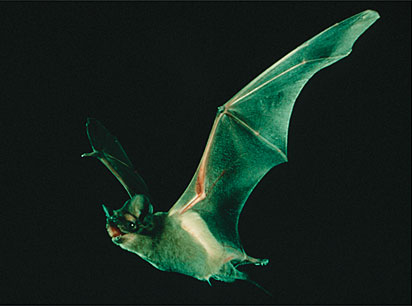
Tadarida brasiliensis mexicana, or the Mexican Free-Tailed Bat to you and I, is a superlative species. Not only do they form the largest congregations of mammals in the world, but less well known is that these little guys are also the fastest bats on the planet.
This is a species that's close to my heart. Just a short drive from my home in Davis, California underneath a freeway bridge that takes cars over the Vic Fazio Yolo Wildlife area (the largest wetland restoration project west of Florida) to Sacramento, roost a colony of an estimated quarter of a million of these bats.
As I bask in media attention for my
Project Calliope, it's worth noting I'm not the only Antunes getting media coverage in the space/IT world. This is one story of 'the other Antunes', and of NASA's Spacebook.
NASA created an internal social network called
Spacebook. As with any social media project that makes it past its first year, it has morphed from its original intent into a compromise of various agencies. But what was its original point, its creation story?
Peak Oil And Global Warming"Our ignorance is not so vast as our failure to use what we know."
M._King_Hubbert
I am confident that, if he were still with us, M. King Hubbard would be strongly in favor of the pursuit of alternatives to fossil fuels. He demonstrated that our use of fossil fuels was not only unsustainable, but could lead to a reversion to an agrarian economy if we failed to address the problem of our dependence on fossil fuels.
What happens in your brain when you experience pleasure? Why are fantasies so powerful? Why do our brains love dopamine so much? Why do some images arouse, while others turn us off? Why are the most attractive people often not the ones we are most drawn to sexually? How can you create the longest neurological orgasm possible?
For the next several weeks, I will be writing a series of articles centered around the topic, The Science of Pleasure. Because there is soooo much good information on the science of how and why we derive pleasure from certain things, I felt this should be a series of articles, rather than trim it down to one post. Sound exciting? Well, it IS.
I was on the phone the other night with a friend. She is in a bit of bind. Every conversation we’ve had recently, we’ve been doing the same thing. We analyze every minutiae of her situation, as women are wont to, and come to the same conclusion. Things are not good nor are they bad. It is just limbo.
While the focus of the international conference in high-energy physics in Paris last week has been on the search for new physics and the precise measurement of standard model quantities, I will offer to you today something more technical, but in no way less physics-rich; it was presented in Paris, but with the many parallel sessions it may have well gone unnoticed... What I wish to explain to you is the procedure by means of which the CMS experiments calibrates the scale and resolution of its charged particle momentum measurement.

The attention we give to (or withhold from) tragedies has little to do
with numbers: many hundreds can die in a cholera outbreak in Zimbabwe or hundreds of thousands in an earthquake in China and it receives
nowhere near the press and public outrage as nearly 200 killed in terrorist attacks in Mumbai. (This isn’t meant to diminish the tragedy
of Mumbai, only to act as comparison.)
The Portland International Conferences on Management of Engineering and Technology (PICMET) occur in Oregon in odd-numbered years, and in diverse locales in the even. I write from lovely Phuket island in southern Thailand, as I listen to bird- and cricket song and the crashing surf of the Andaman Sea, and gather my thoughts following the close of PICMET-2010.
Arctic Heroes #3 - Robert McClureRobert McClure and his crew were the first people to transit the North West Passage - by ship and sled. They were also the first to circumnavigate the Americas - by ships and sled.
McClure's ship - HMS Investigator -
has just been found. She was abandoned in June 1853 due to a combination of factors: the general poor health of the crew; the uncertainty of escape from the ice; the availability of other vessels to take the crew home.
I believe that music sounds like people, moving. Yes, the idea may sound a bit crazy, but it’s an old idea, much discussed in the 20th century, and going all the way back to the Greeks. There are lots of things going for the theory, including that it helps us explain (1) why our brains are so good at absorbing music (…because we evolved to possess human-movement-detecting auditory mechanisms), (2) why music emotionally moves us (…because human movement is often expressive of the mover’s mood or state), and (3) why music gets us moving (…because we’re a social species prone to social contagion).