Superstition may work if you think it works. If only voodoo were so easy, we'd love to have an army of zombies at our command.
But people, and certainly athletes, maintain any number of superstitious rituals, so Lysann Damisch, Barbara Stoberock and Thomas Mussweiler of the University of Cologne designed a set of experiments to see if activating people's superstitious beliefs would improve their performance on a task. Their research says that having some kind of lucky token can actually improve performance – but by increasing self-confidence and not any magical mojo.
A new study says it is the first to identify a life-or-death "cell competition" process in mammalian tissue that suppresses cancer by causing cancerous cells to kill themselves.
Central to their discovery was the researchers' identification of 'Mahjong, a gene that can determine the winners of the competition through its close relationship with another powerful protein player.
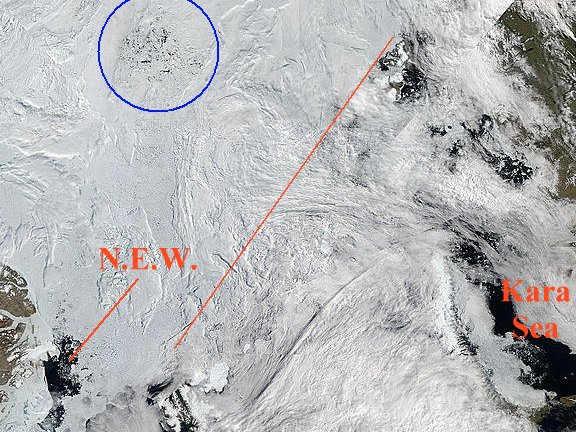
Arctic Ice July 2010 - Update #2
Something strange is going on. Arctic watcher blogs are abuzz with talk about the behaviour of graphics which are supposed to show ice extent, area or volume. many of these graphics seem to show that the Arctic melt has stopped. Which it hasn't.
Historically, the main pack was always thick multi-year ice. Ice would be lost at the edges in summer, and the new winter ice would be pressed into the main pack by the various drift motions. As ice motion opened a new lead it would rapidly freeze over - even in summer. As the ice expanded by cracking it actually made new ice. Summer melt would nibble at the ice margins, but the losses would be made good in winter.
Funny. While dozens of online media are abuzz with the (non)-news, and while
Fermilab Today tweets that there is no Higgs in store for us and a blogger in search of fame is just spreading unconfirmed voices which have no foundation, Lubos Motl over at the Reference Frame
gets more detailed rumors on the same thing, and that does make things a bit more interesting.
How high is space, how far can you fall with a parachute, where is the Project Calliope satellite going to be, and where does the hard radiation from the sun get nasty? Gathered for the first time in one place is our High Altitude Explorer's Guide.
A typical airplane cruises at 9km (6 miles) up, around 30,000 feet. Military jets (from the SR-71 onward to modern planes) can hit over 30km (19 miles) up, over 100,000 feet.
Can you parachute from that height? Yes, in 1960 Joseph Kittinger set the record at 31.3km (19.5 miles), or 102,800 feet. Felix Baumgartner is trying this year, 2010, to freefall from 36km (over 22 miles), an 118,000 feet fall.
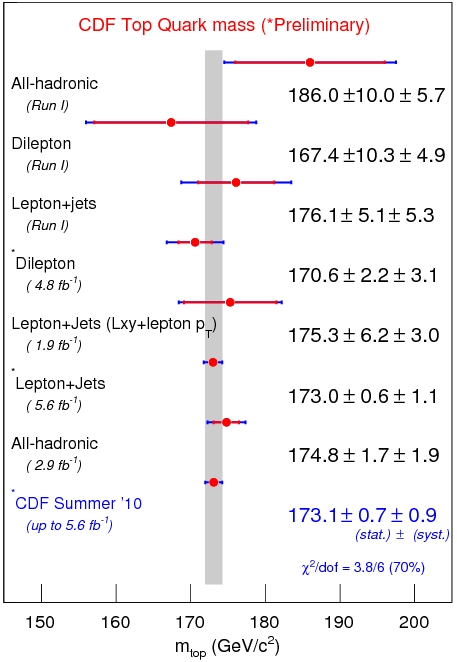
The CDF experiment has just released their new average of top quark mass measurements, obtained with analyses that use up to 5.6 inverse femtobarns of proton-antiproton collisions provided by the 2-TeV Tevatron collider: the new measurement is
M(top) = 173.1 +- 0.7 (stat) +- 0.9 (syst) GeV, a measurement with a total uncertainty of 1.3 GeV, or 0.75%!
Have a look at the various measurements that enter the calculation in the graph below.
Think a a mere 0.0350 millionth of a millionth of a millimeter is unimportant? Think again.
At the Paul Scherrer Institute in Switzerland, an international team of researchers has now measured the proton with experiments they say are ten times more accurate than all previous ones. And all the old values for the dimension of the proton, the nucleus of the hydrogen atom, are off. Instead of 0.8768 femtometres it measures only 0.8418 femtometres, they say
If so, at least one fundamental constant now changes and physicists also have to check the calculations of quantum electrodynamics. This theory is assumed to be very well proven, but its predictions do not agree with these latest measurements.
Even if you know an unexpected event is likely to occur, you are no better, and may be even worse, than those who aren't expecting anything unexpected at all. Did you expect that confusing opening sentence? Now you get the point.
The study, from Daniel Simons, a professor of psychology and in the Beckman Institute at the University of Illinois, appears this month as the inaugural paper in the new open access journal i-Perception. (
www.perceptionweb.com/i-perception)
Ethnobotany is usually defined as anthropological approach to botany. There are several methods of ethnobotanical research and those relevant to medicinal plants are archaeological search in literature, herbaria and the field studies.
“Man, ever desirous of knowledge, has already explored many things, but more and greater still remains concealed; perhaps reserved for far distant generations, who shall prosecute the examination of their creator’s work in remote countries and make many discoveries for the pleasure and convenience of life…”
The above quotation of Linneaus is the most appropriate to this chapter which deals with the relationship between medicinal plants and the total filed of ethnobotany.
The Rise Of The Time Machines
Do you own a time machine? The chances are that if you are reading this, then you own a time machine. They are fairly cheap nowadays. Like so many things, the first time machine was built for the military and cost a lot of money.
What do you think happened to the first person to claim to be able to predict the future using a machine built on scientific principles? You may think he was treated with scorn, treated as a crank. In fact he was given lots of money.
His invention was funded, not because the government of the day went to school with him, but because he was able to validate his method. Scientists using the same method were able to predict future events with great accuracy.