




No one says, "I am in favor of pollution" but how would anyone know who really cares?   Body language, claims a new book.

Professor Geoff Beattie, from The University of Manchester, says mismatches between gestures and speech will allow us to identify ‘green fakers’, regardless of what they actually say.

His research for the Sustainable Consumption Institute used video recordings to examine the gestures and speech of people with differing views on the environment while they talked about carbon labeling, global warming and their lifestyles.  By examining their gestures, each speaker showed a connection between what they were saying and what they actually believed, Beattie says.
How geeky do you have to be to attend a mathematical meeting every 4 years - and think India in August is a cool place to do it?   Pretty geeky.   The ultimate geeks.

If that is you, we know where you will be August 2010, when the largest gathering of geeks ever will happen in Hyderabad.   It's the International Congress of Mathematicians, the biggest and most prestigious international mathematical meeting, which takes place once every four years. No meeting in any scientific discipline has the kind of wide sweep that ICMs have: every branch of mathematics is covered and emphasis is on the essential unity of all mathematics. 

Large amounts of money are being siphoned from the multi-billion dollar cigarette smuggling trade and going right into the pockets of terrorist networks and international organized crime. 

A United Nations Security Council investigative body, the Group of Experts, has reported that millions of dollars in illicit tobacco revenues are reaching al-Qaeda, the Taliban and other terrorist organizations, and is financing Congolese rebels for the recruitment of child soldiers, mass rape and murders.

 The World Health Organization's Framework Convention on Tobacco Control has determined that 600 billion counterfeited and smuggled cigarettes cross national borders annually. This represents $50 billion in lost proceeds affecting nations throughout the world.

NASA Goes To The Arctic

NASA is sending a team of scientists to study the Arctic at close quarters.  I guess it's pretty hard to sample phytoplankton with a satellite.

NASA Icebreaker Voyage To Probe Climate Change Impact On Arctic
 
WASHINGTON -- NASA's first dedicated oceanographic field campaign goes to sea June 15 to take an up-close look at how changing conditions in the Arctic are affecting the ocean's chemistry and ecosystems that play a critical role in global climate change.
Time for a little space business by a citizen scientist-- an ordinary scienc-y person who just happens to be building a personal satellite in his basement.  I'm at the Space Weather Enterprise Forum today, where scientists and policy makers try to tackle space weather awareness from a real world 'money&lives' stance. On Friday I'll write it up in my main column, but for now I'm going to connect these issues with some 'Project Calliope' concerns.

When launching a personal satellite, who will be at fault if there is trouble with the satellite?
A CNN headline reads "Kids of lesbians have fewer behavioral problems, study suggests".

Interesting, but wait...

The study, published Monday in the journal Pediatrics, followed 78 lesbian couples who conceived through sperm donations...

The involvement of mothers may be a contributing factor [to having fewer behavioral problems], in addition to the fact that the pregnancies were planned, Gartrell said.

The children "didn't arrive by accident," she said. "The mothers were older... they were waiting for an opportunity to have children and age brings maturity and better parenting."

The polar regions are far, far away for most people. Do not count me in among 'most people' though. As a Norwegian I practically live in the Arctic. There are only 8 nations that are (partly) situated in the Arctic: Canada, Denmark, Finland, Iceland, Norway, Sweden, Russia and USA Several countries claim rights in Antarctica, which is regulated by the Antarctic Treaty . Sometimes we talk about a third pole, namely The Himalayas. Common for all three regions are remoteness and inaccessibility.
Via GenomeWeb's Daily Scan, some comments on the prospects for citizen science in The Chronicle of Higher Education.


Only one of the three appears to be an actual research scientist, but they make good points about the role of citizen science in research. For example, Clifford A. Lynch, Director, Coalition for Networked information:

I'm not wild about the term "crowdsourcing" and I think it's actually important to disentangle the developments.
Arctic Ice June 2010 - Update


This is an update to my article Arctic Ice June 2010, part of my ongoing series of articles about the Arctic.

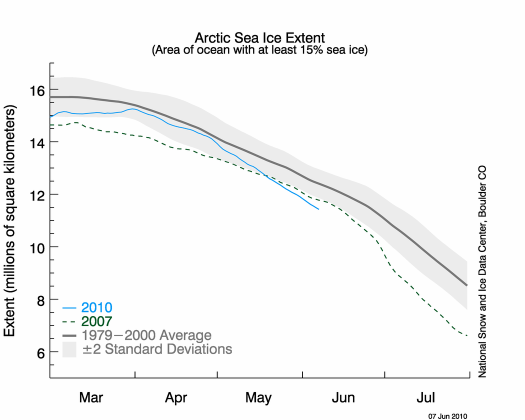
The NSIDC ice extent graph shows a fairly constant and greater then average rate of ice loss over the last four weeks.

Arctic Sea Ice Entent June 07 2010 - NSIDC
http://nsidc.org/arcticseaicenews/
.


In an article published May 06 2010 I wrote:
Terraforming is the concept of engineering planets to make them habitable for terrestrial life. This idea was born out of fiction. Olaf Stapledon, in his 1930 novel Last and First Men, first described a project undertaken to make Venus suitable for humans which began by placing photosynthetic plants on the surface to release oxygen. In 1942, Jack Williamson coined the term “terraforming” in his short story "Collision Orbit."  In 1961, Carl Sagan wrote the first academic paper on terraforming and published it in Science, moving the terraforming to the realm of serious scientific pursuit.

