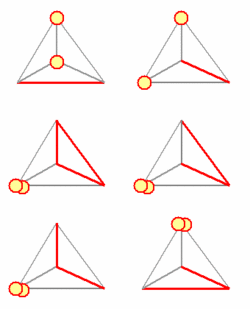
The "exceptionally simple theory of everything," proposed by physicist Antony Garrett Lisi in 2007 does not hold water, according to a particle physicist and mathematician writing in Communications in Mathematical Physics.
In November of 2007, Lisi published an online paper entitled "An Exceptionally Simple Theory of Everything." The paper centered on the elegant mathematical structure known as E8, which also appears in string theory. First identified in 1887, E8 has 248 dimensions and cannot be seen, or even drawn, in its complete form.
Palaeontologists have discovered a new fossil species called Cloudina carinata, a small fossil with a tubular appearance and one of the first animals that developed an external skeleton between 550 and 543 million years ago. The discovery is documented in Precambrian Research.
The fossils were found in the archaeological site El Membrillar (Badajoz), one of the few sites in Europe where the remains of Cloudina can be found. "The specimens display exceptional preservation, they appear preserved in three dimensions, and show their original form and numerous details of the shells", lead author Iván Cortijo says. "Cloudina carinata is characterized by its elaborate ornamentation and complexity of the shells and tube that are formed when inserted."
At Nature's
Innocentive site, (a directory for X-prizes), there is an entry looking for someone who can develop a standard method of placing insects into a latent state and then reanimating them. If you figure it out, you can win 20,000 bucks.
What's interesting about the offer isn't that someone is willing to pay big money in order to Han Solo a housefly. (And by the way, you can put a house fly in a freezer for a minute, take it out, tie a string around it and watch it zoom around when it wakes up, but you can't get 20,000 bucks for suggesting that.) Anaesthesia doesn't count, either.
I've heard a senior colleague say that there is nothing fundamental left to be discovered in biology. It's a nagging worry some people have, including myself. What's left, according to some (including one of molecular biology's founders Sydney Brenner), is to work out the details of particular systems, implied by already established paradigms - kind like chemistry.
Nonsense On Ice
What follows is quoted from an article:
'Climate Cools But Arctic Ice Scares Continue'
by Dr. Tim Ball Monday, January 18, 2010:
My badge of honor is an attack by Phil Jones, disgraced and displaced Director of the Climatic Research Unit (CRU) whose leaked emails showed how they falsified climate science. On May 22, 2009 Jones wrote to Mann, “Our web server has found this piece of garbage - so wrong it is unbelievable that Tim Ball wrote a decent paper in Climate Since AD 1500.
http://www.canadafreepress.com/index.php/article/19087
Two and a half months since Erik Verlinde submitted his entropic gravity paper, and all of physics and cosmology has turned into entropy. Well, I am exaggerating a bit, and perhaps more than just a bit. Yet, fact is that within two weeks of Erik's publication a steady stream of 'entropic everything' papers has developed at a rate of close to one paper per day. Gravity, Einstein's equations, cosmic expansion, dark energy, primordial inflation, dark mass: it's all entropic. Chaos rules.
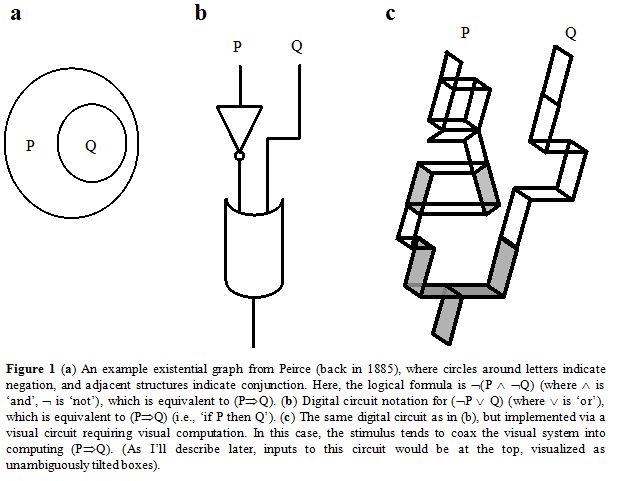
Our everyday visual perceptions rely upon unfathomably complex computations carried out by tens of billions of neurons across over half our cortex. In spite of this, it does not “feel” like work to see. Our cognitive powers are, in stark contrast, “slow and painful,” and we have great trouble with embarrassingly simple logic tasks.
Quantum mechanics has been around for a hundred years and continues to fascinate and astonish scientists. It has been phenomenally successful at explaining the microscopic universe at the level of atoms and elementary particles and yet classical mechanics has survived to model the macroscopic world of everyday objects. But at what level do these two theories meet? Is there a region in which they could overlap; that is, can macroscopic objects display quantum behaviour?
The number in the title, interpreted in units per square centimeters per second, is a flux rate, and it is a new world record set by the Tevatron collider last night on the number of protons and antiprotons forced to cross each other within a tiny interaction region in the core of the CDF and DZERO experiments.
In a paper appearing today in Science, Los Alamos researchers report that a newly discovered "loading-unloading" effect allows nanocrystalline materials to heal themselves after suffering radiation-induced damage. The discovery may eventually lead to much safer nuclear power plants.
Nanocrystalline materials are those created from nanosized particles, in this case copper particles. A single nanosized particle—called a grain—is the size of a virus or even smaller. Nanocrystalline materials consist of a mixture of grains and the interface between those grains, called grain boundaries.