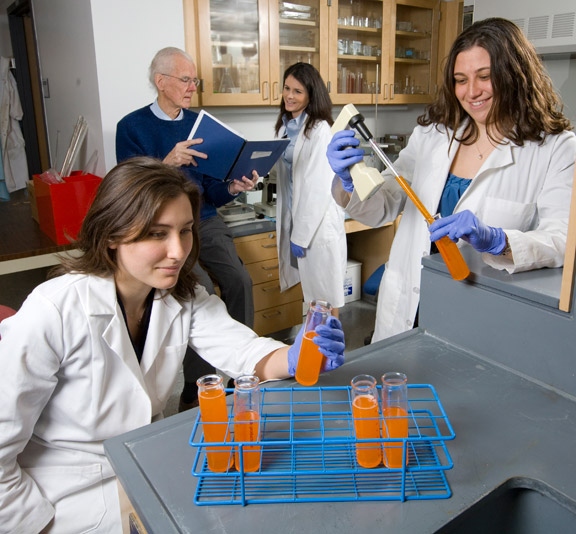
According to a new study in the Journal of Consumer Research, what we think of a product or brand, or how positively or negatively we assess it, depends on the context in which it is viewed.
The research suggests that marketers have to carefully construct and consider the context to get the desired results.
"Although [consumers] generally think their judgments reflect the true quality of the products, many irrelevant contextual factors from the weather to another product brand can influence consumers' evaluations," the authors write.
The study was based on four experiments that looked at how consumers compare and contrast products and brands and what it takes to get them to positively or negatively evaluate them.
Most people think that money is the solution to their problems. But that may only be true if they acquire enough money to improve their social rank, according to a new study in Psychological Science. The study found that a bigger paycheck was not the solution if it did not make the recipients wealthier than their neighbors, friends and colleagues.
Researchers from Cardiff and Warwick Universities looked at data on earnings and life satisfaction from seven years of the British Household Panel Survey (BHPS), which is a representative longitudinal sample of British households.
The combination of a natural gravitational lens and a sophisticated telescope array has given astronomers the clearest view to date of the "star factories" in SMM J2135-0102, a galaxy over 10 billion light-years from Earth. The distant galaxy, they say, is making new stars 250 times faster than our Galaxy, the Milky Way.
Astronomers also pinpointed four discrete star-forming regions within the galaxy, each over 100 times brighter than locations where stars form in our Galaxy. This is the first time that astronomers have been able to study properties of individual star-forming regions within a galaxy so far from Earth.
Past studies have suggested that high-fructose corn syrup and other sweeteners like table sugar are nutritionally identical. But the authors of a new study in Pharmacology, Biochemistry and Behavior say that's not so.
When it comes to weight gain, the study found, rats with access to high-fructose corn syrup gained significantly more weight than those with access to table sugar, even when their overall caloric intake was the same.
We can do a lot of things to reduce the greenhouse gas emissions often blamed for climate change, but cutting back on consumption of meat and dairy products isn't one of them, according to a report presented at the National Meeting of the American Chemical Society.
Giving cows and pigs a bum rap is not only scientifically inaccurate, but also distracts society from embracing effective solutions to global climate change, says UC Davis Professor of Animal Science Frank Mitloehner. He noted that the notion is becoming deeply rooted in efforts to curb global warming, citing campaigns for "meatless Mondays" and a European campaign, called "Less Meat = Less Heat," launched late last year.
The process that lights up big-screen plasma TV displays could also help produce ultra-clean fuels, according to research presented this week at the National Meeting of the American Chemical Society (ACS).
The research describes a small, low-tech, inexpensive device called a GlidArc reactor that uses electrically-charged clouds of gas called "plasmas" to produce clean fuels from waste materials. One is a diesel fuel that releases 10 times less air pollution than its notoriously sooty, smelly conventional counterpart.
Scientists claim that helium rain is the best explanation for the scarcity of neon in the outer layers of Jupiter, the solar system's largest planet. Neon dissolves in the helium raindrops and falls towards the deeper interior where it re-dissolves, depleting the upper layers of both elements, say the authors of the new report in Physical Review Letters.
The research will help refine models of Jupiter's interior and the interiors of other planets. Modeling planetary interiors has become a hot research area since the discovery of hundreds of extrasolar planets living in extreme environments around other stars. The study will also be relevant for NASA's Juno mission to Jupiter, which is scheduled to be launched next year.
Is there some way we can teach our children that there is no such thing as a free lunch? Perhaps then they will not grow up to think that problems can always be solved - if only we throw enough crazy unscientific ideas at them.
The laws of thermodynamics dictate a simple policy of universal application. It is one that policy makers must be forced to understand: mother nature will not permit us to reverse a fossil fuel energy production process without using more energy than the process has itself released.
One of the most ludicrous ideas I have ever read about, purportedly coming from scientists, is that we can somehow sequester carbon. Let me give my reasons.
I'm sure many of you have heard the old story about a group of blind men trying to describe an elephant. One guy grabs the elephant's leg and says an elephant must be like a tree. Another guy grabs the end of its tail and says it's like a woman's ponytail. Another one catches a breeze from the elephant's flapping ear and says the creature is more like a large fan. (Okay, obviously I don't remember the details of the story, but you get the picture.) One of the places I heard this story in detail was in a course on Indian Philosophies, and it was used as a way of describing the difficulty any one person will have in understanding the whole of reality.
Rock Scissors Paper Custard
Ok, forget the scissors and paper - this article is about rocks
and custard.
The Sliding Rocks Of Racetrack PlayaRacetrack Playa is a dry lake bed in Death Valley National Park. It is famous for its sliding rocks. Theories that the rocks have been moved by people or animals have been ruled out. These rocks move according to some as yet unknown natural mechanism.
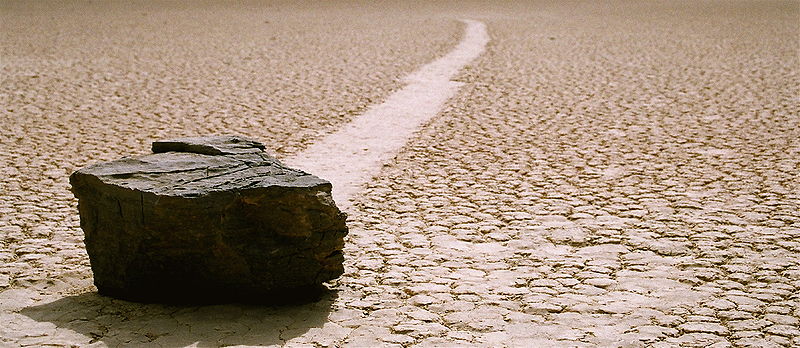
Image source: Wikimedia, Tahoenathan, GNU.
The sliding rocks are few in number and are found mainly in the southeast.