Some chickens appear to be male on one side of the body and female on the other, and researchers writing in Nature this week say they know why.
It was previously thought that sex chromosomes in birds control whether a testis or ovary forms, with sexual traits then being determined by hormones.
The authors of the new study, however, identified differences between male and female cells that control the development of sexual traits. The scientists have named the phenomenon, cell autonomous sex identity (CASI).
The findings may also be relevant to why males and females differ in behavior and in susceptibility to disease.
An analysis in Nature of more than 70,000 galaxies by a team of physicists suggests that the universe – at least up to a distance of 3.5 billion light years from Earth – plays by the rules set out 95 years ago by Albert Einstein in his General Theory of Relativity. But that's not all. They also conclude that the existence of ill-defined 'dark matter' is the most likely explanation for the observation that galaxies and galaxy clusters move as if under the influence of some unseen mass, in addition to the stars astronomers observe.
End of the World Sci-FiOryx and Crake (2003)
The Year of the Flood (2009)
by Margaret Atwood

In Atwood's world of
Oryx and Crake, biotechnology has ruined the world, in more ways than one. As the result of a near-omnipotent ability to manipulate biology, society has become structured around biotech consumer products and services, with a major division between the consumers and the powerful biotech companies. The consumers (the "pleebs") live in a polluted, crime-ridden world outside of the highly secure, isolated, wealthy compounds where the employees of the biotech corporations live.
A reader was aghast-- outraged, I say-- at my suggestion that this precious music satellite, Project Calliope, might launch a few months late.
Now, the rocket people at
InterOrbital Systems are rock-solid and haven't had any reason to announce a delay. Their testing is on track. Certainly (as this blog shows) my satellite construction in proceeding in a timely fashion. So why do I think we won't launch until 2011?
The answer is just about everything launches late. Late is the new early. The launch industry is predicated on being absolutely perfect with engineering details, and wildly inaccurate about when you actually launch.
How do we fix science journalism ? Simple: we don't. We let it sink, and be reborn in a different form.
It is rather utopic to insist that in a world of changing means of communications, a world where printed matter is losing ground to the advantage of electronic media, the diffusion of scientific information may or shall stay the same.
Having once been an environmental activist, one thing that bothers me about modern day environmental activists (*) is their insistence, despite any evidence, that jamming people into cities and going to Farmer's Markets and having governments buy huge swaths of land that can't be used by anyone is a good thing. Emotional arguments mobilize zealots who are already convinced but do very little for the undecided. But common sense and data do.
If most people were going to predict which city would instead have a common sense plan to get greener without more bloated government employment or a bigger deficit or laws, very few people would have said Detroit.
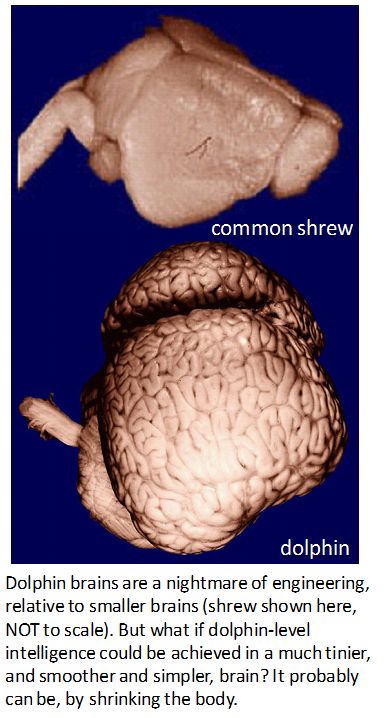
There are currently two ambitious projects straddling artificial intelligence and neuroscience, each with the aim of building big brains that work. One is The Blue Brain Project, and it describes its aim in the following one-liner:
Avalon, "Isle of the Blessed", is a legendary island famous for its beautiful apples, featured in the Arthurian legend described by Geoffrey of Monmouth in the Historia Regum Britanniae (History of the Kings of Britain).
Geoffrey of Monmouth (1100-1135) wrote several works in latin being this the used language of learning and literature in Europe during the medieval period.
A Classic Waste Of Breath
An argument that a thing is natural, therefore not a cause of concern, is used greatly in modern times, most especially in connection with the arguments over whether or not we puny humans can interfere with natural environmental cycles. Such arguments can look good on the face of things.
The naturalistic argument goes back at least to Ancient Greece.
In the art of misleading an audience with a seemingly open-and-shut case it really is a classic.
The 'war on cancer' has led to a reduction in the rate of cancer deaths whether measured against baseline rates in 1970 or in 1990, reports a new study by the American Cancer Society.
According to the study, the downturn in cancer deaths since 1990 is due mostly to reductions in tobacco use, increased screening allowing early detection of several cancers, and modest to large improvements in treatment for specific cancers. The study was published today in PLoS One.
Researchers used nationwide cancer mortality data for the years 1970 through 2006 from the SEER*Stat database, which defines major cancer sites consistently over time in order to facilitate reporting of long term mortality trends.