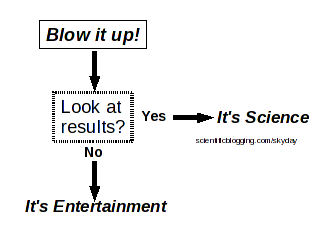







We scientists have a desperate need to make our science interesting to everyone-- including ourselves. Our terminology reflects this. In astronomy, we have the Big Bang. In comp sci, computers Crash. In engienering, "Test to Destruction".

But at some point, usually when I'm in a classroom, my science audience wants me to do something extreme. Mix chemicals until they explode. Shatter a rose in liquid nitrogen. Fire off a rocket. Something 'kinetic', in the sense of lots of fragments of something once whole being rent a'sunder.

As usual, parody best covers the dilemma, as with this week's "The Onion" science headline: Science Channel Refuses To Dumb Down Science Any Further.
What kinds of genetic changes are required to evolve significant changes in body shape and size? The availability of affordable, state-of-the-art DNA sequencing and array technology has made it possible to study evolution at a level of molecular detail inaccessible just a decade ago.
Water has an economic value in all its competing uses and should be recognized as an economic good
The Dublin Statement on Water and Economic Development

In a warming world, will people fight over dwindling water supplies?  Will there be water wars?  What has economics to teach us about this?  As glaciers recede, as lakes and rivers dry up, what then of the laws of supply and demand?  What then of property rights and the free ride principle*?

..........................................................
The War Of The Wells
Anti-smoking activists have made some ridiculous claims about smoking and the associated health risks. In recent years, studies have suggested that movies encourage teenagers to pick up the habit, any exposure to secondhand smoke is dangerous, and that such a thing as ‘third hand smoke’ exists. But a new study in Environmental Health may be the greatest example of exaggeration on the issue ever.
A new report from the National Research Council suggests that naturally occurring methane hydrate may represent an enormous source of methane, the main component of natural gas, and could ultimately augment conventional natural gas supplies. Although a number of challenges require attention before commercial production can be realized, no technical challenges have been identified as insurmountable.

Moreover, the U.S. Department of Energy's Methane Hydrate Research and Development Program has made considerable progress in the past five years toward understanding and developing methane hydrate as a possible energy resource, the report claims.
Writing in PLoS Genetics, UCLA Researchers say they have performed the first complete genomic sequencing of a brain cancer cell line, a discovery that may lead to personalized treatments based on the unique biological signature of an individual's cancer and a finding that may unveil new molecular targets for which more effective and less toxic drugs can be developed.
A new study in Acta Paediatrica suggests that parents of four and five-year-olds may be unaware that their children are at an unhealthy weight.  Half of the mothers who took part in the new study thought that their obese four or five year-old was normal weight, as did 39 per cent of the fathers.

When it came to overweight children, 75 per cent of mothers and 77 per cent of fathers thought that their child was normal weight. More than 800 parents of 439 children took part in the study, carried out by researchers from the University Medical Centre Groningen in The Netherlands. Five per cent of the children were overweight, four were obese and the rest were normal weight.
In recent years, climate change hasn't proceeded as most scientists expected. Global surface temperatures have not risen as fast in the last decade as they did in the 1980s and 1990s, and researchers from the National Oceanic and Atmospheric Administration (NOAA) say they may know why--fluctuations in stratospheric water vapor. The team's new study in Science suggests that Just a 10 percent drop in water vapor ten miles above Earth’s surface has had a big impact on global warming.
Here is an article relating to a discussion about the qualifications of mental health professionals in assessing the long-term effects of torture.

There is extensive research, they argue, that torture causes long-term
mental health problems. However, "we do not yet have the scientific
knowledge to predict with any precision what the psychological outcome
will be for an individual."
GMST : Discovering Trends

What Is The Average Global Temperature? asks Adam Retchless


Adam's question is a good one. 

In brief, and very much oversimplified:

