A University of Exeter research team recently tested squirrels' ability to learn to choose between two pots of food after watching another squirrel remove a nut from one of the pots.
One group was rewarded for choosing the same pot as the previous squirrel, the second group was rewarded for targeting the other pot. Those that were rewarded for choosing food from the other pot learned more quickly than those that were rewarded for choosing the same pot. This suggests that grey squirrels learn more quickly to recognize the absence of food.
Future biology may rely more heavily on ancient math - namely algebra - according to researchers at Sweet Briar College and the Virginia Bioinformatics Institute (VBI) at Virginia Tech.
Future generations of biologists will routinely use mathematical and computational approaches to develop and frame hypotheses, design experiments, and analyze results. Sound mathematical models are essential for this purpose and are currently used in the field of systems biology to understand complex biological networks.
If you're an ordinary, law-abiding citizen in the UK, you can't own a gun. So who owns them? Criminals, of course, making crimes easier to commit. But it isn't just organized crime and the assumption that gangs are most often at the root of gun crime in the UK is overstated, according to a study published today in Criminology and Criminal Justice. In their paper, professor Simon Hallsworth and Dr Daniel Silverstone suggest that while gangs certainly exist, they are not involved in most illegal shootings.
In one of the largest studies examined, the Home Office conducted 80 structured interviews with young people involved with weapons, visiting UK cities with high levels of gun crime and penal establishments.
Is organic food better for you than conventional food? It's the second most asked question we get here about food, the first being '
What is the difference between organic and inorganic food? (Also
Lee Silver's What is the meaning of "organic" (and inorganic) food?)
If you live in New York and like to feel a part of the local intelligentsia, you simply
have to read
The New Yorker. Which I do, regularly, every week.
Tangential Science: it's not necessarily science, but it's still funny.
1. In an overhyped analysis certain to make biologists want to reach for their pistols, it has been declared that women are evolving to be more beautiful:"Evolution has led to women, but not men, getting progressively beautiful, according to scientists" it reads.
Individualism is the political philosophy or ideology that emphasizes independence and self-reliance. Individualists advance the idea of realizing one's goals and desires, while opposing most external interference upon those objectives, by society, or any outside agency.
Collectivism is a term used to describe any perspective that stresses human interdependence and the importance of a collective or group, rather than the importance of separate individuals. In this view, the emphasis is on community and society, and priority is given to group goals over individual goals.
Besides the usual share of random readers who google something and get directed here by mere chance (to be read: by the sheer amount of valuable information I have posted here), this blog is read by an interesting mix of particle physicists, students, experts in other fields of Physics, and Science amateurs -plus a small number of science reporters looking for news.
Of course I love each and every one of my faithful readers like good teachers love their pupils, but among the varied crowd, the readers which I am most happy to host here are students and amateurs, because they provide me with true motivation for spending my time writing popularization articles. Without them, many of my posts would lose their meaning.
Computer trends are interesting to follow[1]; they keep changing, and, as with clothing, the chic trends this year soon become passé, replaced by newer ones. It often seems that it’s really the words that change, while the actual trends continue pretty much intact.
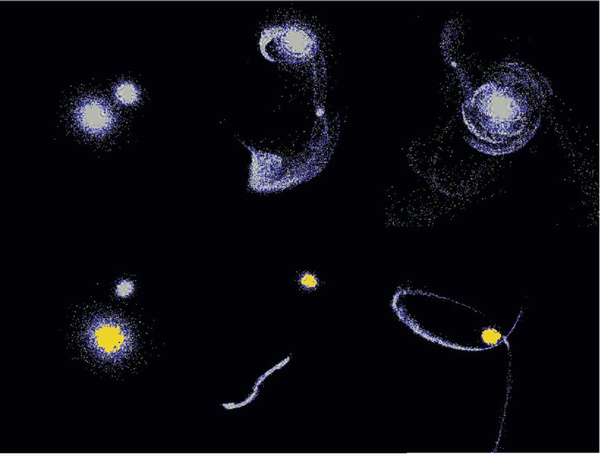
A new study in Nature offers an explanation for the origin of dwarf spheroidal galaxies, one of the current puzzles in our understanding of galaxy formation.
Dwarf spheroidal galaxies are small and very faint, containing few stars relative to their total mass. They appear to be made mostly of dark matter - a mysterious substance detectable only by its gravitational influence, which outweighs normal matter by a factor of five to one in the universe as a whole.