Tunable fluidic micro lenses can focus and direct light at will to count cells, evaluate molecules or create on-chip optical tweezers, according to a team of Penn State engineers. They may also provide imaging in medical devices, eliminating the necessity and discomfort of moving the tip of a probe.
Conventional, fixed focal length lenses can focus light at only one distance. The entire lens must move to focus on an object or to change the direction of the light. Attempts at conventional tunable lenses have not been successful for lenses on the chip. Fluidic lenses, however, can change their focal length or direction in less than a second while remaining in the same place and can be fabricated on the chip during manufacture.
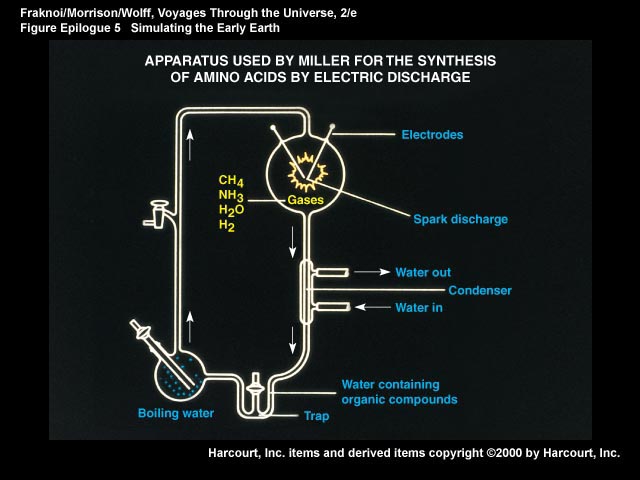
For life to begin, there had to be a source of organic compounds in the prebiotic environment. We now think that some of the compounds were delivered to the Earth on comets, meteorites and dust particles, but others were synthesized in the atmosphere, hydrosphere and in volcanic conditions.
How do we know? This question brings up the important topic of prebiotic simulations. In a simulation, we make a set of assumptions about local conditions on the early Earth, then reproduce those conditions in the laboratory and run experiments to see what happens.
Imagine a time when the entire universe froze - according to a new model for dark energy, that is essentially what happened about 11.5 billion years ago, when the universe was a quarter of the size it is today.
A cosmological phase transition, similar to freezing, is one of the distinctive aspects of this latest effort to account for dark energy; a mysterious, unseen negative force that some cosmologists say makes up more than 70 percent of all the energy and matter in the universe and is pushing the universe apart at an ever-faster rate.
A new low-bandwidth, high-frame-rate videoconferencing technology that creates the appearance of three-dimensionality and a strong sense of co-presence without the use of expensive motion-tracking devices or multicamera arrays could eventually become available for cell phones, laptop computers and personal digital assistants, according to a researcher at the University of Virginia.
The technology was presented Friday in London at the International Workshop on Image Analysis for Multimedia Interactive Services.
As many as 1 in 3 adults (up to 72 million people) in the United States has high blood pressure. Hypertension can lead to coronary heart disease, heart failure, stroke, kidney failure, and other health problems, and is attributed to 7 million deaths worldwide each year.
Blood pressure has a genetic component and hypertension runs in families. Attempts to identify genes associated with blood pressure have met with limited success but now an international research team says they have identified a number of unsuspected genetic variants associated with systolic blood pressure (SBP), diastolic blood pressure (DBP), and hypertension (high blood pressure), suggesting potential avenues of investigation for the prevention or treatment of hypertension.
Scientists in Germany and India are reporting development of a new cobalt imprinted polymer that reduces the amount of radioactive waste produced during routine operation of nuclear reactors. Their study, which details a first-of-its-kind discovery, has been published in Industrial&Engineering Chemistry Research.
Scientists in California are reporting use of a first-of-its-kind approach to craft genetically engineered microbes with the much-sought ability to transform switchgrass, corn cobs, and other organic materials into methyl halides — the raw material for making gasoline and a host of other commercially important products.
The new bioprocess could help pave the way for producing biofuels from agricultural waste, easing concerns about stress on the global food supply from using corn and other food crops. Their study is scheduled for the May 20 issue of the Journal of the American Chemical Society.
Throughout the post-industrial era, science and technology have been central to understanding both global security threats and possible solutions. Within the US and across the globe, major scientific organizations have developed Committees and working groups to integrate science with security policy, however, those efforts have focused almost exclusively on physical/life sciences and been applied predominantly to WMD-related threats.
Helicobacter pylori (H. pylori) infection is considered one of the most important risk factors for stomach (or gastric) cancer with as much as 65% of all cases linked back to the bacteria, although exactly how this occurs is not fully clear.
This blog entry is about one of the most interesting discoveries of the 90's in Neuroscience -- Mirror Neurons -- and a recent research paper that adds to their intrigue.
Mirror neurons are found in the premotor cortex, and what has made them so interesting is that they fire both when the individual performs a goal-directed action and when they watch someone else perform the same action. It is as if the mirror neurons encode an understanding about the intentions of someone else. For example, when my husband reaches for his coffee cup I understand that he intends to take a drink before he even raises the cup to his lips. Neuroscientists think it is the mirror neurons that encode the "understanding" when we watch what others are doing.