Researchers in Japan have turned to mathematics to build a computerized 3D model of the female trunk that could help lingerie and other clothes designers make more sensuous, comfortable, and better fitting product ranges.
According to Kensuke Nakamura of Kyoto Institute of Technology and Takao Kurokawa of Osaka University, identifying body shape components is critical for designing close-fitting products, whether underwear, everyday clothes, or safety garments.
Research at the new School of Creative Arts Therapies at the University of Haifa: Drawing enhances emotional verbalization among children who live under the shadow of drug-addicted fathers
"The use of art seems to help with verbalizing trauma. It is usually difficult to express the trauma through speech, yet the body remembers it," said Prof. Rachel Lev-Wiesel, Head of the Graduate School of Creative Arts Therapies who carried out the study.
Rutgers AIDS researchers Gail Ferstandig Arnold and Eddy Arnold and colleagues say they may have turned a corner in their search for a HIV vaccine.
The researchers say they have been able to take a piece of HIV that is involved with helping the virus enter cells, put it on the surface of a common cold virus, and then immunize animals with it. They found that the animals made antibodies that can stop an unusually diverse set of HIV isolates or varieties.
The NASA/ESA Hubble Space Telescope says a look into the heart of the Perseus galaxy has provided evidence that galaxies are embedded in halos of dark matter. Small galaxies have remained intact while larger galaxies around them are being ripped apart by the gravitational tug of other galaxies.
The explanation? The undisturbed galaxies are enshrouded by a "cushion" of dark matter that protects them.
Dark matter is a theoretical invisible form of matter that accounts for most of the Universe's mass. Astronomers have deduced the existence of dark matter by gravitational influences on normal matter, such as stars, gas and dust.
Are Americans bad at science? If so, are they worse than anywhere else? We know the answer to one of those questions.
A new national survey commissioned by the California Academy of Sciences and conducted by Harris Interactive says that the U.S. public is unable to pass even a basic scientific literacy test.
The good news; U.S. adults
do believe that scientific research and education are important. About 4 in 5 adults think science education is "absolutely essential" or "very important" to the U.S. healthcare system (86%), the U.S. global reputation (79%), and the U.S. economy (77%).
When a single female antbird is nearby, those with male partners will sing over the songs of their betrothed in an apparent attempt to keep their messages from getting through, according to a new report in Current Biology.
Males, of course, then change their tune.
This may be the first evidence that such "signal jamming" and "jamming avoidance" (literal cock-blocking) occurs between mates, according to the researchers.
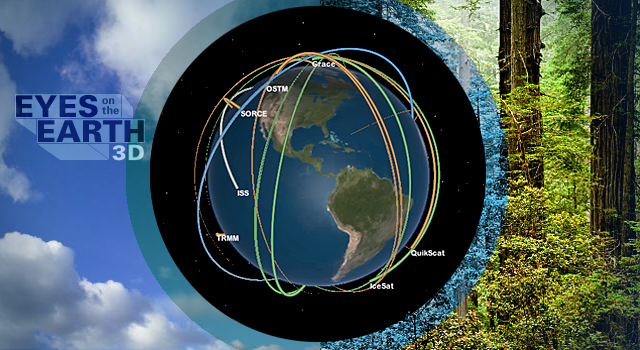
New interactive features on NASA's Global Climate Change Web site give the public the opportunity to "fly along" with NASA's fleet of Earth science missions and observe Earth from a global perspective in an immersive, 3-D environment.
Developed using a state-of-the-art, browser-based visualization technology, "Eyes on the Earth 3-D" displays the location of all of NASA's 15 currently operating Earth-observing missions in real time. These missions constantly monitor our planet's vital signs, such as sea level height, concentration of carbon dioxide in our atmosphere, global temperatures and extent of sea ice in the Arctic, to name a few.
Show Me The Science Month Day 23 Installment 23

Thanks to your parents, you have two copies of each chromosome, which means that you have maternal and paternal copies of every gene. In most cases, having two copies of a gene is no problem, but in some cases, two is too much, and your cells have to shut one copy down. How does a cell do it?
Shutting down one copy of a gene (or an entire section of a chromosome) is called genomic imprinting. (This is not the same thing as the newly hatched duckling that latches on to the first thing it sees, obviously). Genomic imprinting is a critical process used by placental and marsupial mammals to control the dosage of many genes, but how did this process evolve?
The answer, in part, has been discovered by an analysis of the platypus genome. Genomic imprinting appears to have
evolved from a defense mechanism used by cells to knock down parasitic DNA.
Because of the importance of computational genomics, I am writing this article with utmost urgency in hopes of unifying geneticists and biochemists once and for all.
The immune response can protect us from basically any invader but it can also create disease - like it happens in autoimmunity where it attacks the own body - so to understand its regulation is an important tool to assure its proper functioning. In a Nature Immunology article, scientists in Portugal study one of the least understood white blood cells subsets – the gamma delta T cells – and reveal that it is composed by two distinct functional groups that can be identified according to the expression of a molecule called CD27, which is also determinant deciding which subset dominates the immune response.