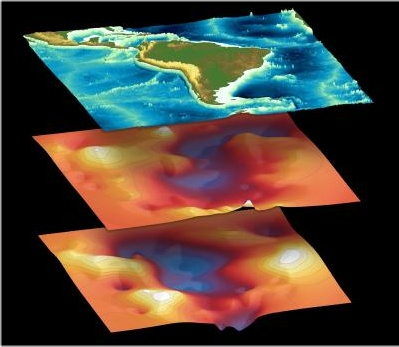
No one can draw a connection between meteorite impacts and massive volcanic activity but the one certain instance where it has been confirmed, at the Cretaceous-Tertiary boundary, was the catastrophic event thought to be responsible for the extinction of the dinosaurs 65 million years ago.
Crucial breakthroughs in the treatment of many common diseases such as diabetes and Parkinson's could be achieved by harnessing systems biology, according to scientists from across Europe. In a Science Policy Briefing released today by the European Science Foundation, they provide a detailed strategy for the application of systems biology to medical research over the coming years.
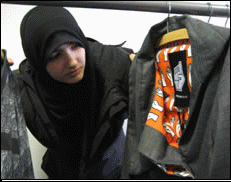
London South Bank University designer Sarah Elenany says there is a lack of fashionable clothing that meets Islamic cultural requirements so she has launched an eponymous clothing line that unites urban chic with Islamic culture. Elenany, 24, calls her new label ‘Elenany’ and says she has drawn inspiration from Islamic art and combined it with contemporary styling for a truly innovative brand.
Cocaine is one of the most abused illicit substances in the United States. According to the National Institute on Drug Abuse (NIDA), there are 35.3 million people in the US age 12 or older that have used cocaine and there were 977,000 new users of cocaine in 2006.
Dengue fever is a nasty disease found all over the tropics, with names like break-bone fever referring to the severity of the pain it causes. It is carried mostly by the mosquito
Aedes aegypti, but also by related species. I have just read three reports on the BBC science site of techniques aimed at controlling the fever by attacking the mosquito in its sex life.
People who have survived severe trauma such as events during war, torture or sexual assault can experience after-effects, a condition called posttraumatic stress disorder (PTSD). The symptoms may include anxiety, uncontrolled emotional reactions, nightmares, intrusive memories, sleep and concentration difficulties, evasion of situations that resemble the trauma, and feelings of shame or even amnesia.
For many, the condition fades away with time but for some
PTSD is a chronic condition that needs treatment, which typically involves drugs that help with anxiety and depression and/or psychotherapy.
A solution to the puzzle which came to be known as ‘Darwin’s Dilemma’ has been uncovered by scientists at the University of Oxford in a paper published in the Journal of the Geological Society.
‘To the question of why we do not find rich fossiliferous deposits belonging to these…periods prior to the Cambrian system, I can give no satisfactory answer’, Charles Darwin wrote in On the Origin of Species by Means of Natural Selection, or The Preservation of Favoured Races in the Struggle for Life in 1859, summarizing what came to be known as ‘Darwin’s Dilemma’ – the lack of fossils in sediment from the Precambrian (c. 4500 – 542 Mya).
Orientation is a puzzle to neuroscience researchers and ever more puzzling to us. If you've ever been lost, or even just in a strange place, you know the feeling of mild panic. But once you get your bearings, that feeling goes away.
Disorientation is unpleasant but our brain quickly sorts it out. Some researcher suggests that animals and young children mainly rely on geometric cues (e.g. lengths, distances, angles) to help them get reoriented while adults can also make use of feature cues (e.g. color, texture, landmarks) in the surrounding area.
Your brain has two methods to compile detail and help you regain orientation, a built-in Global Positioning System (GPS). But the question for psychologists is which method do we use more often?
Many of the battles to desegregate buses, water fountains and colleges were fought in public but some were virtually unknown and are just now getting attention.
A new University of Georgia study reveals how two men traveled the Deep South, facing hostility and risking violence, to ensure that students received fair and impartial treatment when it came to standardized testing, an important barrier to getting into many universities even then.
In 1609, 400 years ago, Galileo revolutionized humankind's understanding of our position in the Universe when he used a telescope for the first time to study the heavens and sketched radical new views of the moon and also discovering the satellites orbiting Jupiter.
To celebrate the International Year of Astronomy (IYA), which marks the anniversary of Galileo's discoveries, a group of astronomers and curators from the Arcetri Observatory and the Institute and Museum of the History of Science, both in Florence, Italy, are recreating the kind of telescope and conditions that led to Galileo's world-changing observations, reports January's Physics World.