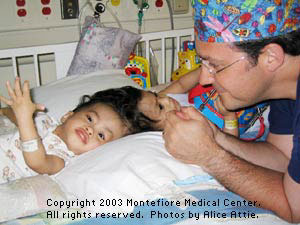






Formerly conjoined twins Carl and Clarence Aguirre celebrated the 10th anniversary of their separation today with the medical team that successfully separated and cared for them at The Children's Hospital at Montefiore (CHAM) - the first documented set of twins to undergo a successfully staged separation of craniopagus twins in the world.

One in two and a half million live births are craniopagus - twins joined at the head - and when Carl and Clarence arrived at Montefiore from the Philippines in September 2003, they were already dying from complications of their condition. Doctors believe that without the surgery, both boys would have died in 6-8 months. 

Effective new drugs and screening would make hepatitis C a rare disease by 2036, according to a new computer simulation conducted by The University of Texas MD Anderson Cancer Center and the University of Pittsburgh Graduate School of Public Health. 

Hepatitis C, a virus transmitted through the blood, is spread by sharing of needles, the use of contaminated medical equipment, and by tattoo and piercing equipment that has not been fully sterilized. Those at the highest risk for exposure are baby boomers – people born between 1946 and 1965. Widespread screening of the U.S. blood supply for hepatitis C began in 1992. A majority of people were infected through blood transfusions or organ transplants before 1992.

Money can't make you happy but perhaps math can predict how much less unhappy you will be than if you lived in poverty.

The happiness of over 18,000 people worldwide has been predicted by a mathematical equation, with results showing that moment-to-moment happiness reflects not just how well things are going, but whether things are going better than expected.

Though being overweight and obese is linked to many health issues, everything from sleep apnea and an incredibly broad metabolic syndrome designation to stranger categories like pre-diabetes, there are lots of instances where obese people survive better and live longer. Scholars term it a paradox but in reality weight and BMI are not magic bullets, curing them will not stop diseases nor will having them be a death sentence.

Tomorrow's commercial refrigeration systems, such as those in supermarkets, could be cooled by carbon dioxide instead of hydrofluorocarbons.

Hydrofluorocarbons are a greenhouse gas that is nearly 4,000 times more potent than CO2 and a future with less of them could be important because millions of pounds of HFCs leak into the environment every year, said Brian Fricke, a researcher in Oak Ridge National Laboratory's Building Equipment Research Group.

To address the problem, Fricke and colleagues are experimenting with CO2 and other refrigerants, including a hydrofluoroolefin called R1234yf.

People routinely edit photos, to take out red eyes or knock five percent of the width off of their bodies - but soon editors will have an extra dimension to work with. People will be able to turn or flip objects any way they want, even exposing surfaces not visible in the original photograph.

A chair in a photograph of a living room, for instance, can be turned around or even upside down in the photo, displaying sides of the chair that would have been hidden from the camera, yet appearing to be realistic.

Antibacterial compounds have obviously saved many lives but there isn't much reason worried parents are being told they need them in every bathroom in the house. 

Compounds like triclosan and triclocarban have become ubiquitous, and not just among the wealthy progressive elites who want other kids to have vaccines but not their own special snowflakes, it's more difficult to find a hand soap without triclosan on store shelves. The compounds are used in more than 2,000 everyday products marketed as antimicrobial, including toothpastes, soaps, detergents, carpets, paints, school supplies and even toys.

For burn victims, guarding wounds against infection is critical but wrapping wound dressings around fingers and toes can be tricky. Scientists have reporting the development of novel, ultrathin coatings - nanosheets - that can cling to the body's most difficult-to-protect contours and keep bacteria at bay. 

Yosuke Okamura, Ph.D., explains that existing wound dressings work well when it comes to treating burns on relatively flat and broad areas. But the human body has curves, wrinkles and ridges that present problems for these dressings. So Okamura's team developed a novel biomaterial out of tiny pieces of nanosheets that are super-flexible and sticky and they have tested them successfully on mice. 

It has been understood for many years that tendons are highly prone to injury and that this likelihood increases as they age. Why this happens is currently poorly understood. A recent study went about examining the mechanisms that cause aging in the tendons of horses and find it may be possible to design better treatment for humans.

The body's assailants are cleverer than previously thought. New research from Lund University in Sweden shows for the first time how bacteria in the airways can help each other replenish vital iron. The bacteria thereby increase their chances of survival, which can happen at the expense of the person's health.

The bacteria Haemophilus influenzae is a type of bacteria in the respiratory tract that can cause ear infections and worsen the prognosis for COPD patients. In rare cases, it can also lead to meningitis and septicaemia.

