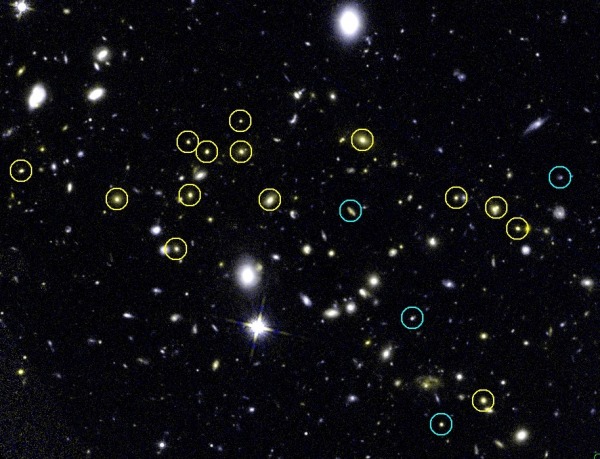
The structures and star populations of massive galaxies appear to change as they age, but much about how these galaxies formed and evolved remains mysterious. Many of the oldest and most massive galaxies reside in clusters, enormous structures where numerous galaxies are found concentrated together. Galaxy clusters in the early universe are thought to be key to understanding the lifecycles of old galaxies, but to date astronomers have located only a handful of these rare, distant structures.

New research from a team led by Carnegie's Andrew Newman has confirmed the presence of an unusually distant galaxy cluster, JKCS 041. It is published in the Astrophysical Journal

WASHINGTON, May 21, 2014—Dark alleys might not feel so dangerous someday thanks to a new ultra-thin type of lens, which could pave the way to making smaller and cheaper heat-sensing imagers. A team of French researchers has found a way to make a thermal infrared (IR) camera with a lens made of silicon, a much less expensive material than is commonly used today.

Washington, DC (May 22, 2014) — Patients with a certain form of kidney disease may have a reduced risk of cancer compared with patients with other kidney diseases, according to a study appearing in an upcoming issue of the Journal of the American Society of Nephrology (JASN).

Polycystic kidney disease (PKD) is a kidney disorder passed down through families in which many cysts form in the kidneys, causing them to become enlarged. It's thought to have cancer-like features, but cancer risk has never been compared between PKD patients and others with kidney disease. Cancer risk is also elevated in people who have received a kidney transplant, due to the immunosuppressive drugs they must take.

Scientists at the U.S. Department of Energy's Argonne National Laboratory have discovered a previously unknown phase in a class of superconductors called iron arsenides. This sheds light on a debate over the interactions between atoms and electrons that are responsible for their unusual superconductivity.

"This new magnetic phase, which has never been observed before, could have significant implications for our understanding of unconventional superconductivity," said Ray Osborn, an Argonne physicist and coauthor on the paper.

BETHESDA, MD – May 23, 2014 – A new approach to studying microbes in the wild will allow scientists to sequence the genomes of individual species from complex mixtures. It marks a big advance for understanding the enormous diversity of microbial communities —including the human microbiome. The work is described in an article published May 22 in Early Online form in the journal G3: Genes|Genomes|Genetics, published by the Genetics Society of America.

"This new method will allow us to discover many currently unknown microbial species that can't be grown in the lab, while simultaneously assembling their genome sequences," says co-author Maitreya Dunham, a biologist at the University of Washington's Department of Genome Sciences.

Conventional oil and gas development in northern Pennsylvania altered bird communities, and the current massive build-out of shale-gas infrastructure may accelerate these changes, according to researchers in Penn State's College of Agricultural Sciences.
The commonwealth's Northern Tier -- one of the largest blocks of Eastern deciduous forest in the entire Appalachian region -- is an important breeding area for neotropical migrant songbirds. These diminutive, insect-eating creatures, which breed in Pennsylvania and winter in Central and South America, contribute greatly to the health of forests.

BOZEMAN, Mont. – Dryland ecosystems, which include deserts to dry-shrublands, play a more important role in the global carbon cycle than previously thought. In fact, they have emerged as one of its drivers, says Montana State University faculty member Ben Poulter.

Surprised by the discovery, Poulter and his collaborators explained their findings in Nature. At the same time, they urged global ecologists to include the emerging role of dryland ecosystems in their research. Nature is a weekly international journal that publishes peer-reviewed research in all fields of science and technology.

Application of a technology currently used to disinfect food products may help to get around one of the most challenging problems in medicine today, the proliferation of bacteria resistant to antibiotics and other antimicrobial drugs. In a paper appearing in the June issue of the journal Technology and already released online, investigators from the Massachusetts General Hospital (MGH) Center for Engineering in Medicine describe how the use of microsecond-pulsed, high-voltage non-thermal electric fields successfully killed resistant bacteria infecting experimentally induced burns in mice, reducing bacterial levels up to 10,000-fold.

ANN ARBOR—Collecting plant and animal specimens is essential for scientific studies and conservation and does not, as some critics of the practice have suggested, play a significant role in species extinctions.

Those are the conclusions of more than 100 biologists and biodiversity researchers who signed a letter to the journal Science scheduled for online publication May 22.

The letter is a response to an April 18 Perspectives article in Science arguing that alternative methods of documentation—such as high-resolution photography, audio recordings and nonlethal tissue sampling for DNA analysis—make the field collection of animal and plant specimens unnecessary.

EAST LANSING, Mich. — We have hundreds of types of cells in our bodies – everything from red blood cells to hair follicles to neurons. But why can't most of them create offspring for us?

New research at Michigan State University suggests that separating germ cells – sperm and eggs –from somatic cells – all other cells – preserves the genetic building blocks while allowing organisms to flourish in a somewhat hazardous environment.

The results, which appear in the current issue of PLOS Biology, show that having somatic cells do the organism's dirty work helps explain this beneficial evolution.

