

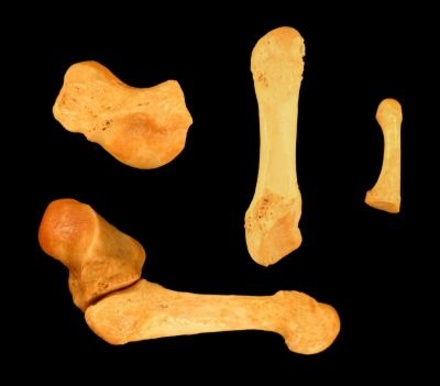


Researchers have shown for the first time in an animal that is more closely related to humans that it is possible to make new bone from stem-cell-like induced pluripotent stem cells (iPSCs) made from an individual animal's own skin cells. The study in monkeys reported in the Cell Press journal Cell Reports on May 15th also shows that there is some risk that those iPSCs could seed tumors, but that unfortunate outcome appears to be less likely than studies in immune-compromised mice would suggest.

Jupiter's trademark Great Red Spot — a swirling storm feature larger than Earth — is shrinking. This downsizing, which is changing the shape of the spot from an oval into a circle, has been known about since the 1930s, but now these striking new NASA/ESA Hubble Space Telescope images capture the spot at a smaller size than ever before.

Jupiter's Great Red Spot is a churning anticyclonic [1]. It shows up in images of the giant planet as a conspicuous deep red eye embedded in swirling layers of pale yellow, orange and white. Winds inside this Jovian storm rage at immense speeds, reaching several hundreds of kilometres per hour.

An article in the feminist, scientific, peer-reviewed journal Psychology of Women Quarterly says that when women in developing countries own land, they are less likely to experience violence.

Psychologists Shelly Grabe, Rose Grace Grose and Anjali Dutt analyzed anecdotes Grabe cataloged by speaking with 492 women in Nicaragua and Tanzania in 2007 and 2009 respectively. 

Grabe wanted to show that the power dynamic between men and women changes when women own land and that gender-based violence against women drops with property ownership.  

"Women in both countries connected owning property to increased power and status within their communities and to having greater control within their relationships," the authors write.

Zinc is essential for optimal plant growth and development but when high levels of the metal are present in the soil, it can become toxic to the plant. Consequently, plants need to trigger mechanisms capable of coping with that stress. Researchers from the Instituto Gulbenkian de Ciência (IGC) have now discovered a novel genetic mechanism that protects plants from toxic zinc levels. The research team, led by Paula Duque, identified a gene that produces a protein capable of sequestering zinc inside the cells of the root. In the presence of high levels of zinc, this gene undergoes a special processing which ensures more production of the protecting protein.

While American adults lead the world in science literacy, and America leads the world in science output and Nobel prizes, American students are only middle of the pack when it comes to international standardized tests.

Is science creativity, teaching how to think, disconnected from scores on standardized tests? It would seem so, but every time standardized tests are given, entrenched constituencies in education say education is broken but they can fix it.

Where did the earliest Americans come from? 

Speculation has pointed to Eastern Asia, Western Asia, Japan, Beringia and even Europe. Differences in cranial form between today's Native Americans and the earliest known Paleoamericans have lent credence to all possibilities but the analysis of a nearly complete Paleoamerican skeleton with Native American DNA that dates close to the time that people first entered the New World may have some answers to part of the puzzle.

The ancient remains of a teenage girl, researchers call her Naia, found deep in the water of a Yucatán Peninsula cave have established a definitive link between the earliest and modern Native Americans, according to a new study in Science.

So, yes, they really were here before you. 

Ancient human remains in the Americas have been a puzzle for science because their skulls are narrower and have other measurably different features from those of modern Native Americans. Some researchers have hypothesized that these individuals came to the Americas from as far away as Australia, Southeast Asia or Europe.  

Deep in the water of a Yucatán Peninsula cave, one of the oldest human skeletons found in North America has been discovered. 

"Naia" is the the researchers' name for the teenage girl who went underground, presumably to seek water, and fell to her death in a large pit named Hoyo Negro - "black hole" in Spanish.

Since the commercialization of medical marijuana in the middle of 2009, the proportion of marijuana-positive drivers involved in fatal motor vehicle crashes in Colorado has increased dramatically, according to data from the National Highway Traffic Safety Administration's Fatality Analysis Reporting System covering 1994 to 2011.

The University of Colorado School of Medicine  researchers analyzed fatal motor vehicle crashes in Colorado and in the 34 states that did not have medical marijuana laws, comparing changes over time in the proportion of drivers who were marijuana-positive and alcohol-impaired.

DALLAS, May 15, 2014 — Older migraine sufferers may be more likely to have silent brain injury, according to research published in the American Heart Association’s journal Stroke.

In a new study, people with a history of migraine headaches had double the odds of ischemic silent brain infarction compared to people who said they didn’t have migraines. Silent brain infarction is a brain injury likely caused by a blood clot interrupting blood flow to brain tissue. Sometimes called “silent strokes,” these injuries are symptomless and are a risk factor for future strokes.

Previous studies indicated migraine could be an important stroke risk factor for younger people.

