
The Bubonic Plague wiped put a giant swath of the affected populations, it was truly an Old Testament wrath-of-God phenomenon - but it also led to a wave of agricultural innovation and the creation of a middle class (How The Bubonic Plague Made Europe Great).

It also did what folklore says about things that don't kill you - it made us a little stronger.

PROVIDENCE, R.I. [Brown University] — Different manifestations of preeclampsia, such as early vs. late timing or typical vs. high severity, appear to have distinct genetic underpinnings, suggesting that they may need to be studied and treated differently. That and several other insights are described in a newly published comprehensive review of genetic studies of the condition, which produces life-threatening complications such as high-blood pressure in as many as 8 percent of pregnancies in the United States.

Leesburg, VA, May 5, 2014—Misinformation and misunderstanding about the risks associated with ionizing radiation create heightened public concern and fear, and may result in avoidance of screening mammography that can detect early cancers.

Leesburg, VA, May 5, 2014—Breast tomosynthesis in the diagnostic workup for one- or two-view focal asymmetry detected at screening mammography resulted in less use of ultrasound, fewer biopsies, and higher positive predictive value for cancer than when diagnostic exams involved only 2D mammography, according to a study conducted at the University of Virginia.

"Tomosynthesis has been evaluated in screening populations and been shown to decrease recall rates," said researcher Brandi Nicholson, "but studies in the diagnostic setting are lacking."

 A computer simulation called "Illustris" has created the first realistic virtual universe - it can recreate 13 billion years of cosmic evolution in a cube 350 million light-years on a side with unprecedented resolution.

A bacterium whose genetic material includes an added pair of DNA "letters," or bases, not found in nature has been created. The cells of this unique bacterium can replicate the unnatural DNA bases more or less normally, for as long as the molecular building blocks are supplied.

The team of researchers behind this have been working since the late 1990s to find pairs of molecules that could serve as new, functional DNA bases—and, in principle, could code for proteins and organisms that have never existed before.

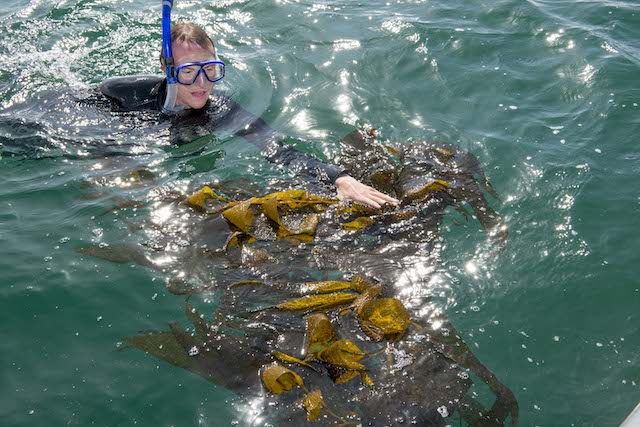
The Kelp Watch 2014 collaboration has some good news - the West Coast shoreline shows no signs of ocean-borne radiation from Japan’s Fukushima nuclear power plant disaster.

Kelp Watch 2014 uses coastal kelp beds as detectors of radioactive seawater arriving from Fukushima via the North Pacific Current. The new results are from samples primarily collected from Feb. 24 through March 14. During the first phase of the project, samples were taken from 38 of the 44 sites originally identified, and the data being presented comes from an analysis of 28 of the 38 sample sites represented.
I'll tell you up front, I am not a big fan of chemicals.

It's not that I have chemophobia, or any science-phobia, I instead have that special sort of elitism that is available to people who have just been lucky enough to not need chemicals. I don't even like to take aspirin and I have that luxury because I haven't needed to take any drugs for a recurring condition, so it's really easy for me to embrace such naturalistic posturing.

Gang culture gets you one way or the other according to a new paper. Gang members are twice as likely to become both a victim and an offender of a crime than non-gang members.

Why? Single acts of violence often lead to retribution between gangs as a whole, according to David Pyrooz, an assistant professor in criminal justice at Sam Houston State University, principal author of the study. 

"In other words, gang members are not distinctly offenders or victims; instead, gang membership is a common source of both forms of violence," said Pyrooz. "Today's criminal offender is tomorrow's victim, and today's victim is quite likely to be tomorrow's criminal offender."

Scientists have discovered a new species of long-snouted tyrannosaur, nicknamed Pinocchio rex, which stalked the Earth more than 66 million years ago.

The dinosaur, officially named Qianzhousaurus sinensis, was unearthed in southern China and confirms the existence of long-snouted tyrannosaurs. Researchers say the anima was a fearsome carnivore that lived in Asia during the late Cretaceous period. 

The newly found ancient predator looked very different from most other tyrannosaurs. It had an elongated skull and long, narrow teeth compared with the deeper, more powerful jaws and thick teeth of a conventional T. rex.

