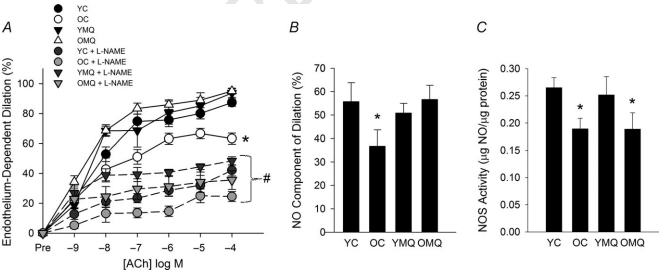


A research team gave old mice -  the equivalent of 70- to 80-year-old humans - water containing an antioxidant known as MitoQ for four weeks and found that their arteries functioned as well as the arteries of mice with an equivalent human age of just 25 to 35 years.

The MitoQ antioxidant targets specific cell structures - mitochondria - and may be able to reverse some of the negative effects of aging on arteries, reducing the risk of heart disease, they conclude.

DURHAM, N.C. -- Along with our big brains and upright posture, thick tooth enamel is one of the features that distinguishes our genus, Homo, from our primate relatives and forebears. A new study, published May 5 in the Journal of Human Evolution, offers insight into how evolution shaped our teeth, one gene at a time.

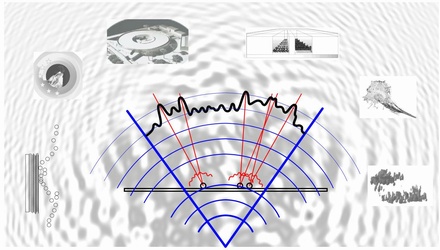
By comparing the human genome with those of five other primate species, a team of geneticists and evolutionary anthropologists at Duke University has identified two segments of DNA where natural selection may have acted to give modern humans their thick enamel.

Teeth have been an invaluable resource for scientists who study evolution, the authors said.

Why is science academia so heavily slanted toward one political party in the last generation while private sector science is not? Why, in 1999, would the lead authorship of an IPCC report chapter be someone who had just gotten their PhD, something that would have been an outcry if it had been done at the NIH or the NSF?

An article in Human Nature says a lack social and political accountability make it easy for people to favor their own and penalize outsiders. They argue that more oversight and government control are the solutions.

There may be a reason why emissions regulations that reduced air pollutants like sulfur dioxide, nitrogen dioxide and carbon monoxide haven't really led to a drop in ozone. A report from 2012 found that ambient levels of fine particulate matter had declined by 20 to 60 percent since 2001 but ozone had continued to rise in that same period, up 20 percent.

A new study from the Bradley Hasbro Children's Research Center has says that family-based cognitive behavioral therapy (CBT) is beneficial to young children between the ages of five and eight with Obsessive-Compulsive Disorder (OCD).

Cognitive behavioral therapy is considered by psychologists to be an effective form of OCD treatment in older children and adolescents. 

The paper in JAMA Psychiatry found developmentally sensitive family-based CBT that included exposure/response prevention (EX/RP) was more effective in reducing OCD symptoms and functional impairment in this age group than a similarly structured relaxation program.

DAVIE, Fla.-- The diverse patterns on the diamondback terrapins' intricately grooved shell may be their claim to fame, but a newly published U.S. Geological Survey study of the genetic variation underneath their shell holds one key to rescuing these coastal turtles.

Listed as an endangered species in Rhode Island and deemed threatened in Massachusetts, the terrapin is the only turtle in North America that spends its entire life in coastal marshes and mangroves. Seven different subspecies of terrapins are currently recognized by scientists based on external traits, such as their skin color and the shape of their shells. Each subspecies occupies a strip of the eastern seaboard or Gulf of Mexico coastline, from as far north as Massachusetts to as far west as Texas.

If wine leaves a bitter, cotton-like coating on the tongue, don't blame your nose or even your sense of smell, say the authors of a paper in
Chemical Senses.

Instead, blame your nerves. The traditional oak barrel character, also called barrique character, is perceived via the trigeminal nerve, which is responsible for, among other things, pain and temperature perception. 


The melting of a rather small ice volume on East Antarctica's shore could trigger a persistent ice discharge into the ocean, resulting in unstoppable sea-level rise for thousands of years to come, according to computer simulations of the Antarctic ice flow by scientists at the Potsdam Institute for Climate Impact Research (PIK).

They detail their estimates in Nature Climate Change.

Utah youth with suspected sports-related head injuries visit emergency rooms far more often since the state's concussion law passed in 2011, and with that boost in defensive medicine came a rise in head CT scans -- leading to potentially unnecessary radiation exposure along with the high costs that defensive medicine brings for health care overall. 

The study examined Intermountain Healthcare's emergency department database for 19 hospitals in Utah between September 1, 2009 and September 1, 2012. Researchers wanted to know if the number of children and teenagers with suspected sports-related head injuries between ages 6 and 18 who came to hospital emergency departments changed, if the number of CT scans grew, and what those scans revealed.

Animal hoarding is a psychological disorder where a person accumulates a large numbers of animals at home, usually cats and dogs, without providing them with a minimal standard of care.

Details about the cause of the disorder remain largely unknown and but it obviously has a negative effect on the health of both the people who suffer from it and the animals involved.  Researchers from Hospital del Mar Research Institute writing in Animal Welfare have tackled the first European study to compile data on this disorder

