



There's a hidden battle happening planet-wide at the microbe level. 

Researchers have discovered that Arabidopsis thaliana, a small flowering plant widely used as a model organism in plant biology, puts out a welcome mat to bacteria seeking to invade, and a new study reveals new targets during the battle between microbe and host that researchers can exploit to protect plants.
Basically, if the winter annual is putting out a welcome met, scientists have discovered that mat's molecular mix.

The study reveals new targets during the battle between microbe and host that researchers can exploit to protect plants.

Just a few grams of the new substance are enough to tag the entire olive oil production of Italy. If counterfeiting were suspected, the particles added at the place of origin could be extracted from the oil and analysed, enabling a definitive identification of the producer. "The method is equivalent to a label that cannot be removed," says Robert Grass, lecturer in the Department of Chemistry and Applied Biosciences at ETH Zurich.

The universe we can see is made up of billions of galaxies, each containing anywhere from hundreds of thousands to hundreds of billions of stars.

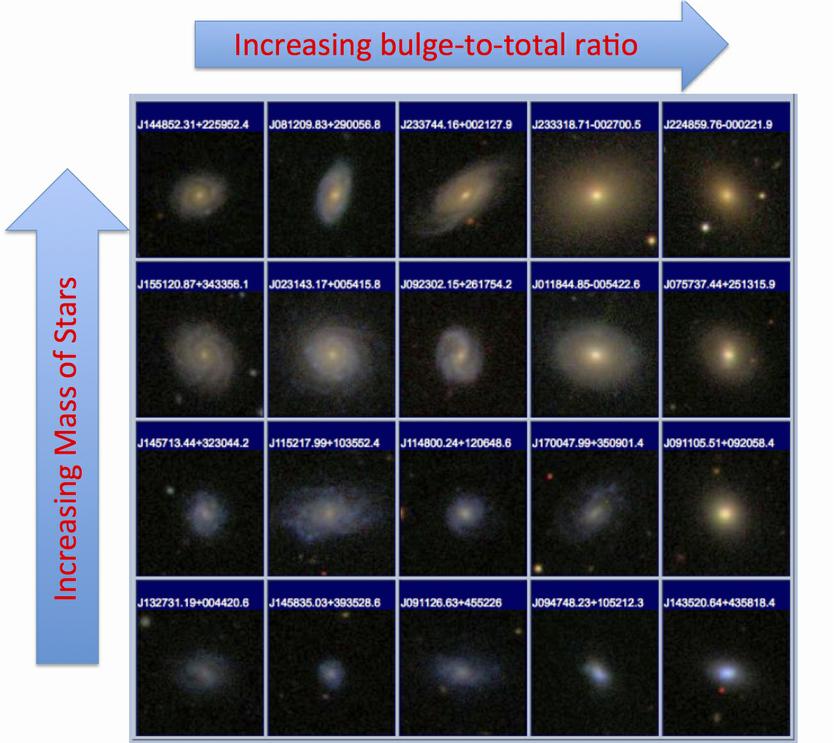
Large numbers of galaxies are elliptical in shape, red and mostly made up of old stars. Another (more familiar) type is the spiral, where arms wind out in a blue thin disk from a central red bulge.

On average stars in spiral galaxies tend to be much younger than those in ellipticals.

Now a group of astronomers led by Asa Bluck of the University of Victoria in Canada have found a (relatively) simple relationship between the color of a galaxy and the size of its bulge – the more massive the bulge the redder the galaxy.

I have seen creeping into recent discussions of the TV show ‘Cosmos’ the idea that we scientists, because of our greater knowledge and understanding of how the natural world works, will somehow be intrinsically better when it comes to dealing with matters of ethics, politics or religion.  I beg to differ.

In the latest episode of Cosmos we got some history regarding how science has tried to converge on the age of the Earth. With that, we also got another jab at religion. Why use yet another religious contrast from hundreds of years ago to show the awesome power of science now? Is there so little actual imagination in their Ship Of The Imagination?(1)

Just like with the age of the Earth, it's hard to know for sure, we only know there is a range of choices and can narrow it down as we get more data.
Relativity says that spacetime is smooth, and only big things can warp it, in ways that are exactly known. Quantum theory says that the smallest parts of the universe are constantly fluctuating and dramatically uncertain. How can something be both smooth and fluctuating, both exact and uncertain?

How, in other words, can we make a quantum theory of gravity? It's unknown. String theory and loop quantum gravity have tried, but a unified theory has remained out of reach.

Enter – of all things – condensed matter physics.

SensaBubble is a chrono-sensory mid-air display system that generates scented bubbles to deliver information to people using different senses. The bubble-based technology creates bubbles with a specified size and frequency, fills them with an opaque fog that is optionally scented, controls their route, tracks their location and projects an image onto them.

Man or woman? Male or female?

Modern sociological woo about gender aside, in humans and other mammals, the difference between the sexes depends on one single element of the genome: the Y chromosome. It is present only in males, where the two sexual chromosomes are X and Y, whereas women have two X chromosomes. Thus, the Y is ultimately responsible for all the morphological and physiological differences between males and females.

Shark data collected by citizen scientists may be as reliable as data collected using automated tools, according to results published April 23, 2014, in the open access journal PLOS ONE by Gabriel Vianna from The University of Western Australia and colleagues.

While creating new springs to support a cephalopod-inspired imaging project, a group of Harvard researchers stumbled upon a surprising discovery: the hemihelix, a shape rarely seen in nature.

