






Want to cause a fight between anthropologists and evolutionary biologists? Throw out an opinion on whether early societies were heirarchical or egalitarian.

Great apes societies are very heirarchical despite the presence of alliances and 'political' maneuvering but a new paper in PLoS says the first coalition-based societies of equals (they use the term 'egalitarian') occurred tens of thousands of years ago, and that has implications for the context of social networks and cognitive evolution.

Great apes' societies have each animal occupying a particular place in the existing dominance hierarchy. A major function of coalitions in apes is to maintain or change the dominance ranking. When an alpha male is well established, he usually can intimidate any hostile coalition or the entire community.

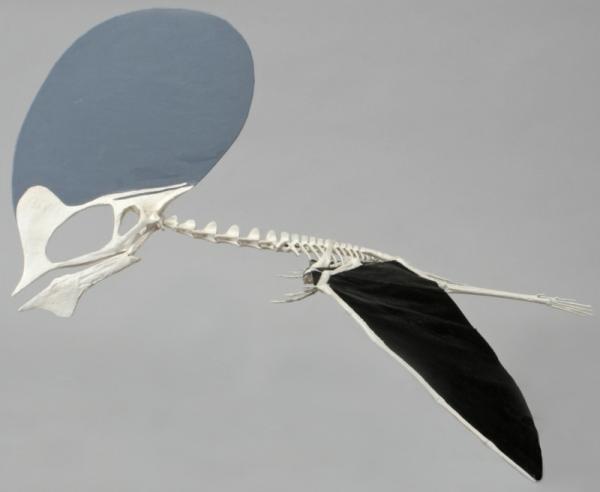
Paleontologist Sankar Chatterjee of Texas Tech University, aeronautical engineer Rick Lind of the University of Florida, and their students Andy Gedeon and Brian Roberts have reached back in time 115 million years to one of the most successful flying creatures in Earth’s history, the pterodactyl, to conjure a robotic spy plane with next-generation capabilities.

Mimicking the physical and biological characteristics of the Early Cretaceous Brazilian pterosaur Tapejara wellnhoferi -- skin, blood vessels, muscles, tendons, nerves, cranial plate, skeletal structure, and more -- the scientists are working to develop a Pterodrone -- an unmanned aerial vehicle that not only flies but also walks and sails just like the original.

In old movies we were going to improve society by making everything think like a computer. Now the goal is to make computers think like brains. Researchers at Missouri University of Science and Technology say they can make power network management more efficient by literally tapping brain cells grown on networks of electrodes.

The Missouri S&T group, working with researchers at Georgia Institute of Technology, plans to use the brain power to develop a new method for tracking and managing the constantly changing levels of power supply and demand.

Researchers are looking to increase security at border controls by developing a computer system that can detect guilt. Obviously a successful prototype could be used in multiple other applications, like police interrogations and interview scenarios. “Who knows - it could even be used to enhance our real-time computer gaming experiences,” says Dr Hassan Ugail, Head of Visual Computing Research at the University of Bradford’s School of Informatics.

Ugail is part of a team working on a £500,000 project to develop technologies that would assist the border control agencies in identifying people trying to smuggle contraband goods or narcotics through customs.

Scientists at the University of Liverpool have tested an ‘invisibility cloak’ that could reduce the risk of large water waves overtopping coastal defences.

Mathematicians at Liverpool, working with physicists at the Centre National de la Recherche Scientifique (CNRS) and Aix-Marseille Universite have found that coastal defences could be made ‘invisible' when water is guided through a special structure made of metamaterials.

Metamaterial was first invented by Sir John Pendry at Imperial College London where scientists discovered that this unique structure could bend electromagnetic radiation – such as visible light, radar or microwaves – around a spherical space, making an object within this region appear invisible.

Researchers at the University of Toronto have shown that the EBNA1 protein of Epstein-Barr virus (EBV) disrupts structures in the nucleus of nasopharyngeal carcinoma (NPC) cells, thereby interfering with cellular processes that normally prevent cancer development. The study, published October 3rd in the open-access journal PLoS Pathogens, describes a novel mechanism by which viral proteins contribute to carcinogenesis.

EBV is a common herpesvirus whose latent infection is strongly associated with several types of cancer including NPC, a tumor that is endemic in several parts of the world. With NPC only a few EBV proteins are expressed, including EBNA1.

GENEVA, Switzerland, October 2 /PRNewswire/ -- Merck Serono, a division of Merck KGaA, Darmstadt, Germany, announced today that Genentech Inc. has reported a case of progressive multifocal leukoencephalopathy (PML) in a 70-year old patient who had received Raptiva(R) (efalizumab) for more than four years of treatment of chronic plaque psoriasis. Genentech markets Raptiva(R) in the United States.

HORSHAM, Pennsylvania, October 2 /PRNewswire/ --

Astea International Inc. (Nasdaq: ATEA), the leader in service lifecycle management and mobility solutions, today announced that it has signed a partner agreement with Larsen & Toubro Infotech Ltd, a leading global IT services and solutions provider and a wholly-owned subsidiary of the USD 7 billion global technology, engineering, manufacturing and construction conglomerate Larsen & Toubro Limited (L&T). The partnership combines L&T Infotech's deep IT services expertise and system integration experience with Astea's global service management and mobility solutions.

It's baseball playoff time and you know what that means; not just hot dogs and beer but also smelly men who refuse to change their socks lest they spoil their good luck. After all, they got this far with smelly socks, right? And

New research published in Science seeks to explain why people sometimes find and impose order in a chaotic world through superstition, rituals and conspiratorial explanations. The research finds that a quest for structure or understanding leads people to trick themselves into seeing and believing connections that simply don't exist.

A new study has concluded that musicians have IQ scores than non-musicians, supporting other recent research that intensive musical training is associated with an elevated IQ score.

Vanderbilt University psychologists Crystal Gibson, Bradley Folley and Sohee Park have found that professionally trained musicians more effectively use a creative technique called divergent thinking, and also use both the left and the right sides of their frontal cortex more heavily than the average person.

One possible explanation the researchers offer for the musicians' elevated use of both brain hemispheres is that many musicians must be able to use both hands independently to play their instruments.

