






The Royal Swedish Academy of Sciences has decided to award the Nobel Prize in Physics for 2007 jointly to Albert Fert, Unité Mixte de Physique CNRS/THALES, Université Paris-Sud, Orsay, France, and Peter Grünberg, Forschungszentrum Jülich, Germany, "for the discovery of Giant Magnetoresistance".

Nanotechnology gives sensitive read-out heads for compact hard disks

This year's physics prize is awarded for the technology that is used to read data on hard disks. It is thanks to this technology that it has been possible to miniaturize hard disks so radically in recent years. Sensitive read-out heads are needed to be able to read data from the compact hard disks used in laptops and some music players, for instance.

Tilapia, a fish that originates from southern regions, has been introduced in over 100 countries. It is the second most commonly produced fish in aquaculture in the world after carp. 99% is produced and consumed in China.

Raising tilapia is easy and inexpensive. It adapts well to fresh or salt water and fattens fast. Unlike most salmoniforms in aquaculture (salmon, trout, perch, bream), for which fishmeal and fish oil constitute an essential part of their diet, tilapia is lower down in the trophic or food chain and feeds on algae, plankton or small animals. In extensive and semi-extensive production systems, tilapia is largely fed on vegetable waste (rice, cotton, etc.).

Thomson Scientific today announced the results of a study analyzing Australian institutions' research influence and scientific output.

In the September/October issue of Science Watch, Thomson Scientific analyzes data from its Australian University Indicators 1981-2006 to evaluate universities and research institutions based on total citations and impact -- the average number of citations per paper.

The study ranks institutions by impact and total citations across 21 fields as well as overall output and impact.

From 135,000 to 90,000 years ago tropical Africa had megadroughts more extreme and widespread than any previously known for that region, according to new research.

Learning that now-lush tropical Africa was an arid scrubland during the early Late Pleistocene provides new insights into humans' migration out of Africa and the evolution of fishes in Africa's Great Lakes.

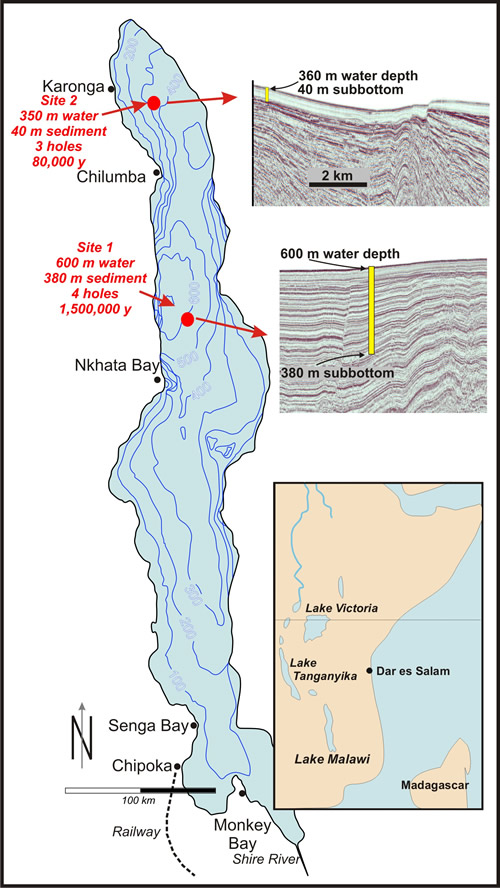
"Lake Malawi, one of the deepest lakes in the world, acts as a rain gauge," said lead scientist Andrew S. Cohen of The University of Arizona in Tucson. "The lake level dropped at least 600 meters (1,968 feet) -- an extraordinary amount of water lost from the lake.

Many consumers take precautions against identity theft, but what about medical identity theft? In addition to financial peril, victims can suffer physical danger if false entries in medical records lead to the wrong treatment.

“The crime occurs when someone uses a person's name and sometimes other parts of their identity -- such as insurance information -- without the person's knowledge or consent to obtain medical services or goods,” said Laurinda B. Harman, PhD, RHIA, associate professor and chair of the health information management department at Temple University’s College of Health Professions.

Is using a Wii too much workout for you? Developers at the University of Washington may have something you like better. Designed for people with disabilities, their new software lets users control a computer cursor without any tactile involvement. Early tests suggest that an experienced user of Vocal Joystick would have as much control as someone using a handheld device.

"There are many people who have perfect use of their voice who don't have use of their hands and arms," said Jeffrey Bilmes, a UW associate professor of electrical engineering. "I think there are several reasons why Vocal Joystick might be a better approach, or at least a viable alternative, to brain-computer interfaces." The tool's latest developments will be presented this month in Tempe, Ariz.

There hasn't been an emergency on the launch pad that required the use of an emergency evacuation system for astronauts but, to be safe, NASA has updated earlier systems of escape for Launch Complex 39B, hosting the new Orion spacecraft and Ares I rocket of the Constellation Program, which were basically cables running from the spacecraft’s crew level to an area near a bunker, to one with rails. And linked cars. 380 feet above the ground.

Yes, it is the most spectacular roller coaster around, and we will never get to ride it.

Kelli Maloney, lead designer for the launch pad escape system, said requirements call for astronauts to be able to get out of the spacecraft and into the bunker within 4 minutes.

If you grew up on a farm, the first thing you were taught about fertilizer is that you can't use waste from anything that eats meat. Cows okay. Humans bad.

Researchers in Finland disagree and say that human urine is virtually sterile, free of bacteria or viruses and naturally rich in nitrogen and other nutrients.

Urine fertilization is rare today though they say it was common in ancient times. Maybe in Finland.

Most of us think of solar power as coming from glass panels on rooftops, and increasingly large arrays in the middle of some sun-drenched desert. Now it can come from green, slimy ponds and bioreactors filled with algae that soak up the rays to make oil.

Some species of algae contain as much as 50% oil, and out-produce other biofuels. An acre of soybean produces around 70 gallons of biodiesel. The same area of corn makes roughly 420 gallons of ethanol. Algae can produce about 5,000 gallons of biodiesel per acre. Not too shabby!

Another plus is that algae don’t compete with our food supply as other biofuels can. No exorbitantly priced corn tortillas just to fill our gas tanks!

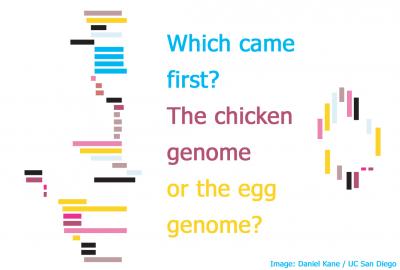
Which came first, the chicken genome or the egg genome?

Researchers have answered a similarly vexing (and far more relevant) genomic question: Which of the thousands of long stretches of repeated DNA in the human genome came first? And which are the duplicates?

The answers, published online by Nature Genetics on October 7, 2007, provide the first evolutionary history of the duplications in the human genome that are partly responsible for both disease and recent genetic innovations.

